
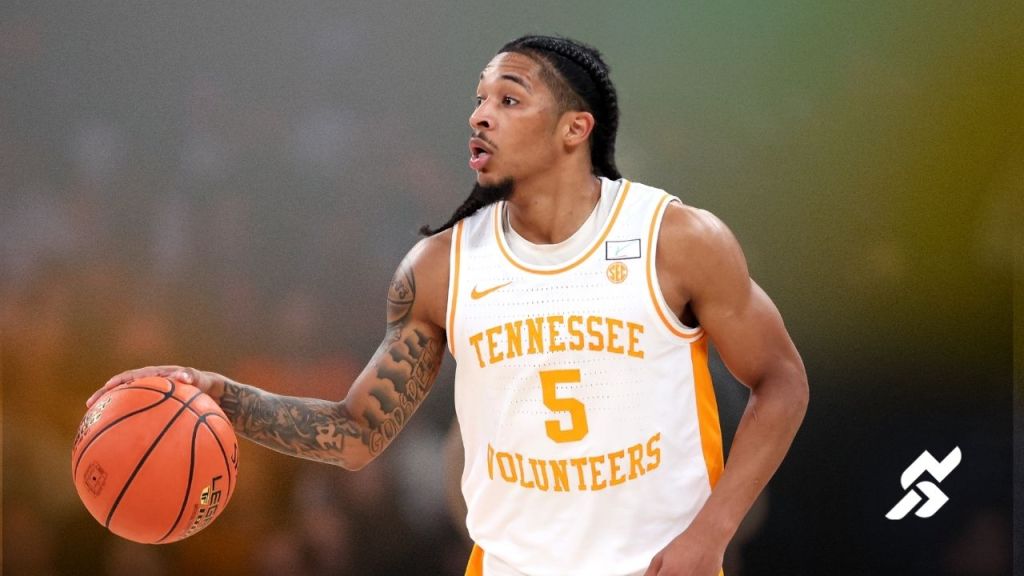
A federal judge on Thursday denied former University of Tennessee basketball star Zakai Zeigler a preliminary injunction that would have allowed the two-time SEC Defensive Player of the Year to play a fifth season as a graduate student in 2025-26.
U.S. District Judge Katherine A. Crytzer reasoned that while the NCAA’s eligibility rule allowing four seasons of intercollegiate competition within a five-year window is subject to antitrust scrutiny—the NCAA insisted it is not—Zeigler failed to show the rule is sufficiently problematic under antitrust law.
The main problem for Zeigler, as Crytzer saw it, is that the NCAA “does not control who receives NIL compensation” and thus Zeigler losing out on—he claims—up to $4 million in NIL deals does not show the NCAA is legally responsible. As the judge explained, NIL deals are between athletes and third parties, while the NCAA does not “enjoy the power to set [NIL] wages” in the labor market for college athletes.
Relatedly, Crytzer wrote, is that his exclusion from college basketball is not all that meaningful from an antitrust law perspective.
“Plaintiff has not shown that defendant’s limit on the labor side of the market—replacing one Division I basketball player with another—produces substantial anticompetitive effects.”
The judge suggested that Zeigler’s case is more about the wisdom of rules that limit how long college athletes can play than the law about that topic.
“This Court is a court of law, not policy,” Crytzer wrote. “What the NCAA should do as a policy matter to benefit student athletes is beyond the reach” of the court.
Crytzer identified other problems in Zeigler’s motion for an injunction. One factor in whether to grant an injunction is if the plaintiff would suffer irreparable harm in the absence of an injunction. Irreparable harm normally means a harm that monetary damages can’t later remedy. In the sports context, irreparable harm is sometimes argued in the context of an athlete excluded from playing in that the athlete will lose the chance to play in games that will never be played again and lose the opportunity to hone their skills.
Zeigler failed to offer a plausible explanation for how he would suffer irreparable harm, the judge concluded.
“Plaintiff’s asserted harms, including loss of substantial NIL opportunities and access to the NIL market,” Crytzer wrote, “are more monetary in nature, and a future money damages award might adequately redress them.”
Crytzer also worried that letting Zeigler play could pose unintended consequences for other athletes. If Zeigler could play a fifth season as a grad student, other players in his position could seek the same remedy, which would mean some incoming freshmen or incoming transfers lose their roster spots.
“Given the fixed number of roster spots available for each Division I basketball team,” the judge wrote, “an injunction would run the risk of harming (1) currently enrolled Division I basketball players who have already committed to a member institution and (2) current high school seniors who might have their college recruitment disrupted.”
Crytzer’s ruling is a win for the NCAA in terms of outcome. Had Zeigler won, numerous college seniors could seek to play a fifth season as a grad student. The NCAA also warned that there is “no limiting principle” in that a player could seek a sixth or additional seasons as a grad student, since Zeigler’s argument—that denial of NIL opportunities justifies an antitrust harm—could conceivably apply for many years.
But the judge didn’t endorse the NCAA’s preferred rationale. The NCAA maintains that eligibility rules are non-commercial in nature since they concern a more academic or educational consideration: when a student is eligible to play sport. Antitrust law governs commercial matters, and thus the NCAA contends eligibility rules should fall outside antitrust scrutiny.
Crytzer disagreed. She wrote that in the modern college sports world, college athletes “may receive compensation in exchange for their athletic services.” She added that “the nature and amount of that compensation” depends in part on whether a player is eligible to play.
Crytzer referenced U.S. District Judge Claudia Wilken granting final approval of the 10-year settlement between the NCAA, power conferences and current and former Division I athletes represented by the House, Carter and Hubbard antitrust litigations. The settlement will allow colleges to directly share revenue with athletes. To be clear, Crytzer clarified House is outside the scope of Zeigler v. NCAA and had no impact on her ruling.
But Crytzer’s reference to the House settlement is a reminder that college athletes in power conference programs are morphing into a status that has some similarity to pro athletes, albeit with academic obligations. And it means the NCAA can anticipate other antitrust lawsuits over rules. The association has been besieged with antitrust lawsuits brought by athletes in their 20s who don’t want to leave college sports. Some are like Zeigler in that they’re college stars who can command millions in NIL (and perhaps soon in revenue-sharing) and whose schools would love to keep them around long-term as grad students who aren’t quite good enough (or in the case of the 5-foot-9 Zeigler, tall enough) for the NBA or NFL. Their chance to make money is in college sports, and they don’t want to leave.
Thursday’s ruling doesn’t end Zeigler’s case. He can continue to litigate and hope to eventually win a trial where he would be awarded damages. Zeigler can also appeal Crytzer’s order to the U.S. Court of Appeals for the Sixth Circuit. Absent intervention by the appellate court, Zeigler will remain a former, rather than active, Vols player.
In a statement shared with Sportico regarding Thursday’s ruling, an NCAA spokesperson said the association “stands by the four seasons competition rule as it continues to work to modernize college sports.” The spokesperson also said that NCAA members “have affirmed” through the House settlement “that that financial and health and safety benefits to student-athletes should continue to increase while maintaining vital eligibility rules to preserve fair competition and ensure broad access” to college sports opportunities.
In addition, the spokesperson mentioned that conflicting outcomes in these eligibility lawsuits serve as a reason for Congress “to provide clarity and stability for current and future student-athletes.”
(This article has been updated with a statement from the NCAA.)