
Here’s a look back at what happened in the Chicago area on June 19 according to the Tribune’s archives.
Is an important event missing from this date? Email us.
A guide to what the Juneteenth holiday is and how to celebrate it
Weather records (from the National Weather Service, Chicago)
High temperature: 102 degrees (1953)
Low temperature: 43 degrees (1980)
Precipitation: 3.97 inches (2009)
Snowfall: Trace (2017)
1933: The Museum of Science and Industry opened for a preview in the former Palace of Fine Arts — the last remaining building from the 1893 World’s Columbian Exposition — in Jackson Park. The building previously housed the Field Museum before it opened in Grant Park in 1921.
The museum was the gift of retail titan Julius Rosenwald of Sears, Roebuck & Co. He and his son, William, visited the Deutsches Science Museum in Munich in 1911. The boy was mesmerized by its interactive exhibits, which required him to push buttons and pull levers to determine the outcomes of science demonstrations. Rosenwald began suggesting such a museum for Chicago, one that would showcase the development of American industrial technology and scientific discovery. In 1926, he pledged $3 million to put one together. By the time it was finished, a year after his death, it would cost Rosenwald and his heirs more than $11 million (or roughly $20 million in today’s dollars).
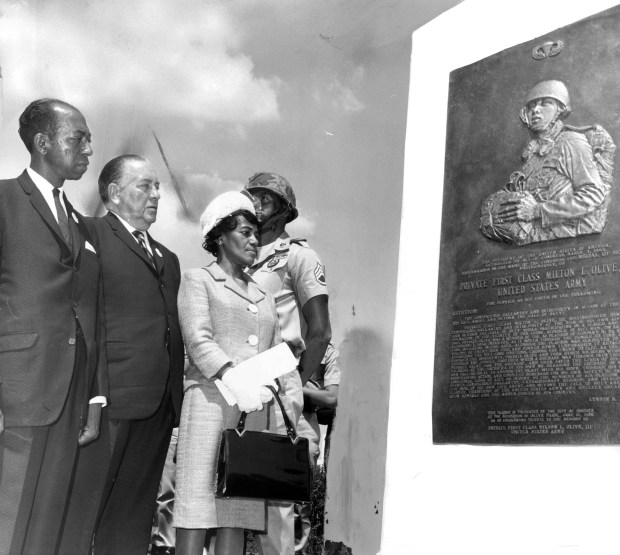 Mayor Richard J. Daley is flanked by Mr. and Mrs. Milton Lee Olive Jr., parents of the medal of honor winner, at ceremonies on June 19, 1966, unveiling the monument to the memory of Pfc. Milton Lee Olive in a park now known as Olive Park. The monument is sculpted in bronze. Editors note: this historic print has some pencil markings on it. (William Vendetta/Chicago Tribune)
1966: A monument to Pfc. Milton Lee Olive was unveiled in a park named for him on the lakefront at the site of the city’s water filtration plant and adjacent to Navy Pier. The soft-spoken South Side teen was killed in Vietnam on Oct. 22, 1965, after throwing his body on a hand grenade to save the lives of four military companions. Olive, whose nickname was “Skipper,” posthumously became the first Black officer who served in the Vietnam War to receive the Congressional Medal of Honor.
The Rolling Stones in Chicago: A timeline of the band’s 55-year fascination with the city’s blues
1972: The Rolling Stones performed three shows in two days at the International Amphitheatre, with Stevie Wonder as opening act. The set list brimmed with songs from the month-old “Exile on Main Street.” At least 25 concertgoers reportedly were arrested. The reviews were gushing: “They were famous; now they are a legend.”
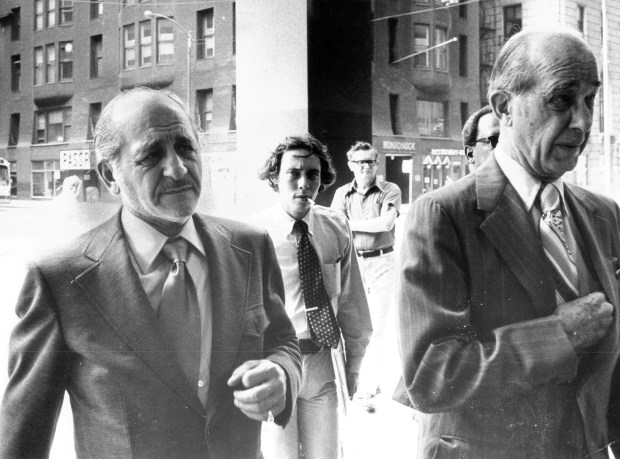 Sam Giancana, left, enters the Dirksen U.S. Courthouse with his attorney, George Callaghan, where Giancana was to appear before a federal grand jury on July 23, 1974. (James O’Leary/Chicago Tribune)
1975: Former Chicago organized crime boss Sam Giancana was shot to death in the basement of his home in Oak Park. The killing has never been solved.
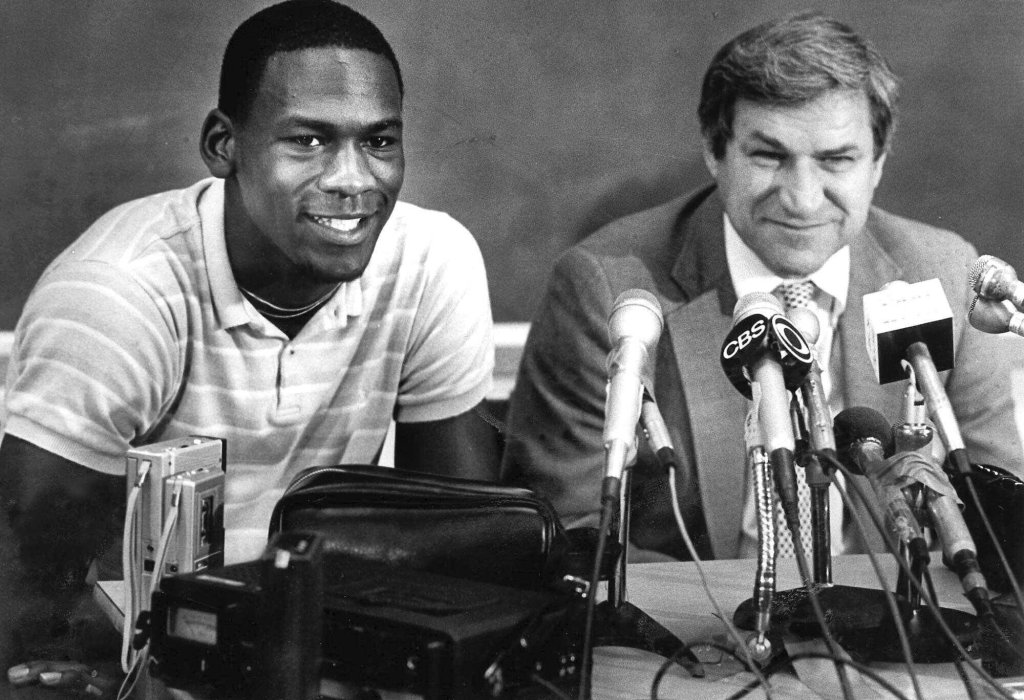
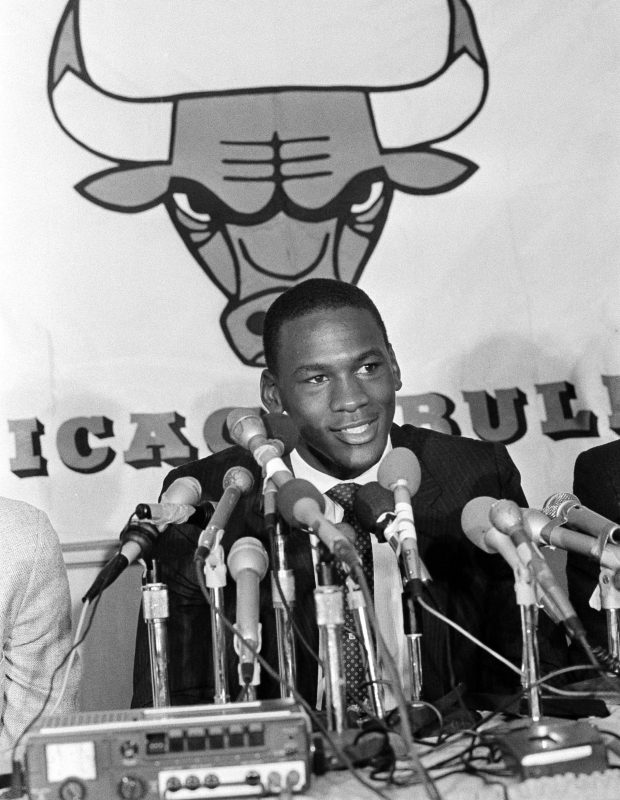 Michael Jordan speaks at a news conference on Sept. 12, 1984, in Chicago, after signing a seven-year contract with the Chicago Bulls. (Charles Knoblock/AP)
1984: The Chicago Bulls chose two-time college player of the year Michael Jordan with the third pick in the NBA draft.
“The Bulls’ No. 1 choice will need a few laughs to ease the shock of moving from a winning team at North Carolina to a loser in Chicago,” the Tribune’s Bob Logan wrote.
Jordan was practicing with the U.S. Olympic basketball team in Bloomington, Indiana, that day when he was asked about it.
“No, I’ve never been on a losing team before, but that doesn’t bother me,” Jordan said. “You don’t join any team expecting to go out there and lose.”
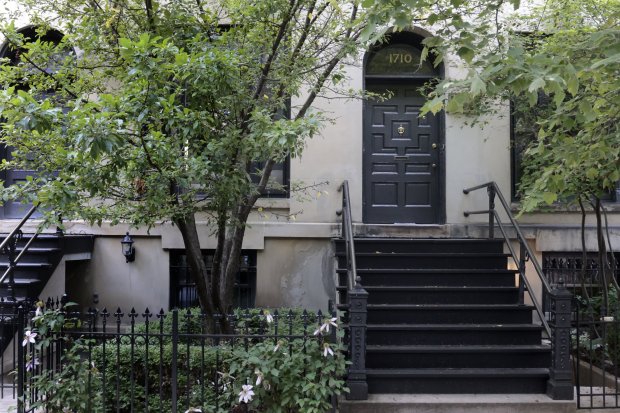 In the mid 1920s, Henry Gerber founded the Society for Human Rights from his home at 1710 N. Crilly Ct., the first gay-rights organization in the country. Gerber’s home is on the National Historic Register, June 6, 2024. (Antonio Perez/Chicago Tribune)
2015: The former home of prominent gay rights activist Henry Gerber, at 1710 N. Crilly Court in the Old Town Triangle neighborhood, was designated a National Historic Landmark. The postal clerk formed the Society for Human Rights, but was arrested in 1924, for being gay.
Gerber was never convicted, but the publicity (including a newspaper headline reading “Strange Sex Cult Exposed”) led to his firing for conduct unbecoming of a postal worker. The group he began quickly disbanded.
Want more vintage Chicago?
Subscribe to the free Vintage Chicago Tribune newsletter, join our Chicagoland history Facebook group, stay current with Today in Chicago History and follow us on Instagram for more from Chicago’s past.
Have an idea for Vintage Chicago Tribune? Share it with Kori Rumore and Marianne Mather at krumore@chicagotribune.com and mmather@chicagotribune.com