
PHOENIX – The color orange does not flatter everyone. That’s how Brandon Johnson felt as he sat on his bed in the Downtown Federal Detention center in Houston donning that dreadful jumpsuit. It was the color of incarceration.
He pulled the bedsheets over himself in embarrassment, attempting to hide even though every man in holding was wearing the same thing.
His whole life had just unraveled, quicker than the metaphoric red carpet he walked on his junior and senior years at the University of San Diego. Here he was, just a year after playing with the Phoenix Suns in the NBA Summer League, facing charges of federal conspiracy related to point-shaving.
Lessons learned in his youth had come back to haunt him.
“Drugs, music and sports, that was our community,” he said.
Johnson’s current chapter in life is one of redemption. His new roles include motivational speaker, and he recently was in Mesa for a camp sponsored by the Prison Fellowship Angel Tree, an organization that offers year-round support for children of incarcerated parents.
Most know Johnson as the standout guard University of San Diego and in 2008, the Toreros made it to the second round of the NCAA Tournament with Johnson leading the team. He was untamed and hot-headed, but also one of the best athletes to go through the program.
“I was just all testosterone,” he said.
On March 1, 2013, Johnson received a six-month sentence for conspiring to commit sports bribery. He wasn’t scared. In fact, he felt a sense of relief for the first time in a long time. In prison, life would stop moving so fast.
He could finally stop running.
“I’ve always been in survival mode,” he said.
The formative years
Johnson and his two brothers grew up in Inwood, Texas, on the northside of Houston. In third grade, his mother was sent to prison. He spent his days playing sports including football and basketball, as many kids do. His home life, however, was far from ideal.
His mom wasn’t around much and when she was, the boys were exposed to adult situations at an early age, he said, surrounded by negative influences in their environment.
Education was never a priority.
At 14, he moved across town to live with his father, who worked to break some of their bad habits. It wasn’t enough.
“We were coming from an environment where we still got that smell on us and no matter how much he tried to fix, we had seen a lot,” Johnson said.
The two clashed and Johnson left. He bounced around and found various places to stay, and said in ninth grade he was homeless.
Although football was his first love, basketball presented opportunities. Johnson was always smaller but could dribble. In a time when AAU basketball was beginning to gain traction, one mentor who made a mark on Johnson was his AAU coach, John Eurey.
Eurey started an AAU program in 1989 to help kids go to college and find a positive path in organized sports. Johnson was recruited to play for the Adidas national team and with them he was able to travel and experience a higher level of organized basketball. Eurey saw talent in him.
“It was the opportunity of a lifetime,” Johnson said.
He found refuge not only with the team, but with Eurey himself. Eurey took him under his wing, kept him fed and kept a few bucks in his pocket. He was a tough coach and although to some “he was horrible at times … he was perfect for me,” Johnson said.
They were an ideal match.
“I just wanted him to be perfect in everything he did and I wanted him to rise out of his living conditions and I wanted him to create his own way in life,” said Eurey, who is also a certified history teacher in the Houston Independent School District.
Johnson thrived and in June of 2005, he left Texas for the University of San Diego on a DI basketball scholarship.
He boarded the plane with two bags of clothes and a basketball.
A difficult adjustment
The noisy bustle of college move-in day is usually a happy one. Televisions are mounted and suitcases are unpacked. For many, the day is an emotional milestone in a young adult life. Tears are shed and final goodbye hugs are given. A silence follows when one sits on their dorm bed alone and wonders what the next four years will deliver.
The only thing Johnson could relate to was the alone part, as no one traveled with him nor provided comfort him during the transition.
He didn’t even have bedsheets. Five other freshmen recruited to the Toreros basketball program were moving in with their parents into the five-bedroom condo they shared with Johnson.
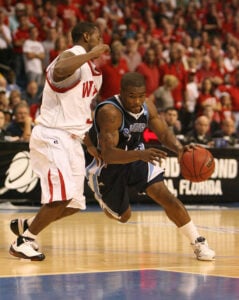
After serving time for a sports betting scandal, Brandon Johnson, right, now works as a motivational speaker and a sports gambling awareness counselor. (Photo by Doug Benc/Getty Images)
He sat on his bed alone at 17.
“I remember hardening my heart that day,” Johnson said.
Through this heart-hardening process, one person stopped the complete solidification of it: T.J. Brown.
Brown, a Toreros assistant and the only Black staff member on the team at the time, had played point guard at Texas A&M before turning to coaching.
On that first depressing move in-day, he welcomed the lost freshman player. Johnson never forgot.
They bonded and Brown knew how to handle Johnson and extinguish his fire on his worst days. Days when he would be kicked out of scrimmages, or days when he would trash talk the seniors on his team because he knew he was better. Days when he had so much anger he didn’t know what to do with it. Brown was there.
“I love him like a brother,” Johnson said.
One thing to note about Johnson: He doesn’t cry. There’s no time to cry when all you do is run, he said, but that sophomore year Johnson did when a motherly figure in his life he called “grandma” passed away. He had stayed with her during his times of homelessness, a woman tender and nurturing when all he knew was toughness.
He also welcomed his first son that sophomore season.
Spreading his wings
In 2007, junior year came and BJ, as friends called him, began to thrive. He was a menace on the court and popular in the USD community.
“He always had a confidence and spoke his mind and everyone liked to hangout with him,” said Gyno Pomare, a former teammate. “He was the life of the party.”
Johnson and Pomare had played at USD together from 2005-2009 and engaged in a friendly rivalry. Pomare held the all-time points record until Johnson beat it by 65 points.
Even after Brown and the staff were fired and a new staff under longtime Gonzaga assistant Bill Grier took command, replacing Brad Holland, Johnson and Brown maintained their close friendship.
The change seemed to work in Johnson’s favor as the NBA noticed him. Grier convinced him to stay for his senior year even though the league may have been an option.
Before the USD-San Diego State game his senior year, Johnson remembers telling two people, “as long as I can play ball, I can control all of this.” What he didn’t expect was to tear his achilles that game, ending his season.
He was helped off the court and taken into a training room. He remembers lying there and staring at the ceiling. The only thing he could do now in his situation was laugh. Had God punished him for his cockiness, he wondered.
Pomare had been playing overseas at this point, but knew “that moment did deflate a lot of us, the whole team and a lot of the alumni because we were going to do a lot of great things.”
Johnson was given a redshirt fifth year after his senior-season ending injury, but by the time he came back, he didn’t know the team.
“I knew I wasn’t the player I used to be and that was tough on me,” he said.
He felt like he didn’t belong anymore, especially because he was much older now physically and mentally. He didn’t have it in him to lead anymore, especially when he had a son of his own to take care of and no financial security.
His stats weren’t the same and neither was his mentality. He partied and skipped classes.
Johnson made it through that grueling fifth year and graduated, the first in his family, in 2010 with his Bachelor of Arts in sociology and a minor in communications.
He was ready for the next chapter of his life and was given the opportunity to train and play in the NBA Summer League for the Suns and in the preseason for the Washington Wizards.
His strength was finally returning and he felt like things were looking up.
One weekend he flew to Houston to stay at his mother’s home to recover and relax, but relaxation was the last thing that happened.
Life-changing moment
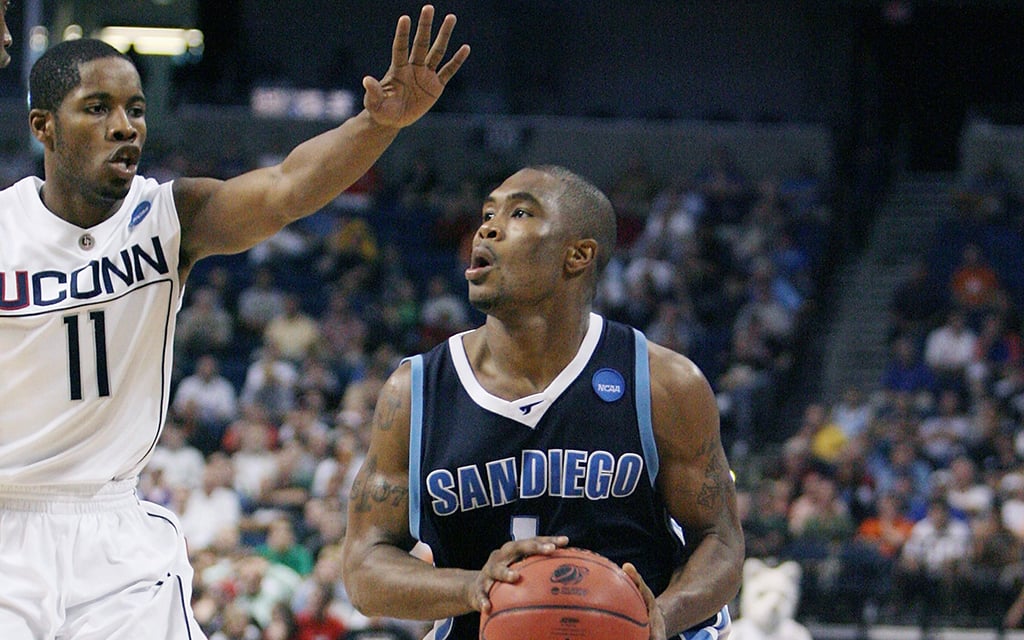
Brandon Johnson brings the ball up court for the San Diego Toreros as he is guarded by Jerome Dyson of the Connecticut Huskies during the first round of the 2008 NCAA Tournament West Regional at the St. Pete Times Forum on March 21, 2008 in Tampa, Florida. (Photo by Doug Benc/Getty Images)
Unmarked cars and multiple police officers surrounding his mother’s house in the middle of the night and like a movie scene, he was arrested and taken in for questioning. Brown had also been arrested.
His recent past had come to haunt him.
In 2010, Brown had approached Johnson about delivering any inside information on the USD men’s basketball team. Johnson knew Brown was a gambler so he wanted to help a friend.
He told Brown he had a groin injury and planned to sit for a game against Portland. Brown immediately called up his bookie, ESPN reported, and said, “Take Portland and lay the points.”
More discussions followed. After a three-point loss to Loyola Marymount, Grier asked Johnson why he didn’t put up an open shot. ESPN reported that “Johnson would later tell Brown, he looked at his coach and thought: That’s a ‘G’ right there. That’s why I ain’t get no shot up. That shot would never have gotten me the ‘G.’”
The FBI caught wind and had conversations that implicated Brown on wiretaps. The jig was up.
March is always a difficult month for Johnson as March 1, 2013, was his sentencing day. He was to serve six months in custody, followed by one year of supervised release, for his role in a conspiracy to commit sports bribery in connection with influencing the outcome of University of San Diego basketball games during the 2009-2010 season and soliciting a USD player to do the same during the 2010-2011 season.
Brown received a yearlong sentence. He pled guilty to an indictment charging him with conspiring to commit sports bribery on November 15, 2012, but never plead guilty to point shaving.
Johnson’s outgoing nature led him to another significant bond during his time in prison. Matt Williams, who was incarcerated for smuggling contraband into a secure facility, and Johnson became inseparable from the moment they met. Both shared a mutual sense of not belonging in those orange jumpsuits.
The two would venture out to the yard together to workout and prepare for life after prison.
“He never let that time in prison affect him mentally and that rubbed off on me because I was beating myself up and his energy rubbed off on me,” Williams said.
The words “inspiration” and “motivation” come Williams’ mind as he thinks about Johnson. He was someone that motivated him to go to culinary school after prison and become a chef.
Williams recalls Johnson saying, “Look if you want to be a chef get out there and do it and don’t let anybody stop you.”
Finding direction
Williams graduated from culinary school two years after his release from prison, and his first job was a personal chef to a professional athlete. Williams and Johnson remain best friends to this day.
Throughout his court case and sentence, he continued to love the game even if the NBA was no longer an option. Johnson would end up playing professional basketball overseas for eight years in Europe, South America and China.
“Done ran around the world before the age of 30,” Johnson said.
Now his focus is as a motivational speaker and a sports betting awareness ambassador where he visits schools, detention centers, universities and organizations across the United States.
In 2020, he launched his non-profit organization called “No Script,” which emphasizes his efforts with young people regarding life skills and education through his AWAKE (Actively Working Acquiring Knowledge Everyday) Program.
He also supports Prison Fellowship Angel Tree, which makes it possible for adults who are serving time in prison to sign their children up for various sports camps.
“When they give me the call I come running because God has been so instrumental, and he’s just showing out now and I couldn’t script this any better, spirituality and helping the youth,” he said.
Although Johnson has found a sense of peace and acceptance over this new chapter, he can’t deny that he thinks about what it would be like to step foot back on campus. That beautiful campus with those bittersweet memories.
At 38, Johnson is still disassociated from the university and its athletics. He is not allowed back on campus or anywhere near Jenny Craig Pavilion, the multi-use sports arena at the University of San Diego.
He has come to the conclusion that “I was the greatest and worst thing to ever happen to that university.”
What would be the first thing he would do if he were able to go back?
He paused for a moment.
“I would go to the middle of the court and do a 360 and probably break down. … I could walk that campus all day and feel poor, but when I got to that arena I was the richest man. … It felt like I was going through hell sometimes, but when I got there … silence.”