
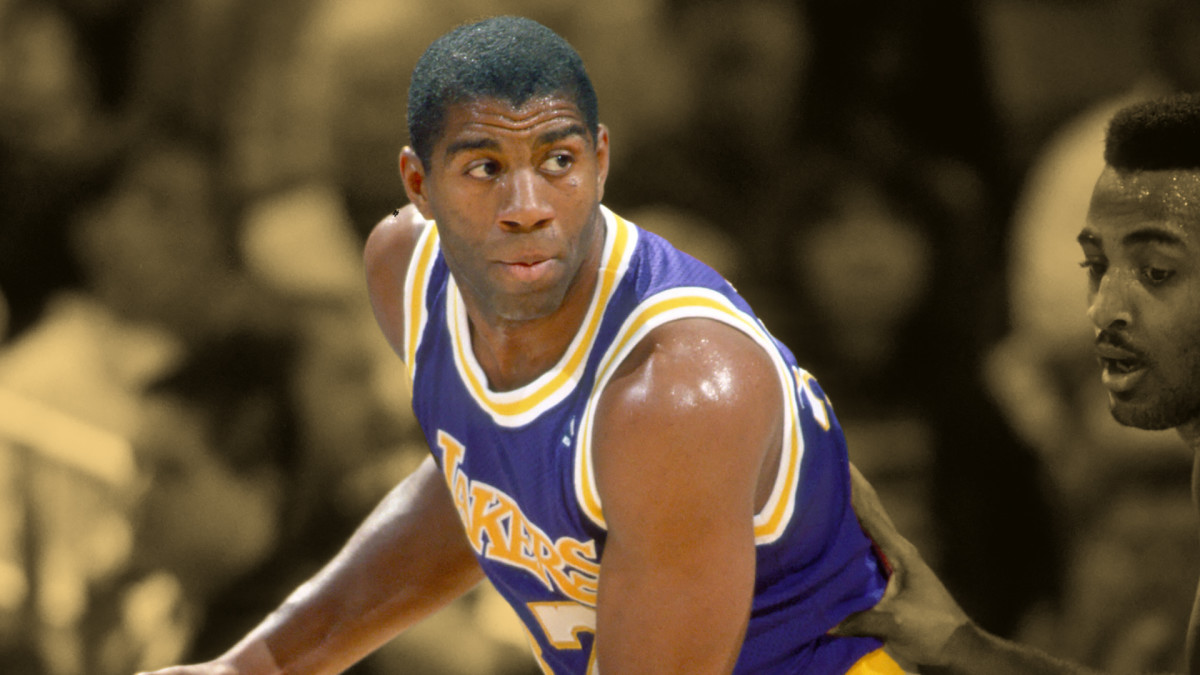
“If it doesn’t register a win, then it wasn’t good enough” – Magic Johnson was disappointed with his 43-point outing in the 1990 Playoffs originally appeared on Basketball Network.
Earvin “Magic” Johnson could score at will if he wanted to, but not in the 40s. However, that changed every time he sensed his Los Angeles Lakers teammates weren’t pulling their weight offensively.
Advertisement
Trailing the Phoenix Suns in the 1990 Western Conference semifinals, Magic took over the offense and dropped a game-high 43 points for the Purple and Gold. Sadly, LA lost and bowed out of the playoffs, leaving the Michigan State product disappointed and frustrated.
“If it doesn’t register a win, then it wasn’t good enough,” Johnson rued after that loss via the Washington Post.
On his offensive explosion, Johnson admitted that scoring heavily was an option he could do had he wanted to. However, it was simply something he didn’t want to do regularly.
Magic hated losing, admits missing KAJ
Having grown used to dominating the regular season and elevating his game in the playoffs, Johnson admitted that losing and getting bounced was unfamiliar territory. He felt that, despite solid talent on the roster, the Lakers simply lacked the necessary fire.
Advertisement
“We used to crank it up another notch. That’s where I think you miss a guy like Kareem [Abdul-Jabbar] and the other guys who knew what to do and turned it over,” Johnson added.
Sans Kareem Abdul-Jabbar, the Lakers still had reliable players in the mix. That list included James Worthy, Byron Scott, Orlando Woolridge and A.C. Green. Mychal Thompson and rookie center Vlade Divac stepped in to replace Kareem Abdul-Jabbar — but those were impossibly big shoes to fill.
Riley failed to weave Magic without KAJ
The Lakers’ season ended in disappointment, as hopes of sustaining their winning ways without Kareem fell short. After a63–19 regular season, it looked like Pat Riley had the team on track — until the playoffs told a different story.
Advertisement
A major shift in the 1990 offseason came with Pat Riley’s departure. A surprising and somewhat controversial move, especially since he had just been named Coach of the Year.
Word got out that Riley’s relationship with his players tourned sour, something he shrugged off. Rather, he explained that he stepped down because the pressure of maintaining the Lakers’ winning culture took its toll on him and he needed to take a break.
“Families change, relationships change, but I had nothing but good relationships with all my players, to the final day,” the champion coach explained via the NYT.
Short-term success before freefall
The Lakers turned to Mike Dunleavy to succeed Riley in the 1990-91 season. With Magic leading the way anew, the decision was justified as LA reached the finals once more.
Advertisement
However, the Lakers fell to the Michael Jordan-led Chicago Bulls in five games. Johnson tried to carry the Purple and Gold in that series, but Scottie Pippen effectively made life miserable for the three-time MVP.
It would be the last NBA Finals the Lakers would reach in the “Showtime” era. Johnson’s abrupt retirement, coupled with the departure of key veterans, signaled the start of a transitional era in LA.
The Lakers stayed relevant in the seasons that followed but never made it back to the Finals. It wasn’t until the 1999–2000 campaign — with Shaquille O’Neal and Kobe Bryant leading the charge — that everything finally clicked again.
This story was originally reported by Basketball Network on Jun 22, 2025, where it first appeared.