
The Big Ten is the home of some of the oldest and most storied programs and arenas in college basketball. That was true even before the conference’s recent addition of UCLA and its 11 national titles, as well as other former Pac-12 powers USC, Oregon and Washington.
Now, specifically with the Bruins and Pauley Pavilion, the Big Ten basketball landscape is second to none. One could argue that the ACC’s Duke and North Carolina boast more individual history than the Big Ten’s top programs. But the Big Ten’s conference-wide depth is unmatched, with a rich history of excellent play, NBA products and, of course, historic arenas.
We recently compiled an updated ranking of those 18 basketball arenas, plus took the ranking a step further with a specific look at their in-game atmospheres.
Now, with the conference’s rich history in mind, here are those 18 basketball arenas ranked from youngest to oldest. It should be no surprise that the conference’s best venues are also among the longest-tenured.
18. Pinnacle Bank Arena (Nebraska Cornhuskers)
Capacity: 15,500
Opened: 2013
Arena Rank: No. 15
Nebraska plays in the youngest building in the Big Ten. It should be no surprise that the arena is also among the nicest. The Cornhuskers are still looking for their first back-to-back NCAA Tournament appearances since the early 1990s, which sometimes lends to their arena being forgotten. If Nebraska ever rises toward the top of the conference, this building and its environment will soon follow.
Get more (Nebraska) news, analysis, and opinions on Cornhuskers Wire
17. Matthew Knight Arena (Oregon Ducks)
Capacity: 12,364
Opened: 2011
Arena Rank: No. 10
Oregon’s building is among the Big Ten’s youngest and has the amenities to match — it’s a fantastic basketball venue. Its new court is certainly better than the previous design, although it could still do without the patterns under the basket.
Get more (Oregon) news, analysis and opinions on Ducks Wire
16. Galen Center (USC Trojans)
Capacity: 10,258
Opened: 2006
Arena Rank: No. 17
USC is one of several Big Ten arenas built after 2000. These buildings have somewhat of a professional feel, depending on the placement of the student section. USC is also forced to contend with being the second-best team in town.
Get more (USC) news, analysis, and opinions on Trojans Wire
15. Xfinity Center (Maryland Terrapins)
Capacity: 17,950
Opened: 2002
Arena Rank: No. 7
Maryland’s arena may be on the newer side, but it still generates a top-tier in-game environment. The student section and the school’s fan base deserve a ton of credit. They impressively make an 18,000-seat arena feel like a classic college venue.
14. Value City Arena (Ohio State Buckeyes)
Capacity: 18,809
Opened: 1998 (Nov. 3)
Arena Rank: No. 16
Ohio State’s arena fits the general theme of those built after 1995. It is the largest basketball arena in the conference, which can sometimes be a detriment to the in-game environment. The building itself is as nice as any, however.
Get more (Ohio State) news, analysis, and opinions on Buckeyes Wire
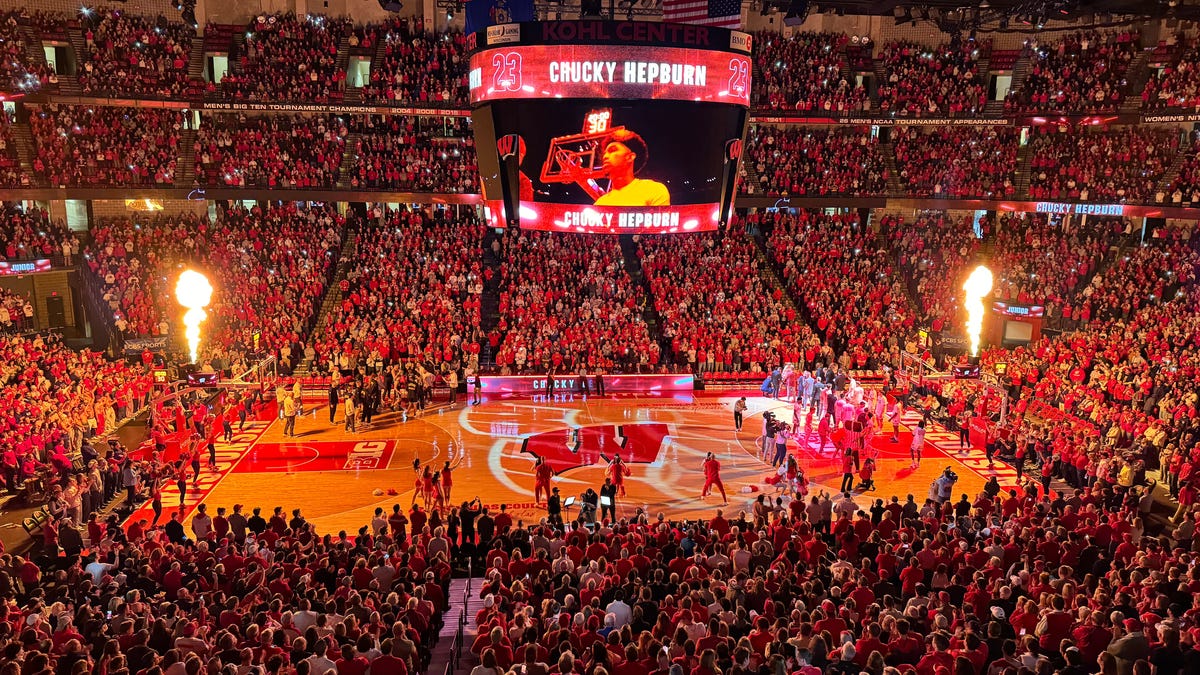
13. Kohl Center (Wisconsin Badgers)
Capacity: 17,287
Opened: 1998 (Jan. 17)
Arena Rank: No. 6
Like the Xfinity Center, Wisconsin’s Kohl Center is one of the rare new-age college arenas that feel like a classic venue. The building itself is also arguably the nicest in the conference. That all leads to a top-tier in-game atmosphere and environment.
12. Bryce Jordan Center (Penn State Nittany Lions)
Capacity: 15,261
Opened: 1996
Arena Rank: No. 18
The Bryce Jordan Center looks a lot like the newer arenas in the conference. Its only issue is the quality of the Penn State program, which rarely threatens the NCAA Tournament.
Get more (Penn State) news, analysis, and opinions on Nittany Lions Wire
11. Breslin Center (Michigan State Spartans)
Capacity: 14,759
Opened: 1989
Arena Rank: No. 4
Circle the Breslin Center as arguably the perfect college basketball arena — one that would be challenging to recreate today. A major part of its environment is a student section that wraps around 80% of the court. Nowadays, newly constructed areas are set aside that area for premium seating and any other initiative to generate more revenue.
Get more (Michigan State) news, analysis and opinions on Spartans Wire
10. Carver-Hawkeye Arena (Iowa Hawkeyes)
Capacity: 14,998
Opened: 1983
Arena Rank: No. 8
The difference in construction eras becomes clear starting with Iowa’s Carver-Hawkeye Arena. The building is a great place to watch a college basketball game, though it is clearly a few steps behind those built after 1995.
Get more (Iowa) news, analysis and opinions on Hawkeyes Wire
9. Jersey Mike’s Arena (Rutgers Scarlet Knights)
Capacity: 8,000
Opened: 1977
Arena Rank: No. 12
Jersey Mike’s Arena isn’t for everyone. The building generates a fantastic in-game environment and is a great place to watch a game if you’re sitting in the first 20 rows. However, the top-level seating is less than ideal, to say the least.
8. Assembly Hall (Indiana Hoosiers)
Capacity: 17,220
Opened: 1971
Arena Rank: No. 1
Assembly Hall is one of college basketball’s classic venues. It hasn’t undergone any dramatic changes, which adds to its allure.
7. Crisler Center (Michigan Wolverines)
Capacity: 12,707
Opened: 1967 (Dec. 6)
Arena Rank: No. 5
Crisler Center is surprisingly old for how nice of a venue it is. Major renovations in 1998, 2001 and 2012 ensure that reality. The building isn’t quite on par with Michigan State’s arena, but it’s clearly one of the Big Ten’s best.
Get more (Michigan) news, analysis, and opinions on Wolverines Wire
6. Mackey Arena (Purdue Boilermakers)
Capacity: 14,240
Opened: 1967 (Dec. 2)
Arena Rank: No. 2
Mackey Arena is older than the Crisler Center by just four days. The building has turned into one of the best venues in the sport, thanks to an energized fan base and one of the perennial top teams in the sport. This is one arena that shouldn’t make major changes. Keeping its current feel should be the top priority.
5. Pauley Pavilion (UCLA Bruins)
Capacity: 13,800
Opened: 1965
Arena Rank: No. 3
Pauley Pavilion is as-advertised and then some. Not only has the building housed some of the greatest teams in college basketball history, but it is a fantastic combination of old-school and updated. A 2012 renovation helped bring the building into the modern age.
Get more (UCLA) news, analysis, and opinions on UCLA Wire
4. State Farm Center (Illinois Fighting Illini)
Capacity: 15,544
Opened: 1963
Arena Rank: No. 9
Illinois’ State Farm Center creates one of the best in-game atmospheres in college basketball. While the building itself is a bit outdated, its unique architecture and feel are major pluses.
3. Welsh-Ryan Arena (Northwestern Wildcats)
Capacity: 7,039
Opened: 1952
Arena Rank: No. 14
Northwestern completely redid Welsh-Ryan Arena in 2017–18. That upgraded it from a near-high-school arena to a fantastic, updated college venue. The building itself is still quite old, but the indoor feel is dramatically different from where it was pre-renovation.
2. Williams Arena (Minnesota Golden Gophers)
Capacity: 14,625
Opened: 1928
Arena Rank: No. 13
Minnesota’s Williams Arena is another Big Ten venue that desperately needs a competitive team on the court. The building is historic and generates a terrific in-game atmosphere. Minnesota just hasn’t won 20 games in six years, and counting.
1. Alaska Airlines Arena (Washington Huskies)
Capacity: 10,000
Opened: 1927
Arena Rank: No. 11
I was a bit surprised to learn that Washington’s Hec Edmundson Pavilion was nearly 90 years old. A 1999–2000 renovation brought the arena itself into the modern age. Like Welsh-Ryan Arena, the building has an intimate and uniquely collegiate feel. Now, it just needs a good team on the court.
Get more (Washington) news, analysis and opinions on Huskies Wire
Contact/Follow @TheBadgersWire on X (formerly Twitter) and like our page on Facebook to follow ongoing coverage of Wisconsin Badgers news, notes and opinion