

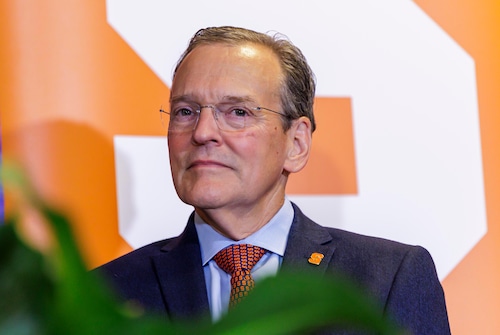
 Syracuse athletic director John Wildhack said athletes who play football, basketball and lacrosse will be paid by the school during the 2025-26 school year. (N. Scott Trimble | strimble@syracuse.com)N. Scott Trimble | strimble@syracuse.com
Syracuse, N.Y. — Syracuse University will pay athletes in its most high-profile sports over the next year, reflecting the pecking order in the SU hierarchy as the school starts to pay athletes directly.
Syracuse will pay athletes on its football, men’s basketball and women’s basketball teams next year. It will also pay some lacrosse players under a new revenue-sharing model that goes into effect Tuesday.
Syracuse athletic director John Wildhack provided some details about the school’s approach to managing the new system in an interview with Syracuse.com | The Post-Standard on Monday.
Thanks to the settlement terms of the House v. NCAA antitrust lawsuit, schools will be able to pay athletes up to $20.5 million directly next year. Players can begin receiving payment Tuesday.
Like most schools, Wildhack said, Syracuse will distribute most of that money to its football team, with payment also going to men’s and women’s basketball players.
Syracuse will also pay a small amount to lacrosse players. Wildhack declined to specify if the school would pay men’s lacrosse players, women’s lacrosse players or both.
“What are our most visible programs?” Wildhack said. “It’s football, both basketballs and both lacrosses. Football you have to be good at for obvious reasons. Basketball is real important. Women’s basketball is a growth sport. Lacrosse you have the opportunity to win championships here.”
Wildhack declined to say how much money would be given to each program to distribute.
Most schools are not making that breakdown public.
The majority are believed to be using back payments used in the settlement to justify paying male athletes substantially more than women.
Using the back payments as a model would mean schools distribute 75% of their revenue-share money to football players, with 15% going to men’s basketball players, 5% to women’s basketball players and the rest going to other athletes.
In addition to paying players, Syracuse will add additional scholarships to its men’s lacrosse, women’s lacrosse and field hockey teams, Wildhack said.
All three of those are high-performing programs at Syracuse that made the postseason last year and have a recent history of playing deep into the postseason at NCAA championship events.
Syracuse’s men’s lacrosse team leads the NCAA in national championships with 11 (one is vacated due to rules violations). Its women’s lacrosse team has reached championship weekend in three of the past five seasons. Its field hockey team won a national title in 2015 and remains the only women’s team in school history with a national championship.
Wildhack said some programs at Syracuse will be provided fewer scholarships than in previous years. He declined to identify those programs.
Syracuse will not change the number of scholarships provided to football players from its current number of 85, meaning the program will continue to rely on walk-ons or partial scholarship recipients to fill out the final spots of its roster.
“Fran (Brown) and I discussed it,” Wildhack said. “I think we’re in a good place. For some of the schools that are going to 105 (scholarships), with kids who are 86 to 105, are they going to stick around? Are they going to go in the portal? It’s going to be a dynamic and fluid environment for the next 12 months.”
Wildhack said the overall number of scholarships that Syracuse provides athletes will increase but declined to say by how much.
The decision to provide additional scholarships to lacrosse and field hockey decreases the amount that Syracuse can pay its athletes directly by the value of those scholarships (with a cap at $2.5 million).
Any school that hits the cap or goes over will only be able to pay athletes $18 million directly. Schools have taken a variety of approaches to adding scholarships.
Some schools, like Indiana, have decided not to provide additional scholarships, option to put the most cash it can in the pockets of its most valuable athletes.
In the ACC, Clemson took the opposite approach by adding 150 scholarships across a variety of programs.
Wildhack said that Syracuse will pay the maximum amount that it is allowed to players during the first year of direct payment. He said the school still has to determine whether it will hit the ceiling in future years.
“To me you have to look at this on a yearly basis,” Wildhack said. “You have to experience this for a year. … We’re going to have to go through it and live this out.”
Wildhack declined to say if Syracuse’s contracts will include concepts familiar in professional deals, such as multi-year agreements or buyout terms.
The NCAA, however, has already provided information about how buyouts should be incorporated into its salary cap.
Paying players will provide an additional cost to athletic departments that have traditionally aimed to break even financially. It is expected to be a significant challenge at schools like Syracuse.
Syracuse Chancellor Kent Syverud said previously that the school’s athletic department ran a small deficit last year.
Wildhack said that Syracuse has been preparing for direct payment for the past year. He said the athletic department has examined and decreased operational expenses, launched a fundraising campaign and brought in a chief revenue officer to try to boost the amount of money coming in.
He said SU has not laid employees off for financial reasons but has decided to leave some positions in the athletic department unfilled.
In addition to navigating paying players on its own, athletics could also be allowed to run a bigger departmental deficit next year.
Wildhack declined to expand on that possibility, saying he wanted to focus on things his department could control.
“We’re going to do everything we can to offset that $20.5 (million),” Wildhack said.
While some schools around the country are cutting entire programs, Wildhack said that would be a last resort at SU.
“That is the last thing you would want to do,” Wildhack said. “We operate 20 sports now. The plan and the model that we are building is to operate those 20 sports going forward.”
With the adoption of its new system, the NCAA is looking to make its member schools the primary entities paying athletes.
The new system permits endorsement deals but seeks to minimize the role of booster-backed collectives, many of whom have been paying athletes de facto salaries for playing for their preferred schools.
Syracuse has three collectives operating on its behalf: Orange United, Athletes Who Care and SU Football NIL. Wildhack said those groups will have to adjust their approach to ensure any agreements comply with NCAA rules.
“They need to reshape or restructure so they can still be a player and still be an element going forward,” Wildhack said. “We’re going through that still, figuring out what they look like.”
The NCAA is requiring financial agreements with players worth more than $600 to be submitted to a clearinghouse operated by Deloitte, a financial firm which has been tasked with ensuring deals reflect an actual business purpose and pay an appropriate amount of money for that purpose.
The rules, Wildhack said, should exclude many payments from collectives and make financial agreements with businesses the primary way for schools to exceed their salary cap.
While the perception of Central New York’s economy might be negative, Wildhack said he thinks the changes will be beneficial for Syracuse.
“We’re not competing against any major league franchise,” Wildhack said. “You see the growth that is coming, that is taking place with Micron coming. I’m optimistic.”
Still, he said, there is uncertainty about how well the new rules will function as equalizers in reality.
The system asks athletes to submit all their outside financial deals, meaning they risk losing financial opportunities when following the rules. Many industry experts have questioned why they would bother.
The new rules may also not last long. They may violate Title IX laws and continue to violate antitrust law, creating the possibility that the same legal arguments that failed colleges once will be rejected a second time.
“We hope (the settlement) holds,” Wildhack said. “It provides a foundation. It provides some guardrails. Anything where we can get to a greater degree of competitive equity benefits us. … If it can hold, I think it provides some competitive equity.”
If you purchase a product or register for an account through a link on our site, we may receive compensation. By using this site, you consent to our User Agreement and agree that your clicks, interactions, and personal information may be collected, recorded, and/or stored by us and social media and other third-party partners in accordance with our Privacy Policy.