
Shew. NBA free agency has been underway for less than 24 hours, and already a cascade of deals has cleaned out the market. Of my top 25 free agents, only eight remain on the market, and one of them (Malik Beasley) is in that situation for non-basketball reasons.
I’ve already opined on several of the Day 1 moves on our running blog, but the thing about focusing on single transactions is that sometimes you miss the big picture.
So taking a step back from the fray, exhaling, and looking out over the landscape from a busy day of transactions, here are three big thoughts that hit me:
The middle class didn’t get squeezed!
The big fear among a certain class of players was that the 2025 free-agent market would be a repeat of 2024’s. Last season saw several players in the league’s middle-class get squeezed as teams seemed unusually reluctant to part with exception money; even good players coming off solid years like Tyus Jones and Gary Trent Jr. had to settle for minimum deals, while the multi-year money that found players such as Caleb Martin still shorted their perceived value.
This year, not so much. We are not even technically in the first official day of free agency on the West Coast as I write this, and already eight players have received some or all of the nontaxpayer midlevel exception (NTMLE) from eight different teams — Dorian Finney-Smith, Brook Lopez, Kevon Looney, Luke Kennard, Luke Kornet, Jake LaRavia, Caris LeVert and Tyus Jones.
That list doesn’t include Ty Jerome’s room exception deal with the Memphis Grizzlies, or D’Angelo Russell’s taxpayer exception deal with the Dallas Mavericks, or the several other MLE-caliber candidates left in the market and still being pursued by teams with this exception; Chris Paul, Al Horford, Deandre Ayton, Duncan Robinson, Guerschon Yabusele, Trey Lyles and Beasley, among others, remain unsigned.
Moreover, in a market where only one team (the Brooklyn Nets) actually had cap room and had little intention of using it on free agents, somehow seven different free agents have already received more than the NTMLE: Nickeil Alexander-Walker, Santi Aldama, James Harden, Julius Randle, Naz Reid, Fred VanVleet and Kyrie Irving. It seems highly possible that Myles Turner, Jonathan Kuminga, Quentin Grimes, Cam Thomas and Josh Giddey will take that total into double figures.
All of this alleviates a huge fear among agents repping the middle class: that teams would use their exception money mostly as trade exceptions for in-season moves — a new feature of the 2023 collective-bargaining agreement — and not bother so much with this tier of the free-agent market. While a few of these moves may retroactively turn into sign-and-trades to take advantage of the new rules, that hasn’t been the driving logic. Teams are out there spending to get rotation-caliber talent.
For that, I suspect we can partially thank the Indiana Pacers, Oklahoma City Thunder and Minnesota Timberwolves. They showed in the playoffs what quality depth can do for a contender or even quasi-contender in the postseason. In today’s “weak link” NBA game, having eight good players can pretty easily swamp a team with the traditional top-heavy model of two or three max-contract superstars surrounded by some guys from the Y.
What’s up with Houston’s frontcourt jam?
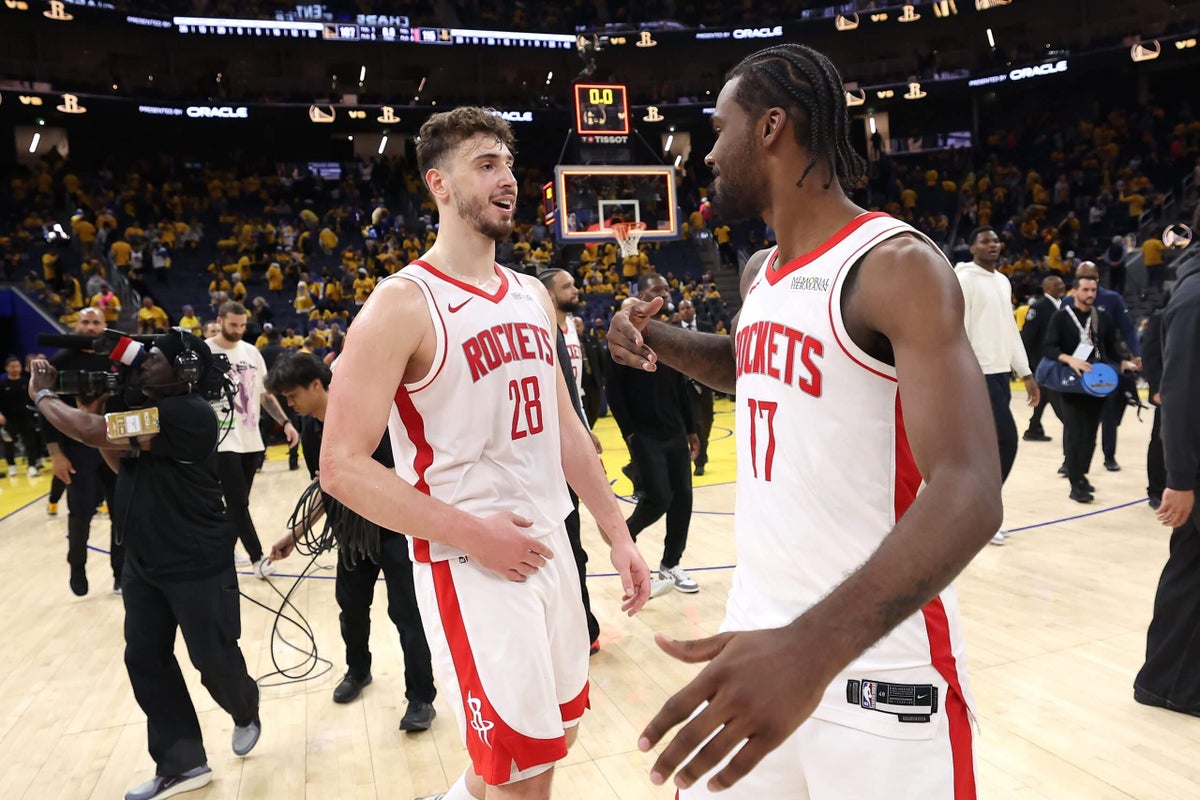
In the past week, the Houston Rockets signed Steven Adams to a three-year, $39 million extension … and signed Jabari Smith Jr. to a five-year, $122 million extension … and traded for Kevin Durant, who makes $54.7 million this year and likely will want an extension of his own … and signed Dorian Finney-Smith for four years and $63 million … and added Clint Capela at three years and $21 million. Did I mention they still have All-Star Alperen Şengün entering the first season of a five-year, $185 million extension? Or that Jeff Green is back again on a minimum deal? Or that none of the people I just named are guards or wings?
In particular, I’m not really sure how this is supposed to work at the center spot with Şengün, Adams and Capela. Which one of them is OK not playing? Yes, I know the Rockets leaned into some lineups with Şengün and Adams on the court together late last season, but this can easily go the other way too. The Rockets may not stay traditionally big all game, especially given how effective Finney-Smith has been as a small-ball five in his stops with the Los Angeles Lakers and Brooklyn.
Meanwhile, the power forward situation seems just as jammed. Durant is a four in today’s game but may be pushed down to the three by the presence of Smith and Finney-Smith, not to mention the minutes that Şengün may spend there.
I haven’t even mentioned Amen Thompson and Tari Eason, the tag-team chaos agents who both seem best suited to playing the four, even if they’re listed as small forwards on the depth chart.
Even excluding those last two, Houston has seven players making a combined $136 million — that’s about 87% of the salary cap — in its frontcourt for this season, with Smith’s extension set to increase that by roughly $10 million a year from now. (Durant’s number in an extension may change this.)
Meanwhile, the Rockets have three guards on the roster, only one of whom (Fred VanVleet) was a full-time rotation player a year ago. The others are Aaron Holiday, returning on a minimum deal, and Reed Sheppard, the 2024 No. 3 pick who hardly got off the bench last season. Thompson is the starting “shooting guard,” I guess, because nobody who truly plays this position is on Houston’s roster at the moment.
So … what’s the endgame here? Another trade? A season-long experiment in bruiserball? Houston has the draft picks, matching contracts and young talent to go in a lot of different directions in the trade market, even after all these deals. But in the wake of the trade of Jalen Green and Dillon Brooks for Durant, the lack of a true wing on the roster of a win-now contender is glaring.
Waiting on Giannis
The underlying question that will impact a few select teams as they tiptoe into the free-agent and trade markets: How much powder should they keep dry in case Giannis Antetokounmpo pushes his way out of Milwaukee?
That’s something for a team like Houston to ponder, but the Rockets are hardly the only ones. For instance, it’s fair to wonder if part of the Lakers’ reticence to push in harder around their current roster is because they think they can be a landing spot for the Bucks’ superstar if he demands a ticket out of Milwaukee. Ditto for teams like the Miami Heat, Toronto Raptors, San Antonio Spurs and Golden State Warriors that, for differing reasons, see themselves as possible destinations for the Greek Freak. You’ll notice all these teams are off to relatively quiet starts thus far in free agency.
Ironically, however, the team that may have done the best job positioning itself may also be the one that has been the most active. You might notice that amidst all of the Atlanta Hawks’ wheeling and dealing, they now own a potential Bucks’ draft pick in both 2026 and 2027, and thus would hold the key to the Bucks being able to tank their way back into contention post-Giannis.
In particular, the Bucks own the least favorable of their own or the New Orleans Pelicans’ 2026 pick, while the Hawks own the most favorable; trading with Atlanta would give them access to both (Milwaukee would likely try to circle the Portland Trail Blazers into any deal as well, since the Blazers own two swaps and one pick from 2028 to 2030). The Hawks can trade two picks and two swaps on top of that, and have a young star forward making $30 million (Jalen Johnson) who can serve as the core of a salary match.
Fanciful stuff from a non-coastal market? (Georgia is on the Atlantic Ocean, but the ATL is four hours from the drink). Perhaps.
Antetokounmpo can put his finger on the scale and effectively veto some destinations, and the others I mentioned are all more glamorous. But while you contemplate the usual suspects for a Giannis run, don’t forget about the Hawks. Because their quiver of assets includes that Bucks’ pick, they’re at least in the game.
(Photo of Alperen Şengün and Tari Eason: Ezra Shaw / Getty Images)