
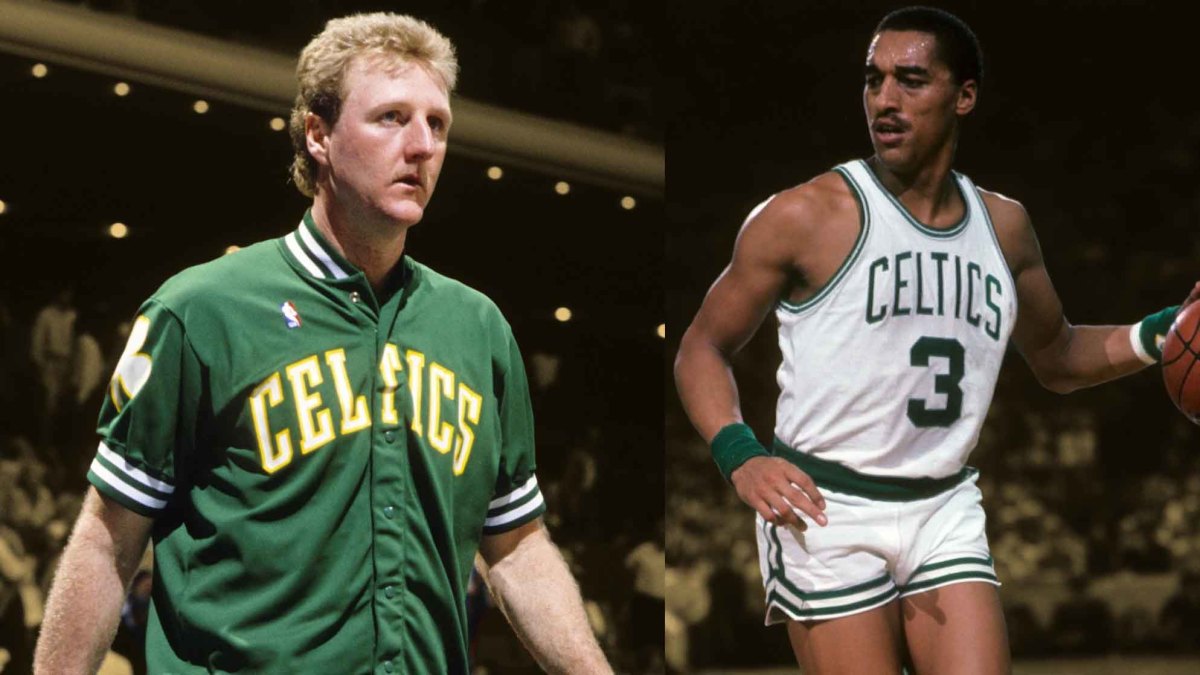
“Without Dennis Johnson, we’d be a mediocre team” – Larry Bird says there’d be no dynasty in Boston without D.J. originally appeared on Basketball Network.
When the thought of the Boston Celtics dynasty comes up, the Big Three are always the first to surface — Larry Bird, Kevin McHale and Robert Parish. They made history.
Advertisement
Three men whose chemistry, size and competitive fire fueled the Celtics’ dominance in the 1980s.
But buried behind the brilliance of that frontline was a fourth piece, one whose impact wasn’t always captured in stat sheets or highlight reels. Dennis Johnson didn’t always shine under the same spotlight, but inside the Celtics’ locker room, his role was never up for debate.
Important piece
Johnson was the adhesive.
He was the rugged guard with the sharp defensive mind, the clutch jumper when it mattered and the silent director of Boston’s half-court symphony. The Celtics won three championships in the ’80s — 1981, 1984 and 1986 — and each time, Johnson’s fingerprints were all over the wins.
Advertisement
Bird may have been the headline, but even he knew where the heart of the team beat.
“I think Dennis Johnson is the best player I’ve ever played with,” Bird said. “He makes everything happen. He really don’t shoot the ball extremely well at times, but without Dennis Johnson, we’d be a mediocre team.”
It was recognition of a foundational truth. Johnson was never the flashiest, but Bird had seen enough to know that his own greatness was made easier by the man who ran the backcourt.
Johnson arrived in Boston in 1983 with a championship DNA. He’d won Finals MVP with the Seattle SuperSonics in 1979, delivering elite two-way play alongside Jack Sikma and Gus Williams.
Advertisement
That title run introduced the league to his clutch gene, especially his defensive work against Magic Johnson in the Western Conference finals. But the fit in Seattle eventually frayed. A rocky stint in the Phoenix Suns followed, where his intensity was often misunderstood. Then came the call from up North.
In Boston, the pieces finally aligned. Coach K.C. Jones saw what Johnson brought immediately — defense, toughness and leadership. As the starting point guard, D.J. didn’t dazzle with speed or a high-flying game, but he controlled the tempo and made decisions that put his teammates in the best positions to thrive.
He was never above diving on the floor, locking up the opposing team’s top guard or making a pass one second quicker than most would even think it.
His defense was elite. Johnson made nine All-Defensive Teams in his career, six of those First-Team. In an era thick with scoring guards — Magic, Isiah Thomas, Andrew Toney and the likes — Johnson was the one tasked with taking the air out of their rhythm. And when the Celtics needed a bucket, his number was never out of the question.
Advertisement
Related: Michael Jordan shows off his $115 million luxurious superyacht in Croatia
Johnson’s Boston legacy
The 1985 Eastern Conference finals against the Philadelphia 76ers, the ’86 Finals against the Houston Rockets and even the fierce duels with the Los Angeles Lakers all featured a Johnson moment.
In Game 4 of the 1987 Finals against the Detroit Pistons, with the Celtics down 2-1 and the game tied at 104, Bird stole the inbounds pass from Thomas and found Johnson sprinting toward the rim and he laid it in as time expired.
It’s one of the most iconic plays in NBA history, but it’s remembered more as Bird’s steal than Johnson’s poise to finish it. That was always the paradox with a player like that in a dynasty setting. His greatness quietly underpinned Boston’s legacy.
Advertisement
Across 14 NBA seasons, Johnson averaged 14.1 points, 5.0 assists and 3.9 rebounds per game. In the playoffs, those numbers rose. In Boston’s 1984 championship run, he averaged 16.7 points and 4.4 assists while battling against Showtime in the Finals, a matchup that showcased not just skill but sheer will. He was the glue that kept the Celtics together.
The numbers don’t jump out like Bird’s or McHale’s, but Johnson’s 1,100+ career steals, 6,700+ assists and over 15,500 points remain a testament to consistency. He wasn’t a stat-chaser; he was a stabilizer. He also logged over 1,100 career games, a feat of durability and commitment.
His influence continued long after retirement. Johnson became a coach in the CBA, guided young players in the Celtics organization and eventually took over as head coach of the Los Angeles Clippers in 2003 on an interim basis.
Tragically, his life was cut short in 2007 when he passed away suddenly from a heart attack at just 52. In 2010, the Hall of Fame finally opened its doors to him. It was long overdue.
Advertisement
This story was originally reported by Basketball Network on Jul 2, 2025, where it first appeared.