
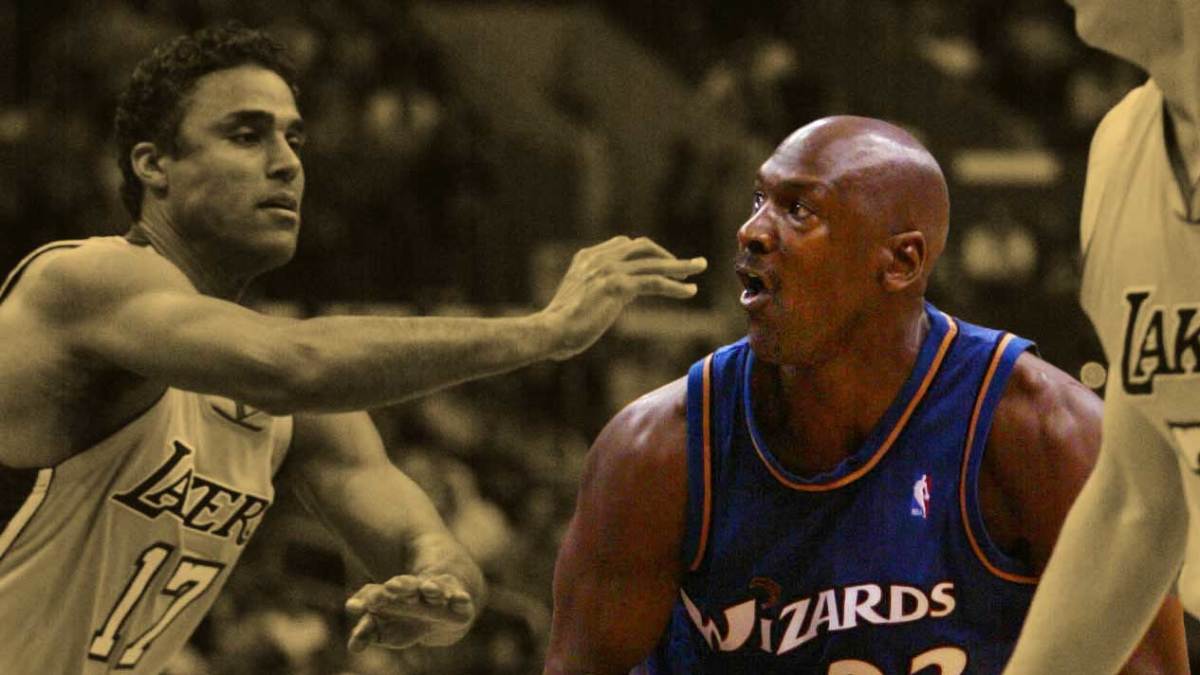
“I’m not about the money. I don’t care if I’m paid a single dime” – Michael Jordan said he returned at 38 to play for the Wizards for the love of the game originally appeared on Basketball Network.
Michael Jordan laced up his sneakers for the third ride, this time for the Washington Wizards in 2001. By then, his place in basketball lore had already been sealed with six-time NBA championships, five MVP awards, 10 scoring titles, and the face of a dynasty that reshaped the business and beauty of the game.
Advertisement
Still, when he returned at age 38, after three years away from the court and with nothing left to prove, critics sharpened their knives. Eyebrows were raised as to why he came back to risk the legacy.
And more so, play for a team that hadn’t sniffed the playoffs since the ’90s.
Jordan’s angle
MJ didn’t come back for legacy preservation but passion, proximity and principle. The decision, layered in personal challenge and professional curiosity, was never meant to please the press. He wasn’t out to reclaim his throne, just to get back on the court.
“If I can do it, great. If I can’t, great, that’s great too,” Jordan said at the time. “But you can’t take my six championships away, you can’t take all the things that I’ve done as much as you probably want to. I just want to play the game of basketball that I love. I’m not about the money. I don’t care if I’m paid a single dime; I’ve said that many years.”
Advertisement
By that point, Jordan’s resume wasn’t up for debate. He had already walked away from the game twice, once in 1993 to chase a baseball dream and again in 1999 with a tearful goodbye in Chicago. But it was during his front-office role with the Wizards, serving as the team’s president of basketball operations, that the itch returned.
He watched from the sidelines, helped shape the roster, mentored young talent and inevitably reached the same conclusion competitors often do when they’re too close to the action. He could still play.
The Wizards were struggling at the time. The team had gone 19–63 the season prior and hadn’t cracked .500 since 1997.
Jordan knew what he was stepping into. But he didn’t flinch. The critics saw a crumbling legend chasing ghosts. He saw an unfinished canvas. And when he returned in a Wizards jersey, it was less about rewriting the past and more about adding a footnote to it.
Advertisement
Just want to play
In 2001–02, Jordan played 60 games and averaged 22.9 points, 5.7 rebounds and 5.2 assists per game, numbers that would make any rising star blush. In December, he dropped 51 points against the Charlotte Bobcats (now Hornets), proving his scoring instinct hadn’t aged a day. But this wasn’t the acrobatic Air Jordan of the ’80s or the cold-blooded Finals assassin from the ’90s.
His presence didn’t turn the Wizards into contenders, but raised expectations and gave the franchise national relevance. Arenas filled. TV ratings climbed. Jordan’s work ethic set a tone inside the locker room. And while injuries cut his season short, the statement had already been made.
Advertisement
He wasn’t there for nostalgia; he was there to compete.
“I came to Washington because they gave me an opportunity to play here,” Jordan said. “It kind of fits because of where my job was. I’m gonna play the game of basketball.”
There was no parade or superstar entourage. Just a man in his late 30s, trying to squeeze out the last drops of competition from a game that had given him everything.
He would return for a second season in 2002–03, playing all 82 games at age 40, averaging 20 points per game and becoming the first 40-year-old in NBA history to score over 40 points in a game — something he did twice that year.
Advertisement
By the time he retired for good in April 2003, Jordan had played 15 seasons, scored 32,292 points and carried a generation on his shoulders. His Wizards stint didn’t deliver playoff magic, but it added another layer to a career built on defying the expected.
The criticism never really stopped, but then again, it never really mattered.
This story was originally reported by Basketball Network on Jul 2, 2025, where it first appeared.