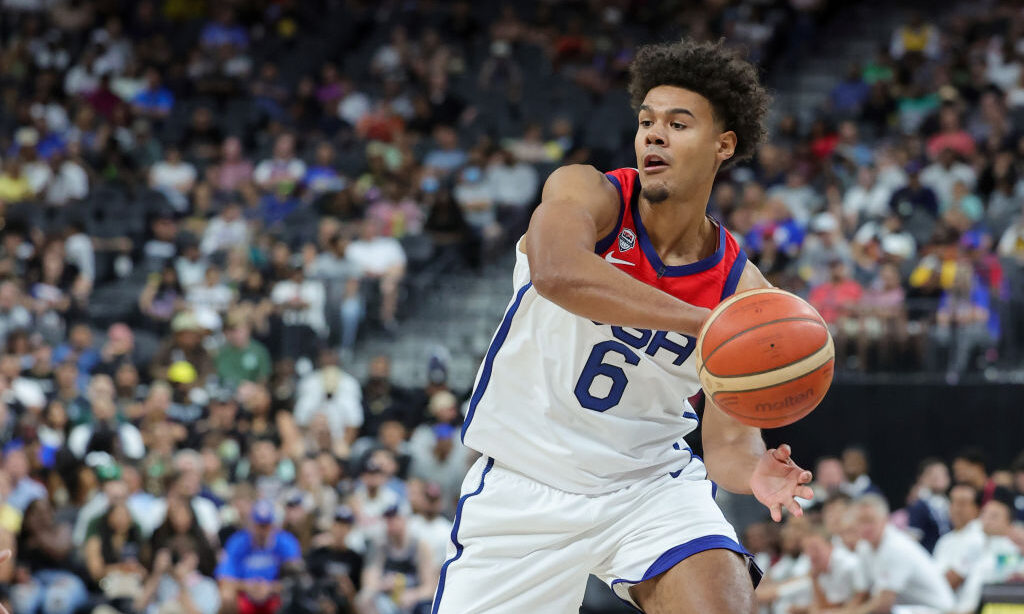
The Denver Nuggets finalized their massive trade with the Brooklyn Nets on Tuesday, swapping Michael Porter Jr. and a 2032 first-round pick for Cameron Johnson. With the deal complete, there are some questions and thoughts yet to be discussed.
Who is Cameron Johnson, and what does he bring to the Nuggets?
Johnson, 29, is a 6-foot-8 forward who averaged a career-high 18.8 points per game on 48 percent shooting from the field, 39 percent from 3-point range and 89 percent from the free-throw line in 57 games for the Nets last season. He also set a new career-high with 3.4 assists per contest and stacked 4.3 rebounds a game. While Johnson isn’t as rugged on the glass as Porter, he’s a better defender.
Johnson and Porter are similar players, with outside shooting as their top strength. Johnson ranked in the 99th percentile last year in off-ball gravity, thanks in part to his 40.3% shooting on 5.1 3-point catch-and-shoot jumpers per game, that is judged by BBall Index and NBA.com. Porter shot 41.8% on 4.6 of those shots a contest, which is better on a lesser volume but does not factor in that Nikola Jokic was throwing him passes. Johnson quietly finished second on the Nets in total assists last season — a sign of his underrated playmaking and the rag-tag nature of the passes the forward was getting.
Johnson excels at shooting off screens, ranking in the 93rd percentile league-wide in off-ball shot-making. His play-type versatility will allow the Nuggets to use a similar caliber of shooter to the sharp Porter in many more ways. Johnson can even create his own deep-range shots at times.
Cam Johnson is an elite shooter
Player Profile linkhttps://t.co/y9CYZNwZ47 pic.twitter.com/Dycg4WMgCK
— BBall Index (@The_BBall_Index) July 2, 2025
Johnson is a good player, with many metrics suggesting he had a better season than MPJ last year. While MPJ won the title with the Nuggets in 2023, Johnson has also played in the NBA Finals. Before being dealt for Kevin Durant, Johnson was a key member of the Phoenix Suns early in his career. The 11th pick in the 2019 NBA Draft out of North Carolina proved quickly to be a plus shooter with size and some defensive skills. Johnson’s defense hasn’t been as well-regarded since the trade to Brooklyn — though the Nets haven’t really been trying to win anything for years.
Johnson spent three and a half years in the desert and two and a half in the city.
Cameron Johnson’s 2024-25 Regular Season: pic.twitter.com/rWbofydBy5
— PivotFade (@PivotFade) June 30, 2025
How Johnson fits in Denver
Johnson played 57 games last season, missing time due to hamstring and knee issues. He’s had a few injuries in recent years, but nothing chronic — his health will be something Denver monitors. In dealing MPJ, they actually got a player back who has been more of an injury risk lately.
But Johnson is a much better in-action defender than MPJ. Porter was pretty good as a backside rotator and used his size well in iso situations. Johnson has way better lateral quickness and can guard a pick and roll. His size with Christian Braun’s ruggedness and Aaron Gordon’s strength should make for a solid trio of defensively capable players next to Jamal Murray and Jokic.
Johnson’s position versatility will also help the Nuggets in solving some lineup issues they have against the Thunder in the playoffs. Their new player, like Porter, can play both the three and the four. Denver can go small or big with Johnson, and his shooting and some creation skills can let David Adleman get creative if needed when Jokic goes for a rest.
Johnson will be either the third or fourth option on offense and Denver badly needed some more creation and ball skills over the last two seasons in the playoffs. Murray was attacked by both the Wolves and Thunder and Denver didn’t have many ways to release the pressure. Johnson’s IQ and off-ball movement will do more than alleviate the issues for the Nuggets, it will open up new ways for the Nuggets to generate offense.
Why the Nuggets traded Porter for Johnson — the financial side
Trading Johnson for Porter saves the Nuggets about $35 million over the next two seasons, assuming Porter picks up his player option. This drops the Nuggets from a team bumping up the ultra-restrictive second apron of the luxury tax to being a non-tax team.
Some may call the Kroenkes cheap for dodging the tax during Jokic’s prime, but the move gives Denver significantly more flexibility, which the team tried to use almost instantly.
From Denver’s perspective, the Nuggets did not wrap up the Johnson and Jonas Valanciunas trades into one deal. In order to trade for the big man, Denver needed to first make the swap with Brooklyn. However, if the Nuggets combined these two deals, they would have been able to spend deeper into the luxury tax. By making these trades separately, the Nuggets will be hard-capped at the first apron at $196 million in total salaries.
The Nuggets are also signing Bruce Brown and Tim Hardaway Jr. to minimum deals, leaving Denver with $12.5 million to spend on their 15th and final roster spot.
The Nuggets can use the $14 million mid-level exception, just not all of it, since they can’t exceed the first apron. If Denver clears more salary, it could use the full amount. Otherwise, the team will likely use part of it to bring in a final player.
Additionally, by conducting these two trades that work together, separately, the Nuggets have more flexible trade matching rules in season and can sign anyone on the buyout market. Teams over the first tax apron are restricted from signing certain players in buyout situations — a limit Denver avoids with this structure.
The Nuggets also carved out the largest possible trade exceptions, which are rarely used but can be helpful to get a player without having to match salaries — something that could be useful before Braun and Peyton Watson get paydays next summer. In short, this approach gives Denver more flexibility throughout the season.
The other wrinkle here is that the Nuggets are only about $9 million under the luxury tax. It behooves ownership to dodge that number altogether because of the repeater rule. And since the Nuggets have been taxpayers the last few years, their bills have become hefty.
By staying below the tax, ownership will also get paid out in revenue sharing by the tax-paying teams — it’s the difference of tens of millions for ownership’s wallets, which nobody cares about, but KSE is the entity running the team, so it matters.
Denver offseason
The likelihood is that Jonas Valanciunas and Cam Johnson trades are intertwined into 1 (or at least it should).
That would avoid the first apron hard cap pic.twitter.com/Rvby0RN5G7
— Bobby Marks (@BobbyMarks42) July 1, 2025
What’s next for Johnson in Denver
Johnson is set to make $20.5 million this season and another $22.5 million in the 2026-27 season. He will hit free agency in the summer of 2027, having just turned 31 a few months earlier.
Denver can offer Johnson an extension right now if wanted, something they did right after getting Kentavious Caldwell-Pope. However, this deal and the changing landscape of salaries around the new aprons may have the Nuggets holding off on that conversation until next summer, if at all. Aaron Gordon’s team-friendly extension does not jump in cost until the 2026-27 season when both Braun and Watson will be on their second, much more lucrative contracts.
The Nuggets are set to get a whole heck of a lot more expensive in the 2026-27 season, and Johnson will have to play his way into the core.
Some personal info on Johnson
Johnson was the Nets player rep for the players’ union. He’s well-spoken and is often on the Young Man and the Three Podcast.
Johnson played for Team USA during the 2023 FIBA World Cup and was in the player pool but not selected for the 2024 Olympics roster.
Johnson has a Balkan connection — his mother is Croatian American.
Saying goodbye to MPJ
The Nuggets saw Porter grow from a broken prospect into a champion. This trade comes with significant emotion aside from on-court fits and salary cap stuff.
Porter is an all-time Nuggets player. He finishes his Nuggets career second in 3-pointers made, second in playoff rebounds, third in playoff blocks, third in playoff minutes played, fifth in playoff steals and sixth in playoff points.
He has one year plus the player option left on his deal with the Nets, who are not trying to win next year. He will play for former Nuggets assistant coach Jordi Fernandez.
Porter will be asked to space the floor with his shooting for the several young guards Brooklyn has. He will likely shift from the small forward spot he played in Denver to what may be his more natural position at power forward. The Nets may use his size at the four to complement Nic Claxton.
Brooklyn will likely look to build his value and trade him again for more assets. Their main return: an unprotected 2032 first-round pick, which comes toward the end of Jokic’s career and could be a great pick.