
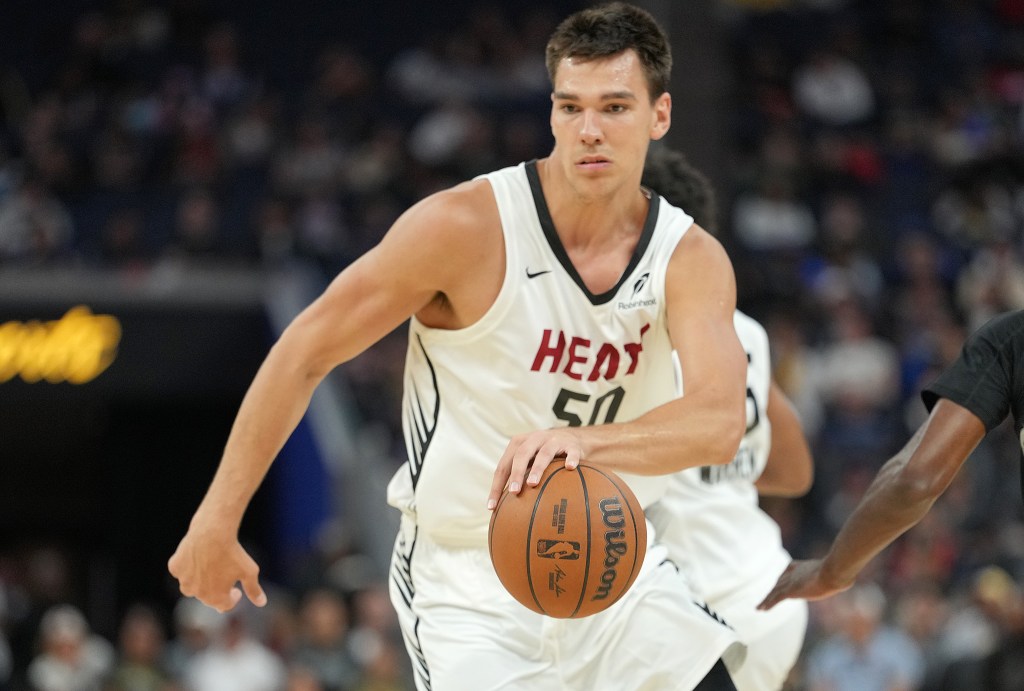
Q: Ira, since there is no backup true center on the Heat’s roster, wouldn’t it be feasible to convert Vlad Goldin’s two-way contract to a standard one? – Bill, Palm Beach Gardens.
A: Would the Heat be allowed to do so? Sure. There still is that vacant spot on the Heat’s 15-player standard roster for the regular season. But there also seemingly would be little need, with it highly unlikely that Vlad Goldin would be needed for more than the maximum 50 regular-season games allowed on a two-way deal. At this point, there are no guarantees there even will be that two-way deal, with such contracts eligible to be swapped out at any point. The reality is that for all the craftiness Vlad has shown with his offense with his post game, there needs to be more on the boards. Beyond that, because he only can defend in drop coverage, there are limitations on the defensive end. For the most part, figure on Bam Adebayo, Kel’el Ware and Nikola Jovic being able to take most of the reps when height is needed in the middle. And there still are veteran options available in free agency (Paging Thomas Bryant? Orlando Robinson? Precious Achiuwa? Daniel Theis? Bismack Biyombo? Mo Bamba?). Actually, one of the more intriguing names became available Monday, with the Wizards waiving Richaun Holmes. He would be a quality fit if the Heat were willing to fit the 15th and final spot on their standard roster. As for Goldin, he did have his moments on Monday night against the Celtics, and at least there were five rebounds in his 15:28.
Q: Start here, I am a Tyler Herro fan. I also think we have probably seen his ceiling. I am concerned about how much an extension hurts the team’s ability to have the flexibility they may need next year. I also wonder if the extension that they may give him will be equivalent to what the league would think he was worth in a possible trade. I know they don’t have to deal with it until October (per previous question), so maybe all of this is a circa deadline conversation. – Seth, Weston.
A: The issue at play here, and seemingly always in play in the cash-gone-wild NBA, is the notion that if a player is eligible for an extension at a certain maximum number, he gets that number. For Tyler, starring in October, it would be three years at roughly $150 million. But the reality is they don’t have to offer that much, and in today’s second-apron NBA, maxing out creates significant issues no matter the talent level. Likely, the Tyler extension talks will come down to compromise and if there is any willingness. Otherwise, it gets tabled.
Q: If Andrew Wiggins buys in and wants to put forth the effort he has a chance to be one of the best small forwards in the East, a 6-foot-7 vet with a championship, can shoot the 3-pointer, post up, and take you off the dribble and will play lockdown defense. – Douglas.
A: Look, this has to stop. Andrew Wiggins bought in and put in effort when he arrived. Then he got hurt and the roster still was recovering from the Jimmy Butler grenade tossed in the locker room. He’s a quality component. But he also is a trade asset. That’s a reality. So it comes down to accepting what might be a transient reality. That is not always the easiest reality for some.