
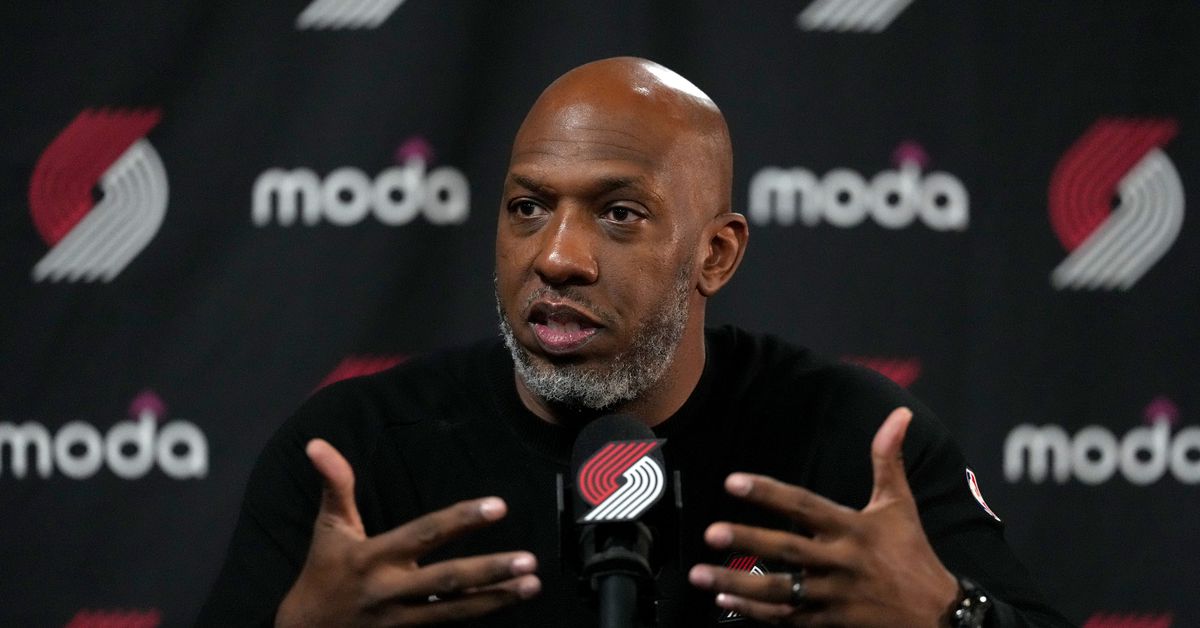
The news broke today that the Portland Trail Blazers have negotiated a multi-year extension with Head Coach Chauncey Billups. Let’s be clear: this is not a by-the-numbers move. Over four years with the franchise, Billups has accumulated a 116-211 record. That’s a winning percentage of just 33.5%. Only four coaches in the history of the NBA have coached 300 or more games with that low of a percentage: Ron Rothstein, Tim Floyd, Sidney Lowe, and Billups. None of the other three made it past four and a half seasons as a head coach. Billups has not only made it four, he’s now slated for three more. By next February, he will likely be a unicorn, with no other coach ever having served longer with a worse record.
What is the rationale for this signing? The Blazers have already come out with the boilerplate explanations in their press release: certain slices of the season looking good, frosted with a layer of “collaborative culture” and “growth mindset” office-speak. Portland General Manager Joe Cronin gave the best, albeit most predictable, quote:
Chauncey Billups is a great leader, motivator and communicator that has worked tirelessly to establish an identity for this team that has taken shape over his time in Portland. I am beyond excited to continue this partnership with Chauncey and take this team to the next level.
The official word will boil down to this: “We think he’s the best person for the job.”
That’s a risky assertion, though, considering the best person they can envision is on track to become the worst coach who’s ever worked the sidelines by record and tenure.
The only response to Portland’s above-the-water explanation is equally simple: “You’d better be right.”
Let’s be fair. Maybe the team’s assessment is correct. Not all of Billups’ losses can be pinned on him directly. He’s stood at the epicenter of a storm: change in management, loss of superstar, fractured and sputtering rebuild. All of the impetus for these events came above or beyond him. Billups has simply been trying to organize and manage these drastic changes. It did appear that, once his entire coaching staff was recycled last summer, he got a handle on it this season.
Realistically, though, this is the kind of move that can blow up in the franchise’s face. There’s also a possibility that Billups is not a winning coach. The current situation resembles a car with two and a half wheels over the edge of a cliff. The driver yanked the wheel hard enough to keep a purchase on the embankment, but they’re not back on the road yet. Instead of stopping, reassessing, and getting a more experienced person behind the wheel, the team has said, “Drive on!” Fair enough, but if those wheels even approach the edge again, this car has to stop and the driver has got to go. One could easily envision the Blazers having to call another press conference—82 games and 25 wins from now—explaining how awesome Billups is but it’s time for a new voice and thank you very much for everything…enjoy the free two years of your contract.
There’s also the story below the waterline, other reasons that might have come into play in this decision. If the Blazers thought Billups was the best choice, what other factors bolstered that assessment and made it easy to sell? Some or all of the following may have contributed.
Last month we ran extensive articles on the things Billups appears to do well and the holes in his approach. You can consult those for analysis and nuances of his style. One of the main points boiled down to Billups being an apparently-decent player development coach but a relatively-poor x’s and o’s tactician. The Blazers might flat-out disagree with that assessment. Or, quietly, they might view the next three years as more player development than contending. Not that they’ll give up on either, but they may feel Chauncey lives right at the nexus of their needs and personnel. Extending him may herald more rebuilding than rejoicing in the near future.
The Blazers may feel like this is a low-risk move. The tenure isn’t over-long. Details of the contract haven’t been divulged, but odds are Billups is not among the league’s higher-paid coaches. If Portland does have to eat a year or two of the deal, it’s not going break them. (It’s worth pointing out, though, that they could have tried the middle ground of picking up the last year of Billups’ existing contract option without offering him extra seasons.)
The Blazers may feel like the underpinnings of statements by Cronin and owner Jody Allen are as critical as the records and stats. Both mentioned culture, overtly or obliquely, in their praise of Billups. One critique of the Blazers over the past decade and a half has been that they lost theirs. Continuity is a simple way to create identity. Billups is, by all accounts, an easy-spoken, approachable figure. The combination of familiarity and warmth could equate to distinct, attractive culture in their minds. Preserving the fragile rebirth of the franchise’s identity may have played a key role in this decision.
Though it seems affirming at first, that last motive feels like the most dangerous of the three. No matter the franchise, no matter the environment, winning has to be the key element at the heart of a team’s identity. Otherwise it’s just a way to feel nicer about losing. That’s not going to attract free agents, fans, or any positive attention whatsoever. Nice guys don’t finish last, but they better find a way to get a shot at first sometimes or they don’t belong in professional sports.
Substituting continuity for winning culture also brings up the fear of the Terrible Trifecta looming in Trail Blazers fans’ minds. Extending Billups was the first leg of the stool, probably the most palatable to most observers given the state of the team and his progress this season. The second and third involve similar extensions for veterans—and semi-questionable fits—Anfernee Simons and Deandre Ayton. Should all three come to fruition this summer, there will be some head scratching in Rip City, plus a strong suspicion that keeping things the same was not just a factor, but the factor guiding management and ownership. For the problems with that, see also: the first paragraph above, where we describe some of the losing woes the Blazers have encountered over the last four years. “The same” is the last thing they need to be.
On the surface, it’s hard to say that this was a good move on Portland’s part. It was a safe move, but that’s not at all the same thing. And “safe” here applies only to ease of execution, not risk-reward. The Blazers have re-invested in a basket that hasn’t held very many eggs unbroken. Resources—draft picks, seasons, careers—are not infinite. Portland can’t afford to keep dropping them by the wayside if they want to return to relevance.
For perspective, Shaedon Sharpe and Scoot Henderson will both hit the end of their rookie-scale contracts during Billups’ projected tenure. Portland’s babies will have grown to adults—perhaps in need of handsome compensation—under the watch of a single coach whose abilities are as-yet-questionable, whose results have been demonstrably negative.
If this generation of the rebuild ends up flatlining while management and ownership decide to die on the hill of Billups’ coaching prowess, it won’t just be the coach under fire. The Trail Blazers have made a highly unusual decision with relatively little justification save their own assessment. They have nowhere to hide on this one. If that assessment turns out to be wrong, no amount of explanation will make up for it.
Let’s hope for everyone’s sake that this works, which is the same as saying let’s hope the next four years represent a huge and unmistakable turn-around from the last four. If the reasons for Portland’s confidence are solid, we’ll all rejoice. We sure haven’t seen it yet, though. That makes this extension head-scratching at least. Unless things change, it’ll also end up a waste. At this stage of franchise development, that’s the one thing they cannot abide.
Hoping this was the right move isn’t enough. It had better be, else this franchise will be heading towards territory that only Clippers and Timberwolves teams of yore will understand, having made a call that went differently with 352 of 356 NBA coaches in history. And soon, perhaps, every single coach but Billups.
Nobody said you have to make every move perfect. That’s impossible in a long and wide-ranging rebuild. But you can’t get obvious moves demonstrably wrong. Blazers fans right now are praying that their team hasn’t.
I guess we’ll see.