
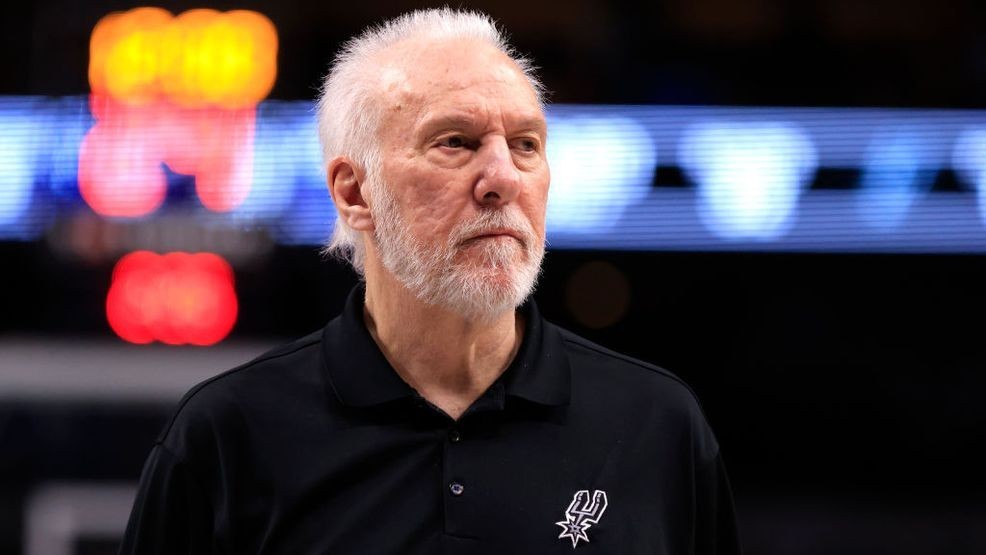
SAN ANTONIO – Gregg Popovich, the NBA’s all-time winningest coach and a Basketball Hall of Famer, will step down Friday as head coach of the San Antonio Spurs and transition into a full-time role as the team’s President of Basketball Operations, the team confirmed.
RELATED | Mitch Johnson succeeds Gregg Popovich as new head coach of San Antonio Spurs, sources say
Popovich issued a statement about his decision:
While my love and passion for the game remain, I’ve decided it’s time to step away as head coach. I’m forever grateful to the wonderful players, coaches, staff and fans who allowed me to serve them as the Spurs head coach and am excited for the opportunity to continue to support the organization, community and city that are so meaningful to me.
Popovich, 76, is synonymous with the Spurs’ success, leading the franchise to five NBA championships and establishing one of the most successful coaching tenures in NBA history. His decision marks the end of an era in San Antonio basketball, where he has become a legendary figure, not just for his Xs and Os but for his leadership, consistency, and development of a winning culture.
Spurs Managing Partner Peter J. Holt talked about Popovich’s impact on the team:
Coach Pop’s extraordinary impact on our family, San Antonio, the Spurs and the game of basketball is profound. His accolades and awards don’t do justice to the impact he has had on so many people. He is truly one-of-one as a person, leader and coach. Our entire family, alongside fans from across the globe, are grateful for his remarkable 29-year run as the head coach of the San Antonio Spurs.
ESPN’s Shams Charania first reported the story.
RELATED: Spurs coach Gregg Popovich out for season as he recovers from stroke
Coach Popovich has been sidelined since suffering a mild stroke in November.
Popovich suffered a setback in his recovery after suffering an incident at a restaurant on April 15. He had fainted and was then transported in non-life-threatening condition to a local hospital as a precaution.
Popovich’s legacy as a coach is unmatched. His career in San Antonio spans over two decades, beginning in 1996, and he quickly transformed the Spurs into perennial championship contenders. Under his leadership, the Spurs won NBA titles in 1999, 2003, 2005, 2007, and 2014, with Popovich earning NBA Coach of the Year honors three times (2003, 2012, 2014).
In 1988, Popovich joined Larry Brown’s staff as an assistant coach with the Spurs before leaving to join the Golden State Warriors as an assistant coach with Don Nelson. Popovich returned to the Spurs in 1994 as general manager and vice president of basketball operations. He took over as head coach in December 1996, following the dismissal of Bob Hill.
In 29 seasons, Popovich amassed 1,422 regular-season wins, the most in NBA history.
His coaching philosophy, centered on teamwork, defense, and unselfish ball movement, made the Spurs the model of consistency in an era dominated by superstars. Popovich’s ability to adjust, his sharp basketball mind, and his emphasis on developing players, most notably Tim Duncan, Manu Ginóbili, and Tony Parker, were key to his long-term success.
Throughout his tenure, Popovich became known for his discipline and his willingness to push the boundaries of conventional coaching wisdom. His teams weren’t just about winning; they were about playing the right way, embracing selflessness, and building a lasting legacy. It was this culture that set the Spurs apart from the rest of the NBA.
President and CEO of the San Antonio Food Bank Eric Cooper issued the following statement on Popovich’s retirement:
Coach Pop is the winningest coach of all time for his work on and off the court. His coaching made the players, the team, and our community better. He sees potential and he works to develop it. For us at the Food Bank, he saw the potential for a community where no child goes to bed hungry and where public policy helps people who struggle. Thank you Pop for an incredible coaching legacy!
Cooper also shared a throwback photo of Popovich at a press conference during one of his early NBA Championship runs sporting a SAFB ball cap.