
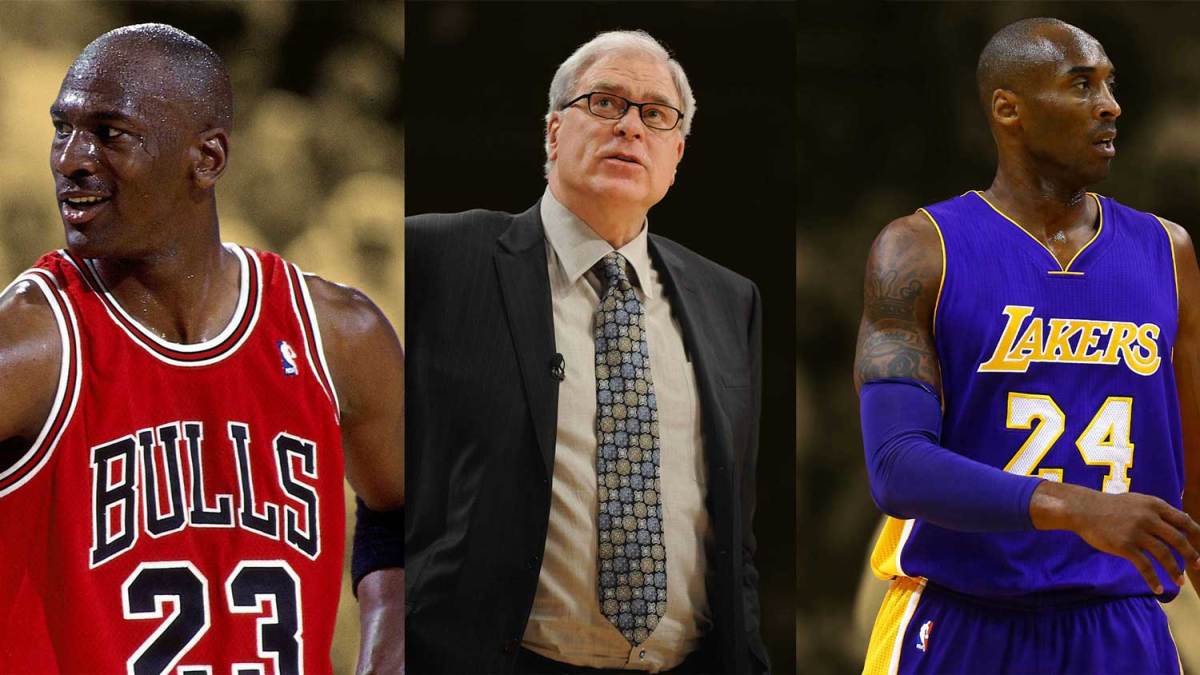
“He was willing and able to slip into what I asked him to do” – Phil Jackson on why Michael Jordan was easier to coach than Kobe Bryant originally appeared on Basketball Network.
Phil Jackson coached both Michael Jordan and Kobe Bryant, two players who were similar, even though it was at different stages of their careers.
Advertisement
In the 1990s, Jordan was the face of the NBA, brilliant, dominant and obsessive.
Bryant, meanwhile, was the talented heir apparent who came of age in the early 2000s.
Yet despite the parallels in their skill, mentality and competitiveness, Jackson saw a critical difference that made coaching one distinctly more seamless than the other.
Jordan’s adjustment
When Jackson introduced the triangle offense, a system designed to distribute responsibilities, share the ball and move away from isolation-heavy basketball, it wasn’t immediately clear how Jordan would respond.
Advertisement
After all, the system asked the league’s most lethal scorer to pull back, to trust teammates more and to function within a structure that muted individual flair for the sake of collective rhythm. But Jordan surprised him.
“He was willing and able to slip into what I asked him to do and we asked him to conform to, to run this offense that we were going to run,” Jackson recalled.
When Jackson first took over as head coach of the Chicago Bulls in 1989, he inherited a team centered around one singular force, Jordan. He had the output statistically; however, that hadn’t translated into team success. The Bulls consistently fell short of the NBA Finals, often hitting a wall against more balanced teams like the Detroit Pistons in the Eastern Conference playoffs.
Advertisement
That adjustment laid the foundation for what would become one of the most dominant dynasties in sports. Jordan was willing to embrace the triangle. It didn’t necessarily hinder him because he still had the ball in crucial moments and took over when necessary, but the offense no longer depended on him doing everything.
Learning the offense
In the years leading up to Jackson’s arrival, Jordan had established himself as the most explosive offensive force in the league. He was an unstoppable scorer. In his third season in 1986–87, he averaged a career-high 37.1 points per game.
Advertisement
Scoring titles came easily, but playoff success remained elusive. He was outmatched by more complete teams whose brand of basketball punished isolation scorers and thrived on exploiting one-dimensional strategies.
Jackson saw the problem clearly. A team that relied too heavily on one scorer, no matter how gifted, would eventually collapse under pressure. So he challenged Jordan to shift the focus from personal glory to team synergy.
“He averaged 37, 38 points a game previous to that and I asked him point blank to not win a championship in scoring,” Jackson said. “I said I don’t think there’s been a scoring leader that has won a championship since Kareem Abdul-Jabbar… He said, ‘I don’t think that’s a problem. I can average 32 points a game and still win a scoring championship.”
Advertisement
Jordan made the change and moved from being a soloist to being the centerpiece of a wider orchestra.
His scoring dropped slightly, but his efficiency increased. More importantly, the Bulls began to rise. With Scottie Pippen maturing into an all-around star and Jackson’s system taking root, Chicago’s style evolved. It became harder to defend, more dynamic and less predictable.
What followed was a decade of dominance.
Jordan led the Bulls to six championships in eight years, with two separate three-peats from 1991–1993 and 1996–1998. The triangle offense became the league’s most feared strategy and Jordan’s legacy transformed from the most electrifying scorer to the ultimate winner.
Advertisement
When Jackson later joined the Los Angeles Lakers and coached Bryant, the situation was fundamentally different. Bryant was younger, still evolving and fiercely independent. The Lakers won titles with him and Shaquille O’Neal, but maintaining cohesion became harder as egos clashed. Bryant was brilliant but less inclined to surrender control, especially in his early years under Jackson.
Jackson never wavered in his respect for Bryant’s talent, but Jordan met him at the right time, with the right mindset and was willing to change for the greater good. That decision didn’t just redefine his career. It reshaped an era.
This story was originally reported by Basketball Network on Jul 23, 2025, where it first appeared.