
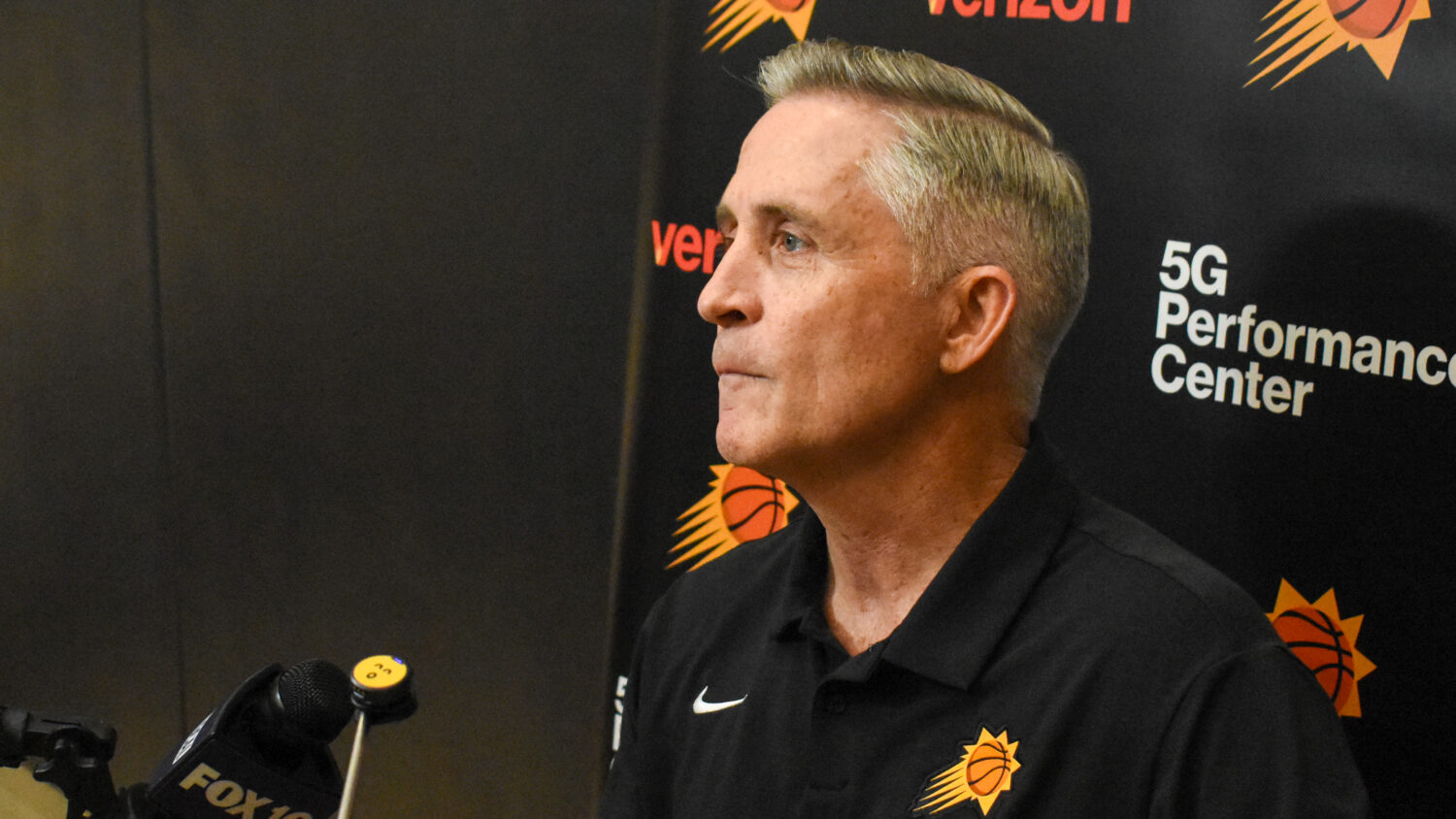
The Phoenix Suns have a full 15-man roster, signaling the end of the offseason is here.
Acquirable talent with upside keeps whispering sweet temptations into their front office’s head like the Green Goblin mask, with the primary name at the moment serving as Golden State Warriors restricted free agent Jonathan Kuminga, so maybe another sizable move comes. There’s also the matter of shuffling a roster that is far too deep in two areas of the depth chart, but again, it’s the end of July. Most of the business is done.
With that, some takeaways for you.
Suns making things happen
Even if you are more critical of what the Suns have done this offseason, you can still respect the new front office’s ability to get done what they said they would. And this is not to give them credit for making “major changes” when it was blatantly obvious before the season was even over that the head coach, general manager and two big players were gone. It is instead a nod to how this reshaped front office had to make this group younger and clean up its biggest roster deficiency.
Phoenix entered June with only Ryan Dunn (22 years old) and Oso Ighodaro (23) as the young players making up the next “core” of what the Suns would be. It ends July with Khaman Maluach (18), Jalen Green (23), Mark Williams (23), Rasheer Fleming (21) and Koby Brea (22) added to it. They have at least given themselves a shot at getting out of this in the next couple of years.
Maluach, Green, Williams and Fleming all bring some S-tier-level combination of size, length and athleticism that will go a long way comparatively to the last two years of Suns basketball. If those guys are indeed zooming around the court with those traits while the high-motor intangibles flash that Phoenix supposedly has in droves now, we will in theory see a far more entertaining product.
The disclaimers of “supposedly” and “in theory” are necessary since you never know how losing seasons will go, with gasoline leaking near the fire at all times. But regardless, it’s setting the Suns up for a step in the right direction in the long-term planning and delivering on the short-term acknowledgment that their product in the past two years to their fans was for the most part awful to stomach.
As stated a few times this summer and as stated a whole lot more in the next year, player development will keep this ship afloat or sink it deep below. They now have proper talent to develop.
Price of doing business
What has really held the Suns back is a complete lack of leverage across all of their most important roster moves, in a way where it felt like the league also took advantage of a front office with little experience. This all came to a head with the Kevin Durant trade, one in which those able to shrug at what the Suns got by saying “they weren’t going to get anything better” ignore how they were the ones to put themselves in that position.
Phoenix is right to say that it believes in Green and how he fits with Devin Booker specifically but no one can truly take that belief seriously. Green was a salary to make the deal happen, and Phoenix’s inability to get one done without him in it or him getting rerouted elsewhere speaks to the compromised position the Suns were forced to act in. Even worse, this will continue to hold lingering effects that jeopardize the structure’s integrity.
By being forced to take on Green, the Suns are forced to start him for now, an awful fit for giving Green a chance to thrive in a new environment and one that forces Booker to play the role of Steve Nash, elevating all of his teammates and making them better in a point guard-ian sense. Booker will do his best and is somewhat capable, but Phoenix has an unseemly gap between its best player (Booker) and second-best guy (Green? Williams?), so maximizing him is even more important. This is not maximizing him. It is, if anything, minimizing him.
So, the report comes in that Green will play point guard, presumably to avoid this. The stretch in which his playmaking was touted was one without Fred VanVleet, and Green over that period finished third in assists per game on his team and 64th in the league. Four different Suns finished ahead of him over that span.
If he can get the ball to Booker in his spots while bringing the ball up, that is helpful, while also taking some defensive pressure off Booker’s shoulders so Booker can use his energy elsewhere, which the Suns would hope comes primarily on defense. But what Green does with the rest of that responsibility has a troubling forecast ahead.
Like the Bradley Beal situation and the Durant situation, there are only bad options for what the backcourt will look like unless Green embraces a role off the bench or he dramatically improves in the areas where the most skepticism lies. That won’t happen, at least right away.
And whatever Booker’s role is, it does zero favors to him or Green, who all of a sudden becomes an immovable contract if he stagnates or regresses in Phoenix for two more years. The Suns have absolutely zero wiggle room for another one of those situations in the outcome that this turnaround is actually completed.
Teeter-totter
To expand on this, Phoenix’s Durant deal and choice of using its remaining tradable assets on Mark Williams that we’ll cover in a bit has their roster incredibly unbalanced.
When it comes to two-guards or “wings” that are the size of guards, Phoenix has seven: Booker, Green, Grayson Allen, Koby Brea, Dillon Brooks, Jordan Goodwin and Royce O’Neale. The only plus athlete is Green. Brooks and Goodwin were two additions in particular that are perfect fits for the attributes Phoenix targeted but in doing so makes other pieces on the roster more redundant.
Ditto for Williams, the double-down on centers that met the hype and then some of the too-loud-to-ignore rumblings of the Suns targeting 5s in the offseason. Now in order for Ighodaro to see the floor, which he absolutely should given the flashes he continues to show, he will likely have to do so at the 4. Can he play the 4? In some ways, yes. Is it his best position? No!
Essentially, the return from Houston and trading for Williams were two trades that set up the Suns to have to make more trades. Sounds like a good way to lose leverage. We’ll see if Phoenix can get something done in the latter stages of summer. It does not seem like that is coming easy based on where the roster is at with August right around the corner.
In addition, Phoenix was so blinded by establishing culture and identity that it created this rickety and lopsided roster. The Suns should have prioritized that, to be clear. It was just sloppily done at the expense of opportunities for the young core and multiple visions clashing with one another, a different example of this teeter-totter of imbalance where Phoenix wants to be competitive and win games next year while also building for the future. Even the best organizations with all the flexibility in the world struggle at doing that.
Dunn should play 30 minutes a game. Ighodaro should have a clean development pathway, as should Maluach and Fleming. That gets more complicated with a bunch of veterans deserving of minutes who probably won’t be the most chill presences if they are told to step aside on a 30-win team so the kids can run around. Setting your young players up for success to properly develop will be another consistent subplot next season and it’s an uphill task for first-time head coach Jordan Ott.
In terms of trustworthy ball-handlers, the Suns have one — Booker. Green will have to prove he can make “the right play” before earning that and if Collin Gillespie is indeed the backup point guard then this is will be the 26-year-old’s first time holding a role in a situation without injuries and/or tire fires leading to that. Jared Butler is a long shot to join that list.
The Suns the last two years had 55-win talent and went on to win 49 and 36 games. This team on paper is somewhere around 30, and for reference, FanDuel has the over/under at 31.5. But those expectations could be greatly surpassed by the culture and identity clicking into place as much as the roster’s fit does. The latter is in a rough spot, while the former is a believe it when we see it.
Win condition
We have come out of the offseason with Phoenix’s win condition, another way of saying what needs to get met to be “back in the hunt” during Booker’s prime.
The first is striking gold on the second-team situation for Green and/or Williams. Guys do flounder for a few years before finding success. It is not uncommon. It is more common that those guys continue to flounder.
The second is striking gold with the 2025 draft class — Maluach, Fleming and Brea.
Let’s define “striking gold.” At least one of these five has to be near an All-Star level by the start of the third season in this run-through, which would be 2027-28. It doesn’t have to be a “second star” per se, but someone who is definitively a top-50 player in the league. That’s the value of having Booker, who is top-10 at his best and has shown top-5 potential (2023 postseason). Beyond that, three of these five guys have to be dependable starters by then that other teams would desire.
Doesn’t sound too hard, right? Here’s what that would have to mean for those five guys, while also shouting out the chance of Dunn and Ighodaro becoming one of those too.
We already covered Green’s biggest challenge. His clearest pathway toward this is fully embracing the defensive end, beyond even the ways he improved in the last two years with Houston, and becoming legitimately great on that end. Escaping his blinders and tunnel vision with decision-making to become a reliable drive-and-kick guy while consistently taking good shots when he does hold onto it is next. From there, he has the scoring (and underrated shooting) talent to shine.
Maluach will simply require patience. He’s got a long way to go with feel for the game, to be expected for someone who didn’t begin playing basketball until six years ago. With that time comes his physical maturity, getting stronger and also more accustomed to moving around the floor with all those limbs. The mindset and motor are there.
Fleming is actually more of the same. Do not think of him as a three-year player at a mid-major. He is more of that five-star freshman who showed serious flashes while needing some seasoning. “Activity level” can be a tremendous skill or a great hinderance, and it is the former for Fleming. Affecting the game with all of this athleticism and energy is second nature. It’s just a matter of him connecting fully to the game, and that’s stuff like being in the right spot, when to burst into the play offensively and so on. Again, like Maluach, that should come with time.
Brea just needs to be either passable in every area beyond shooting or good in one area beyond shooting. That’s it. Pretty simple. He’s that elite of a shooter.
Then there’s Williams, and it’s even more simple than Brea’s. He just has to stay healthy. There are needed steps for him to take forward on the defensive end, but it really doesn’t have to go that far.
Because there is a path for the Suns to actually flip all of the beyond questionable value with his arrival that we’ve already covered previously.
Even if Williams plays 65 games next season, which feels quite improbable, he will not earn a lucrative contract extension. For once, the Suns will hold leverage. He is a restricted free agent, and it would be genuinely shocking to see another team come in with an offer sheet that outbids the Suns given the injury red flags from Williams’ first three seasons. So, Phoenix should be able to navigate that into a pretty affordable deal. Given they don’t extend him this summer, and they absolutely should not.
From there, Williams would again just need to hold that dependable track record. Because the unavoidable end to Phoenix’s best-case scenario is having to trade Williams.
Maluach’s potential is higher than anyone in the young core by a sizable margin. With that, if he has a median-level outcome to his development, he supplants Williams. Again, do not fall into the same trap you can with Ighodaro. If Maluach becomes a dependable 3-point shooter, perhaps he could play some 4 in the future. But he is best as a center. So, you know, just play him at his best position. And both of them would need to play beyond a combined 48 minutes, before even getting to Ighodaro, who should be treated as a factor in this equation.
It’s honestly a bizarre and unique set of qualifiers for Williams, one of the many reasons why the trade was polarizing. The most value it provides is giving the Suns quality center minutes right now, which shouldn’t matter much because this team isn’t going anywhere in the present and they just need to get over the fact that they don’t have control of their draft, so losing more shouldn’t matter, either. There is no value in tanking. There is also no value in winning an extra few games when you’re still bad.
The following sounds like the reasoning of a teenager explaining why they needed to drive their parent’s car without their knowledge that they subsequently went on to wreck, but Williams in a way also serves as insurance in case Maluach doesn’t work out. It is completely unnecessary and is in the hands of someone who has a chance to be unreliable enough to not even meet that qualification anyway. But there’s that.
All in all, the path is there. It was not a few months ago. Let’s start talking our stroll together down it, shall we?
