
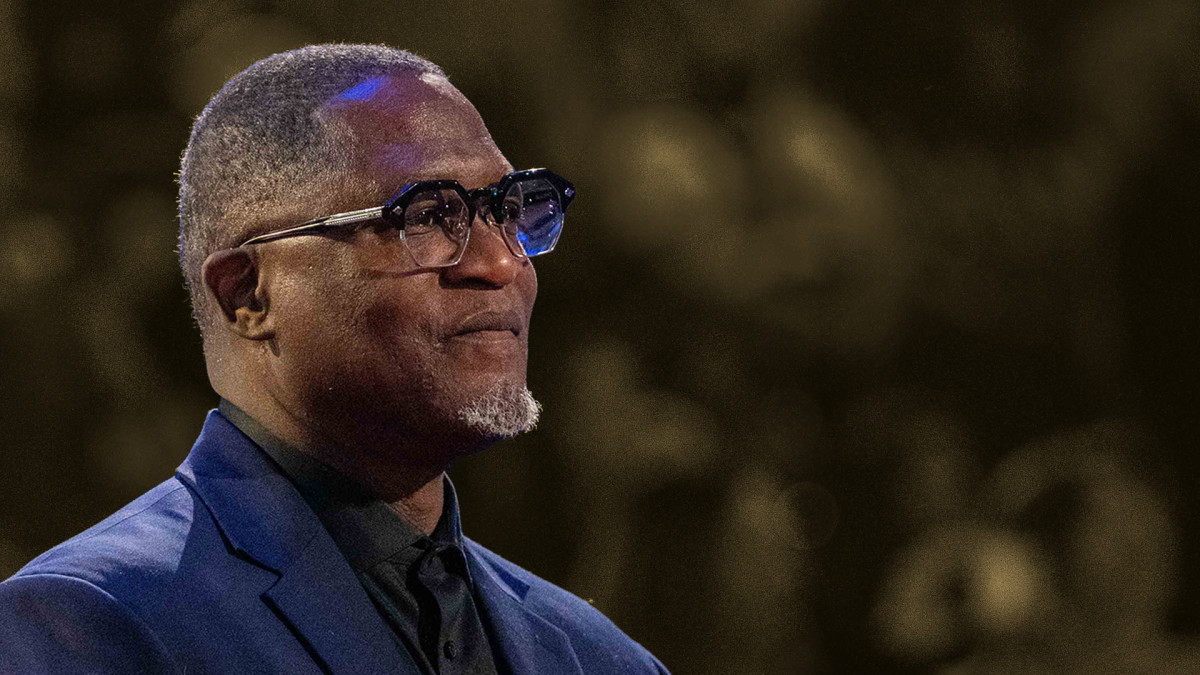
“Going to Utah, I was not happy about that at that time” – Dominique Wilkins admits he forced a trade to Atlanta after refusing to play for the Jazz originally appeared on Basketball Network.
It is hard to imagine Dominique Wilkins anywhere else but with the Atlanta Hawks, but that relationship almost never happened in a quiet and rarely told standoff behind the scenes of the 1982 NBA Draft.
Advertisement
That night, one of the league’s future icons made a personal power play that forever altered the trajectory of two franchises.
Wilkins was fresh off a stellar collegiate career at the University of Georgia, already branded “The Human Highlight Film” for the way he dominated with explosive dunks, footwork and raw scoring ability.
Scouts had him pegged as a potential No. 1 overall pick. But as the draft approached, the Los Angeles Lakers, holders of the top pick after a coin flip, opted for a different direction.
Advertisement
Changing directions
Wilkins was no stranger to the spotlight. In Georgia, he had averaged over 21 points per game during his three seasons there. He played with a flair that made him a fan favorite long before the NBA lights came calling. Yet despite the buzz around him, the Lakers, seeking a versatile forward to balance their already-stacked roster of Magic Johnson and Kareem Abdul-Jabbar, looked elsewhere.
James Worthy, the smooth forward from North Carolina, fit their mold better as a team-first, efficient player with strong fundamentals and championship experience. Wilkins, as he later revealed, understood what that meant for him.
Advertisement
“I knew if I didn’t go first, I would go third,” Wilkins said of being drafted. “And so, going to Utah, I was not happy about that at that time. I don’t know how long after that, I got traded to Atlanta.”
The Utah Jazz held the third pick, a franchise then based in Salt Lake City and only beginning to build its identity. While the selection of Wilkins made perfect basketball sense, he was easily the most explosive scorer available; it never felt like a cultural fit.
Advertisement
Wilkins was a Southern star who played his college ball in Georgia. The Jazz were still adjusting to life in Utah after relocating from New Orleans in 1979. The disconnect wasn’t only about geography or culture but about vision.
Utah was a team in flux, without a clear foundation or direction that suited Wilkins. According to him, the franchise wanted to draft him to play a different position from what he was accustomed to.
Nique had no intention of joining a franchise where he felt he wouldn’t thrive, both professionally and personally. Behind closed doors, he made it clear that playing for the Jazz wasn’t an option.
Advertisement
So the Jazz moved him. Mere months after drafting him, Utah dealt Wilkins to the Hawks in exchange for John Drew, Freeman Williams and cash considerations. The trade, which at the time drew minimal fanfare, became one of the most lopsided in league history.
Atlanta’s gamble, Utah’s loss
In Atlanta, Wilkins didn’t just fit in; he flourished. He became the face of the franchise, putting up scoring titles, nine NBA All-Star appearances and endless highlight reels that turned the Hawks into one of the NBA’s most entertaining teams of the 1980s and early ’90s. The city embraced him as a basketball player and a cultural figure, deeply tied to the identity of Atlanta sports.
Advertisement
Utah, on the other hand, would take years to find its footing. The Jazz eventually struck gold with the arrivals of John Stockton and Karl Malone later in the decade. Still, the missed opportunity to build around Wilkins lingered as a cautionary tale. What Wilkins pulled off wasn’t common for the era.
Players didn’t often wield the kind of leverage to dictate where they landed out of college. Free agency was still developing. Team control ruled the system. But Wilkins, through sheer will and quiet maneuvering, made it happen. The significance of that decision is still felt decades later.
Without it, Atlanta may never have become a relevant basketball city in the ’80s. Without it, Wilkins might have been stuck in a system that never fully let him be himself.
Advertisement
This story was originally reported by Basketball Network on Aug 2, 2025, where it first appeared.