
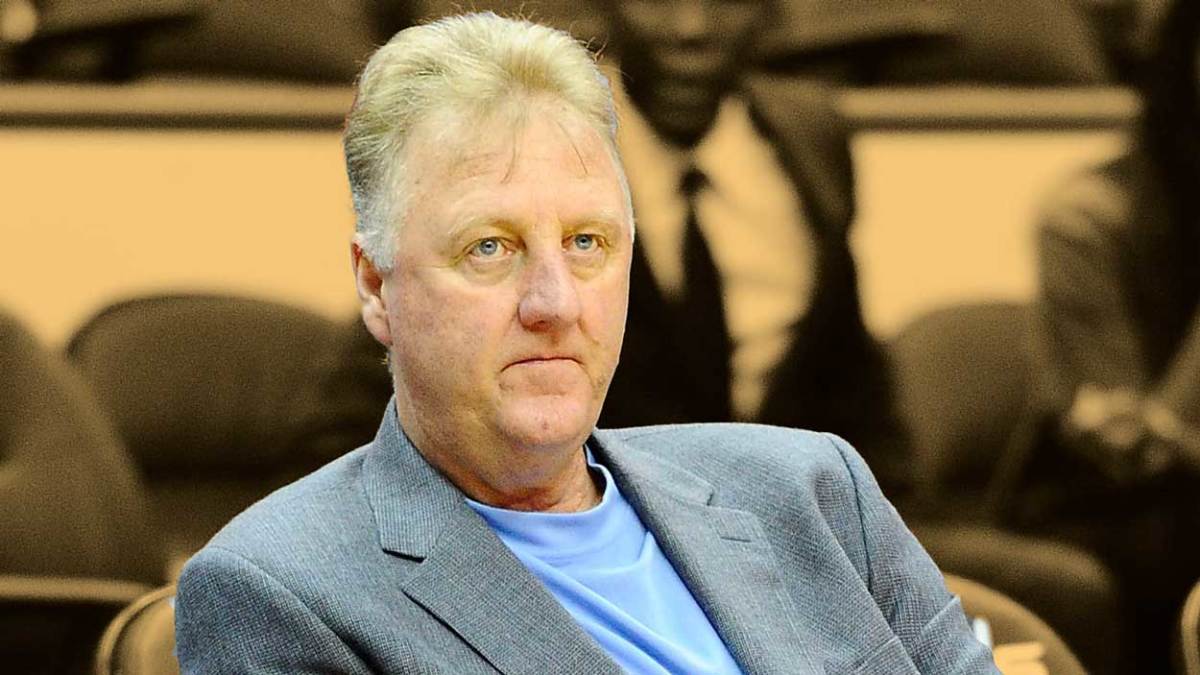
“That’s when I resigned from the Celtics. I have never looked back” – Larry Bird on why he cut off ties to the Boston Celtics originally appeared on Basketball Network.
Larry Bird wishes that his years in the Boston Celtics front office would be forgotten. For someone who had given every piece of himself to the franchise, from rookie phenom to three-time NBA champion and league MVP, it seemed natural that retirement would lead him back to the only basketball home he ever knew.
Advertisement
There was no hesitation when he accepted a front office role with the Celtics. In his eyes, it was an extension of his loyalty to the team that shaped his career and legacy.
Leaving the Celtics
Bird lasted only five years in the front office and left when he felt that his opinions and views in the front office weren’t valued or even heard. He didn’t plan on returning to Boston.
“That’s when I resigned from the Celtics. I have never looked back … It’s too bad my time with the Celtics ended that way,” Bird said. “I had some great years in Boston, and I still love it out there. I’d love to go back someday, but things have changed, and that whole organization is completely different than it was. There’s nothing for me there now.”
Advertisement
In 1992, Bird officially retired from playing, and just two years later, in 1994, he joined the Celtics front office, working alongside then-owner Paul Gaston. He was named special assistant to the Celtics’ senior management, a title that sounded important but came with the foggy reality of limited authority.
He had spent his career speaking with his game, leading by example and expecting mutual respect. In the front office, that clarity disappeared. What seemed to be collaborative decision-making on paper was, in Bird’s experience, something very different behind closed doors.
Several decisions and circumstances left him disillusioned. During his time, the Celtics went through a turbulent period. The team struggled on the court, and ideas clashed in the front office.
Advertisement
Bird, whose basketball instincts had never failed him, was routinely sidelined in discussions, and his input began to carry less and less weight. He was brought in to offer guidance, but found himself in a position where his name was on the door, yet his influence was diminished.
Bird’s lost friendship
Adding to that frustration was the situation surrounding the head coaching position. The team had fallen into a rough patch under M.L. Carr, and ownership began floating the idea of finding new leadership. Bird was asked to be part of the process of scouting for replacements and in his mind, Carr had already been made aware of the plan. But that assumption turned out to be wrong — and costly.
Advertisement
“It’s disappointing that so many relationships I had with people fell apart,” Bird said. “But I would feel a lot worse about it if I thought I had done something wrong. I’m not wrong. I’m sorry M.L. didn’t like it that he lost the coaching job, but it wasn’t my decision. And I never would have purposely kept it from him about looking for a new coach. I thought he knew.”
“And I feel bad that Dennis Johnson was frustrated,” he continued. “He, like everyone else, probably thinks I should just stop everything and tell the Pacers to hire him, but I can’t do that. I don’t believe that should end our friendship.”
Carr had been an energetic, defensive-minded former teammate and Bird had always shared mutual respect with him. But the narrative became complicated when it emerged that the coaching change had been orchestrated behind Carr’s back. Even if Bird had acted with good intentions, believing his former teammate had been informed, the damage was already done. In Carr’s eyes, it was betrayal.
Advertisement
On another front, Dennis Johnson, who was then an assistant coach and another Celtics great, had expected to be part of the conversation about the head coaching role. Bird, who was involved in listing potential candidates, did not include Johnson and also did not include him on the shortlist for an assistant coaching position with the Indiana Pacers. It created a sense of being overlooked, and Johnson’s disappointment extended to their personal relationship.
Bird would later find the professional respect he sought when he joined the Pacers in 1997 as head coach, winning Coach of the Year in his first season and leading the team to the NBA Finals in 2000. Unlike his Celtics front office experience, his time in Indiana allowed him to call the shots, earn respect on merit and work in an environment that trusted his instincts.
This story was originally reported by Basketball Network on Aug 4, 2025, where it first appeared.