
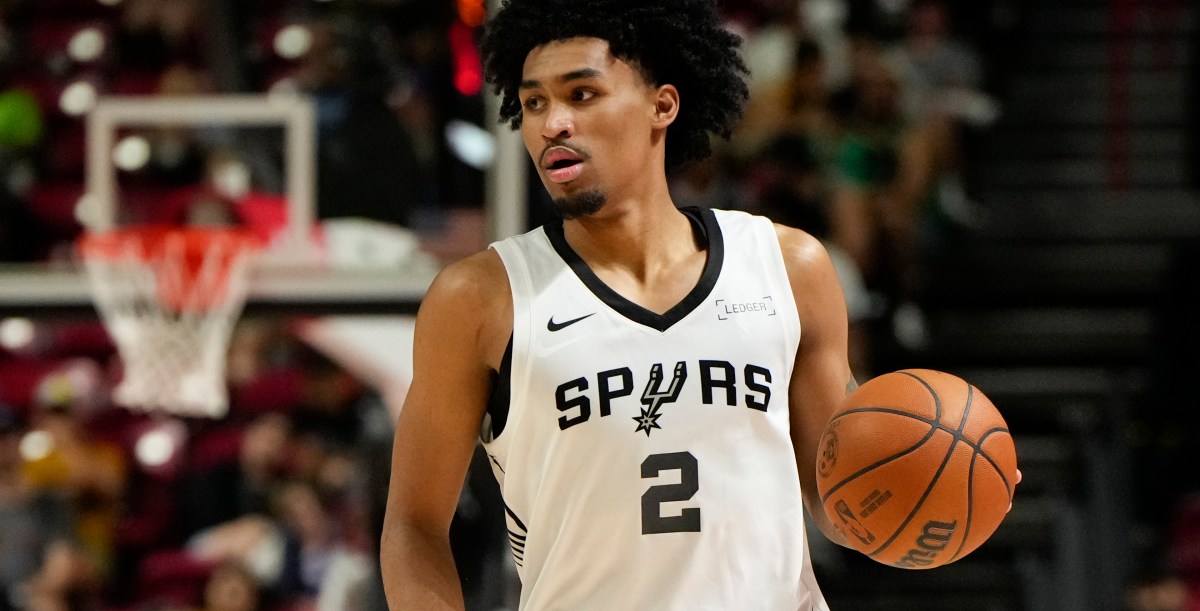
The Spurs’ two-season streak of Rookie of the Year winners could end in 2025-26, but it’s unwise to disregard a player in the summer. They could show up better than advertised, and a sad reality is that injuries happen, altering paths and award races.
FanDuel Sportsbook has Dylan Harper at the third-highest odds for the Rookie of the Year crown at +1,000. DraftKings has him second at +900, and Caesars has him fourth at +1,000. These are fair odds considering Harper will presumably be a pivotal bench piece, and the Mavericks’ top overall pick, Cooper Flagg, looks like a game-changing stud who will probably start.
But what could Harper do to be a serious challenger without starting? Don’t forget, LaMelo Ball (31) and Malcolm Brogdon (28) are the only two ROTY winners to record starts in less than half the season. The latter won because Joel Embiid hurt his left knee, missing the rest of the season after his 31st game.
The last 25 Rookie of the Year winners have averaged 33.6 minutes per game. The only ones in that span to win playing below 30 minutes were Stephon Castle (26.7), Victor Wembanyama (29.7), Ball (28.8), Brogdon (26.4) and Mike Miller (29.1).
Historically, scoring is the top measuring stick for determining a winner. Of all those who have earned it, only 14 since 1947-48 got it, averaging below 15 points per game. Castle was the last of the 14, and he took advantage of the opportunity to start when Wembanyama (blood clot) then Fox (left pinkie surgery) were ruled out for the season. Additionally, Castle averaged 30.8 minutes per game from March 14 until the last night of the year, but recorded 25.5 minutes per game from the season opener until March 12.
The competition is stiffer this year, and Harper is a great prospect but not a generational talent. He would need to average around a minimum of 30 minutes per game and not let the offense fall apart when De’Aaron Fox rests. One of the big factors that will shape his candidacy is the lineups he’s used in. Significant playing time as lead with Victor Wembanyama on the court would make his job much easier and give him a great pick-and-roll partner. In this scenario, there is no doubt he could easily have four assists per game, feeding the big man because he’s like a wide receiver, who is always open.
Another thing needed is hitting 3-pointers at an above-average clip. The more he does, the closer he will be played, allowing him to use his maneuverability to get by on a drive. Despite a below-average 3-point efficiency at Rutgers, Harper has good form on his release and shouldn’t be dared with space in drop coverage. Playing next to Luke Kornet could help him elevate in this area because of the good screening and offensive rebounding. One of the best times to pop a three is on a second look, and Kornet, was second in offensive rebounding percentage for all backup players in 2024-25 who played a minimum of 55 games.
The other skill that would need to be sharp for him to be in the race is moving off the ball well when playing next to Fox. Points will be there for him if he cuts into the space given to him when the defense helps on Fox’s dribble.
The last would be ball security. Since he plays for an up-and-coming team, he won’t have as much leeway to make mistakes. Yet, his below-par assist-to-turnover numbers (1.67) at school should improve with time, being next to dependable weapons.
The other early prospects of the field are also affected significantly because they are not expected to start. They include V.J. Edgecombe, whose opportunity could skyrocket, depending on Embiid (arthroscopic knee surgery in April) and Paul George’s (offseason arthroscopic knee surgery) health in Philadelphia and a need to fill minutes; Tre Johnson, another natural scorer for the Wizards; and Kon Knueppel, who will have plenty of usage off the bench in Charlotte as a developing do-it-all wing.
Accounting for Harper’s talent, it’s hard not to see him make one of the spots on the All-Rookie team.