
If someone had told Karl-Anthony Towns his Knicks would be up 2-0 in the playoffs on the reigning champion Celtics — the same Celtics who swept New York during the regular season — of course he would’ve believed it.
“Yeah, how would I not?” Towns said after practice at the team’s Tarrytown training facility on Friday. “We know we put the work in. We know what we have in this locker room, and we know we deserve to be in this moment.”
The Knicks return to Madison Square Garden on Saturday with a chance to take a commanding 3-0 series lead against a team that entered the second round as a heavy favorite. They’re expecting Boston to come out desperate — and sharp — determined to prove it’s not the team that’s blown back-to-back 20-point leads or missed more threes over a two-game span than any team in NBA playoff history.
“A lot more desperation, and I think they’re gonna execute at a higher level. We have to do our jobs. Control the controllables. Game plan. Offensive and defensive execution. Game-plan discipline. Those are the things we can control,” Towns continued. “We gotta do what we talk about or game plan for, and we gotta execute at a high level. They’re one of the best teams in the NBA and they’re the defending champions. So we expect nothing but their best every single night, and nothing should change.”
And yet the Knicks are treating Game 3 like it’s the start of the series — not the continuation of a surprising 2-0 lead. Because even though 86% of teams to take a 2-0 lead in the playoffs go on to advance, they’re approaching Saturday’s matchup like they’ve accomplished nothing.
“But we also know we don’t deserve any of it yet. We haven’t earned the right to capture the moment,” Towns continued. “We have to do a lot more work playing one of the best teams in the NBA, and we know we can’t relax at any point.”
The Knicks know they can’t keep giving up ground on the glass.
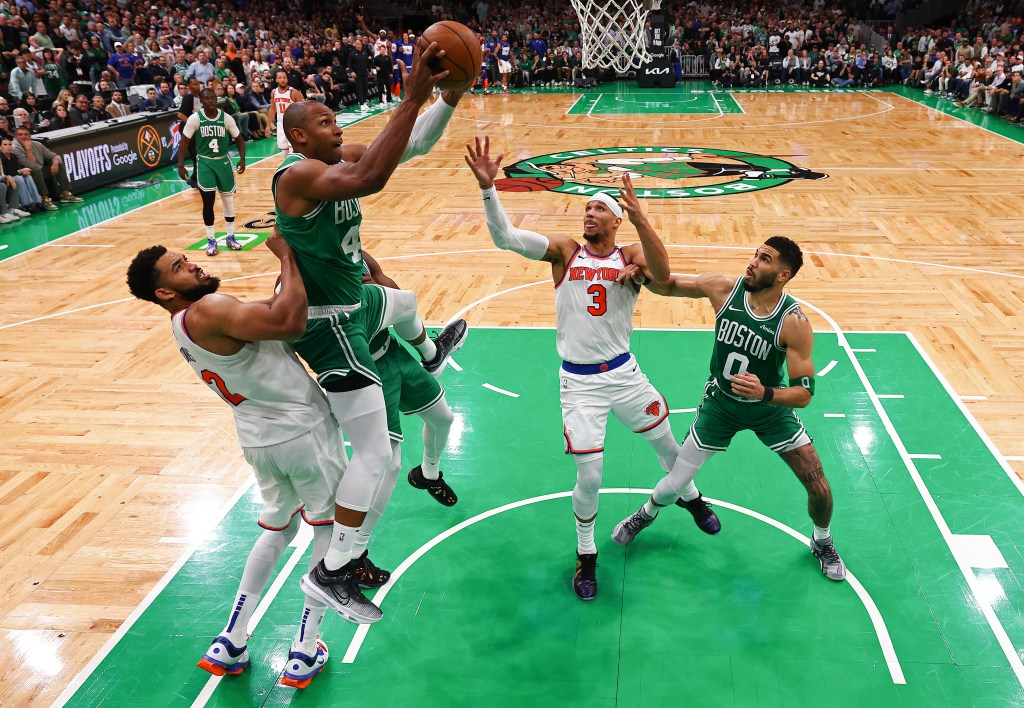
New York lost the rebounding battle 51-46 in Game 2, and 59-49 in Game 1. The Celtics have dominated the offensive glass, grabbing 35 offensive boards to New York’s 22 and converting those into 47 second-chance points — 13 more than the Knicks — through two games.
Jalen Brunson said Boston’s rebounding edge is a product of its volume from three. The Celtics have attempted 100 threes across the first two games — and even though they’ve made only 25%, all those long misses lead to long rebounds.
“I feel like they’ve been getting to the offensive boards quick, and so we are aware of that, but it’s a different thing in-game when in-game they are taking a lot of long shots and [get] a lot of long rebounds,” Brunson said after Friday’s practice. “The natural thing to do is to go in around the restricted area, but with long shots we have to not be as far in the restricted area.”
Towns said beating Boston on the glass isn’t about schemes — it’s about repetition, discipline, and execution over a full 48 minutes.
“Doing those things that can become monotonous, just finding a body and boxing-out, something that we have to be willing to do for 48 minutes if we want to put ourselves in position to win against a team like this,” he said. “I think that we’ve watched the film, we’ve seen our mistakes and we’re just trying to clean it up as much as possible so we can be a better version of ourselves than we were in the first two games.”
The Knicks believe Boston’s offensive rebounds have fueled their biggest runs — the kind that open games wide or erase leads in a flash. New York may be comfortable clawing back from double-digit deficits, but that doesn’t mean it’s part of the plan.
“Just making sure we are coming out ready from the jump. Limit their runs and make sure we are not having long lapses,” Brunson said. “There will be times in a game when they go on a run, but you have to snap out of it quickly. Focus on our defense and rebounding and making sure that we are running. Just focusing on each other.”
Tom Thibodeau said Boston’s five-out offense makes rebounding even harder — because with shooters in every spot, the floor is wide open and assignments become tougher to track.
“I think they’ve always been real good at reacting to the ball. They’re quick to the ball, so you have to anticipate,” Thibodeau said. “Because of the five-out [spacing] you have to make sure you’re getting to bodies. If they get a running start, their smalls are great rebounders.”
Boston’s spacing and firepower make every mistake costly — but so far, the Knicks have responded every time the Celtics take their foot off the gas.
“I think the way they’re built they can go on runs. Obviously we prefer not to do that,” Thibodeau said. “We also understand that it’s a 48 minute game and you’ve got to fight to win every possession. And I think that’s important to understand, it’s play after play. Sometimes if you fall short, the next one you’ve got to come back and do better. Just have the mentality of you’re going to keep going forward.”
Towns is hoping the version of the Knicks that shows up late in games — aggressive, locked in, relentless — can arrive a little earlier.
The Knicks won the second half and overtime of Game 1, 63-44. In Game 2, they lost the third quarter 23-20 before outscoring Boston 30-17 in the fourth.
“The way we’ve been playing in second halves, just kind of executing at an even higher level than those,” said Towns. “You’re playing a defending champion. You know you’re playing one of the best teams in the NBA, so you know you’ve gotta bring your A-game. We just had a good two days, recalibrate, watch some film, get some practices in, so hope we can bring that kind of basketball team that’s in the second half that’s been playing.”
The Knicks have taken two. But they’re not counting. Because to take this series, they know they’ll need to play 48 minutes at a time — starting with the first. And if they keep the Celtics off the glass, they might finally be able to avoid the games of catch-up they’ve had to overcome to start the series.