
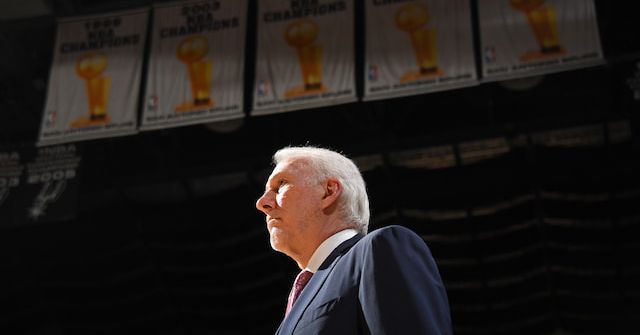
Gregg Popovich officially retired as head coach of the San Antonio Spurs last Friday, but I have a serious knack for being unavailable when big news hits. I was traveling from Houston to San Antonio on Friday morning when J.R. Wilco texted me the big news. I told him I couldn’t get it at that moment because I was driving, but I was prepared to make a pit stop in the next tiny town of Waelder, TX if needed. Fortunately, the always reliable Jacob Douglas came to the rescue.
After an extremely busy weekend (and after getting to watch his press conference on Monday), this is the first chance I’ve had to truly ponder the meaning of this massive news. It’s historical. It’s emotional. It’s both team and league-altering, and it’s something we all probably knew was coming but would never be ready to accept when it actually happened. We’ve already had plenty of excellent pieces on this topic, so be sure to go check them out, but after covering the team for nine seasons now, I couldn’t let such a monumental moment in basketball history slide without giving Coach Pop my own proper sendoff.
While I have been a Spurs fan my entire life and grew up idolizing David Robinson, I only started watching them religiously at the start of the Tim Duncan era because that happened to coincide with my mom allowing it (after we got our homework done, of course). This was just a year after Pop fired Bob Hill, took the head coaching job for himself, and “tanked” for Duncan.
After a record-setting regular season turnaround, they once again fell to Karl Malone and the Utah Jazz in the second round of the 1998 Playoffs. (I remember hoping they’d get some revenge after Malone knocked the Admiral out cold a few weeks prior, but alas.) Then, Pop’s job was in serious jeopardy to start the lockout-shortened 1999 season, when a team with championship aspirations was out to a 6-8 start. Pop’s players loved him but knew he was probably one loss away from losing his job, so they had a team meeting and came out determined to win their next game in Houston. They did, and as we all know, the rest is history.
“If we don’t win tonight in Houston and turn this thing around, Gregg Popovich has probably coached his last game.”@adaniels33 on how a Spurs team meeting in 1999 may have saved Gregg Popovich’s job.
Hear Antonio Daniels with @WorldWideWob weekdays from 1-4pm ET on NBA Radio! pic.twitter.com/Go7T5LO4u1
— SiriusXM NBA Radio (@SiriusXMNBA) May 2, 2025
That being said, I didn’t know much about Pop at the time. The internet was still very young, and search engines were just becoming a thing. All I knew was my grandmother, who was a passionate Spurs fan, hated Pop, thought he was jerk and snake in the grass, and didn’t think he could lead the team to the promised land. She wasn’t the only one who thought that way, but fortunately, he and everyone else proved her wrong in 1999, and her wish of seeing her beloved team win a championship was fulfilled a year before she passed.
As time went on, the Spurs kept winning and rebuilding through unconventional means, such as using the then-untapped European market, late first/early second round picks, and castoffs from other teams to build one of the strongest supporting casts in the NBA. With three more championships in 2003, 2005 and 2007, Pop had more than gained the respect of the San Antonio and NBA communities, and the Spurs’ status as a dynasty was cemented, but doubters still had their nit picks.
“The Spurs can’t repeat. Pop got lucky. He was handed a good team. No one’s watching,” and so on were the common posts in message boards and comments sections. Even professionals who shouldn’t be haters (at least publicly), like Phil Jackson and former NBA Commissioner David Stern, would express their distaste for the “boring” Spurs who didn’t bring as many viewers to the Finals as the big market teams.
Even so, winning is winning, and it was only after the championships stopped coming with relative ease would Pop face his toughest and perhaps most rewarding challenge yet. With a tough (by Spurs standards) stretch from 2009-2011, they continued to win their requisite 50 games but couldn’t get out of the first two rounds of the playoffs, even losing as the top seed to the 8th seeded Grizzlies in 2011 while Manu Ginobili played with a broken elbow. It was becoming clear that Tim Duncan’s knee issues were catching up to him, and Pop knew it was time to shake things up.
Defense might still win championships, but offense was on the rise, and teams still needed to score enough to get there. That’s when Pop made one of the biggest adjustments to the game in modern basketball history. He moved away from the post-up heavy, outside-in game centered around Duncan, added more unselfish ball movement, and The Beautiful Game was born. Even though it featured more of the shot Pop despised the most — the three-pointer — it was unstoppable for opposing defenses.
The one other thing the Spurs were missing was the defensive wing stopper they had in Bruce Bowen during their three-in-five-years championship run, and they found him in a non-Spursian way. Breaking their mold of typically keeping or stashing their own late draft picks, they traded up for Kawhi Leonard at 15th overall even though it meant giving away one of Pop’s all-time favorite players, George Hill. All these changes showed that even an old curmudgeon like Pop was willing to make adjustments to win, and it all came together for their most magical championship of all in 2014, which had Pop showing rare signs of emotion with tears of joy.
That final championship would end up being the peak of Pop’s career. He had seemingly done the impossible, which was build a second dynasty centered around Kawhi to succeed the Big Three of Duncan, Ginobili and Tony Parker with nary a blip, but Leonard decided he wanted to play in his hometown of Los Angeles. He and his uncle tarnished the Spurs’ reputation so he could justify demanding a trade from not just what was considered the greatest organization in sports, but also a team that was already built to contend. (And yes, with all that we knew then and all we have seen since, I stand by that narrative.)
There were still some highs in those trying times, such as Pop becoming the winningest coach of all time…
… but after a few years in the no-man’s land as a play-in level team that lacked upside, the Spurs realized the only way to climb back up the mountain was to get a new franchise player, and they did it the same way they had before: tank in the right season and pray to the lottery gods. That required trading away their best players, including draft-day steals/classic Spurs underdog stories Dejounte Murray and Derrick White, but it paid off. For the third time in franchise history, the Spurs struck gold with a potential all-time great big man in Victor Wembanyama.
Pop had always said he would not pass a losing team on to a new coach, and would see them through the rebuild, but now he had a new reason to stick around. He felt revitalized by coaching young players and helping them grow not just on the court, but also in life: one of his greatest attributes. Despite getting plenty of criticism for “experimenting” too much during Wemby’s rookie season, it again paid off with a second straight big draft get in Stephon Castle, and after signing veterans Chris Paul and Harrison Barnes, the Spurs seemed ready to take the next step this season.
Unfortunately, Pop did not get to be a part of it. After just five games, it was reported that he had suffered a health issue prior to the game November 2, and it would later be revealed that it was a stroke — a serious issue no matter how “minor”. He would not return for the remainder of the season. Mitch Johnson acted as his interim before Pop finally announced last week that he just didn’t feel he could recover enough for the taxing grind of being a head coach and passed the torch to his protege while maintaining his title of President of Basketball Operations.
Of course, the Hall of Fame coach — who was known for his crass attitude in public but is actually one of the kindest, funniest personalities in the league — had one last joke up his sleeve, revealing himself as “El Jefe” (or the boss) in his first public appearance in six months.
Seeing Pop for the first time in six months was a relief but also sobering, as it revealed his true condition. At the same time, it was an amazing reminder of who he is as a person. He was flanked by Ginobili and Duncan, who he said had been by his side at every rehab workout (while also joking they they were out for revenge for all the years he yelled at them), which was a reminder of the father figure he has been to all his players and staff. Johnson reaffirmed this moments later as he was introduced as the new head coach, and despite the complications several player health issues brought in Pop’s final official season as head coach, it appears safe to say he succeeded in his goal of creating what should be a winning team with a franchise player and plenty of potential upside for his successor.
There never has and never will be another Gregg Popovich. His military background combined with an underdog mentality from his younger playing/coaching days make him his own unique person. He’s beloved by all he has worked with, and while someone else will officially be roaming the sidelines for the first time in 28 years, the culture and legacy he built will continue to live on while he operates the franchise from an office. This isn’t the end of Pop and the Spurs, it’s merely the start of a new era.
Thank you for everything, Pop. The Spurs and city of San Antonio wouldn’t be the same without you.