
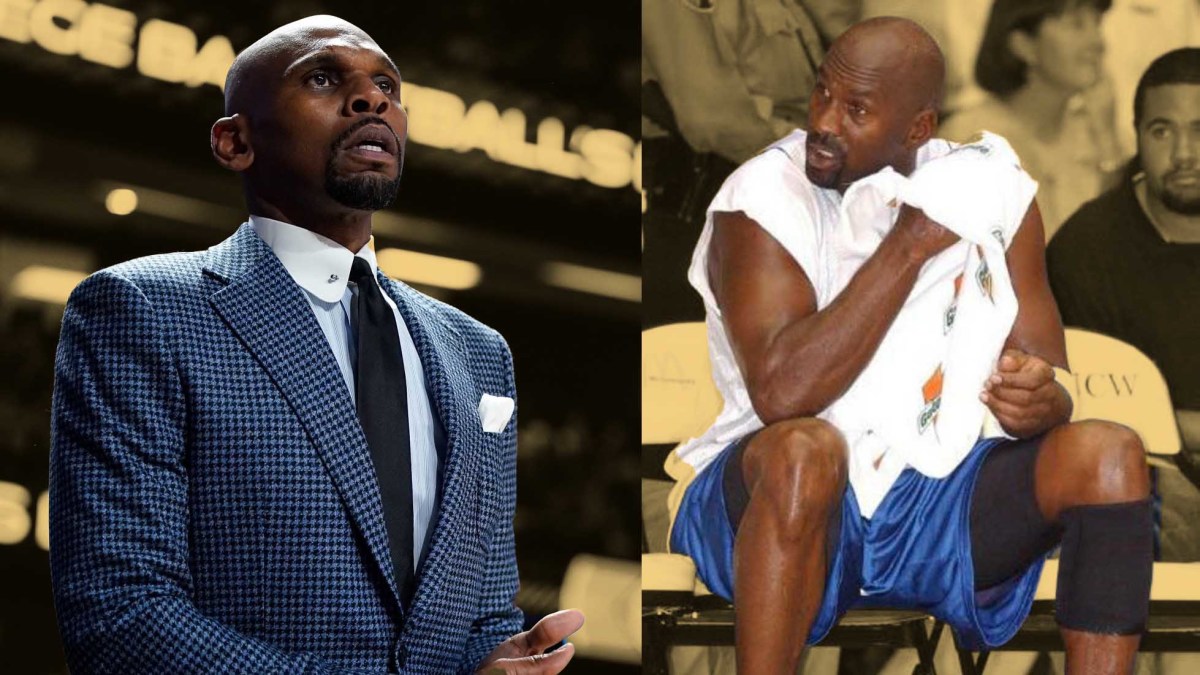
“The reverence I had for him, I lost a little bit of it” – Jerry Stackhouse admits he lost some respect for Michael Jordan when playing with him in Washington originally appeared on Basketball Network.
There are few opportunities in sports that are more surreal than sharing a locker room with one’s childhood hero.
Advertisement
For Jerry Stackhouse, that moment arrived in the summer of 2002, when the Detroit Pistons traded him to the Washington Wizards in exchange for Richard Hamilton.
At that point, Stackhouse was coming off a monstrous scoring run, having averaged over 29 points per game just two seasons earlier and carrying himself with the confidence of a man who knew he belonged among the NBA’s elite.
Playing with Jordan
The destination might not have been ideal — Washington wasn’t exactly a franchise known for momentum, but the prospect of suiting up alongside his boyhood hero, Michael Jordan, added a sense of anticipation rarely attached to Wizards transactions.
Advertisement
But what Stackhouse encountered wasn’t what he had envisioned. The season turned into a difficult, disillusioning experience, one that altered his perception of the man he had once revered.
“It just kind of spiraled in a way that I didn’t enjoy that season at all,” Stackhouse said. “The kind of picture I had in my mind of Michael Jordan and the reverence I had for him, I lost a little bit of it during the course of that year.”
Stackhouse grew up with Jordan’s posters on his bedroom wall, memorizing his moves, his walk, even the way he carried himself in interviews. They shared the bond of North Carolina and were cut from the same cloth.
Advertisement
So when the day came to stand on the same floor with him — even at 39, even after two retirements — it felt surreal. Jordan still had that presence that made the whole gym lean toward him. His competitive fire still flickered in every possession, his voice still carried the room.
The Wizards had imagined Stackhouse as the centerpiece. He was young and hitting his prime, with the energy and legs to lead them into a new era. But once the season began, the offense naturally flowed back to Jordan.
After three years away, he still commanded the ball, controlled the tempo and certainly demanded the spotlight like it was owed to him.
Advertisement
Stackhouse, who’d grown used to being the first option in Detroit, was learning how to fit alongside a legend, still sharp in flashes but no longer the same player from those posters.
There were moments when it worked beautifully, but the rhythm between them always felt a little uneasy.
Tough dynamic
Washington finished that 2002–03 season with a record of 37-45, missing the playoffs again. Jordan, in his final season, averaged 20 points per game, which was all-world for a 40-year-old at the time, but Stackhouse struggled with the inconsistent flow of the offense.
Advertisement
The hierarchy was confusing. The team lacked cohesion. What was supposed to be a transformative season turned into one of quiet frustration.
“It was really challenging to be able to be in a situation with an idol who at this particular point, I felt like I was a better player,” Stackhouse said.
Stackhouse wasn’t trying to replace Jordan’s legacy, but he had entered that season as a top-tier scorer, and it was difficult to defer to a version of a legend that no longer matched the one in his memory. The childhood fan in him clashed with the professional competitor he had become.
Advertisement
This wasn’t the first time the Wizards had wrestled with conflicting identities under Jordan’s influence. The year before Stackhouse arrived, Hamilton had quietly voiced frustrations about his role in Washington’s Jordan-led offense.
Years later, the team would still be picking up the pieces from an era where nostalgia and ambition had been in constant tension.
For Stackhouse, the Wizards chapter was just one stop in a long and evolving career. That season in Washington didn’t ruin his respect for Jordan entirely, but it added a new layer to it and a realness that only comes from seeing the full picture.
Advertisement
This story was originally reported by Basketball Network on Aug 10, 2025, where it first appeared.