
Size has turned into a vague buzzword among basketball parlances. Is the focus height? Length? How much space you take up? In reality, it’s a catchall for many attributes on the court.
In the past, bigger players dominated by using their high release and post moves to score inside over smaller post defenders. Defensively, length and vertical range helps defend by altering or all together deterring shots. In today’s game, bigger stretch bigs can use their advantages to shoot over smaller ones from range.
While small ball has been a more and more common tactic to stack as much skill and range as possible in the modern game, teams can still zag and counter with old school methods.
It’s not out of line to suggest the Hawks have too often struggled with finding sizeable players to insulate their start player, the 6-foot-1, 162-pound (per Basketball-Reference) Trae Young. The return of Jalen Johnson from injury should help, as well as the emergence of Mouhamed Gueye down the stretch of last season and the drafting of Asa Newell this summer. But the one player who helps the most in that regard is obvious.
Kristaps Porzingis took the league by storm after being drafted fourth overall in 2015 from a lesser-known Spanish professional club. His combination of 7-foot-2 height in shoes, 7-foot-6 wingspan (per Chad Ford), and fluidity soon earned him the moniker “The Unicorn.”
While he’s had a largely productive decade in the NBA, injuries have muted the promise of a revolutionary player archetype. The price to acquire Kristaps Porzingis this offseason was staggeringly low — once you factored in the motivation to get Terance Mann’s and Georges Niang’s money off the books — essentially just a first-round pick with a future second-round pick coming back from Boston for his expiring contact.
So, what does he bring to this team? Well, Onsi Saleh addressed that very question in a July public media appearance prior to Summer League, saying, “[Porzingis], just so unique in what he does. Every team looks for a center like that at some point. He’s dynamic. He can stretch the floor and rim protect.”
He later remarked, “I just think Kristaps’ archetype is so unique in this league. We’re very confident with our performance staff and very confident with him and his health. We don’t have any worries or issues there. I just think from a player standpoint, he is very, very dynamic and offers something that Atlanta really hasn’t seen before.”
Porzingis handles the ball less frequently than he did in his early days in New York and Dallas, at least as far as driving and initiating. His main focus is in spot up shooting and creating post up mismatches — something that’s largely a relic of the past.
You can see his unassisted (or in other words self-created) field goals made dip when teamed up with Luka Doncic and later in Boston with Jayson Tatum and company. His shot diet should be similar when playing with the mega creator Trae Young at point.
Porzingis led the league this past season in post up scoring efficiency, registering 1.19 points per possession (PPP) in 149 possessions among players with at least 50 post up scoring attempts. He was even better in 2023-24 when he registered an eye-watering 1.30 PPP in 185 possessions out of post ups even with a possession cutoff of 25. The Celtics’ volume three-point shooting paired well with him to operating out of the post, and so it would behoove Atlanta to do their best to emulate the same spacing for him this season.
Outside of the end of last season, when Onyeka Okongwu claimed the starting center spot and continued to stretch the floor with his shooting, the last time Young played serious minutes with a reliable pick-and-pop threat was way back in 2019-20 with journeyman Dewayne Dedmon. The effect on the team’s overall spacing with ‘KP’ will be absolutely vital, especially in postseason situations when the Hawks’ offense has tended to crater post-2021 playoff run.
Year in and year out, Trae Young leads a fast-paced offense, and having a center who can hit trail threes in transition always adds another threat to the fastbreak arsenal:
In the halfcourt game, Porzingis’ ability to seal mismatches in post ups and rise and fire is just something that virtually can’t be stopped:
He has a variety of ways of creating more space in these situations, like pivoting to face up and use his long arms to subtle push defenders back:
One he’s established how big a mismatch he in these situations, teams are almost obligated to send help his direction. But ‘KP’ has become a better and better post passer from double and triple teams over the years, often quickly finding open three-point shooters or cutters when the chances present themselves:
Defensively, while Porzingis showed incredible range and agility in his 20s, he has slowed down a bit and will be best utilized as a traditional drop big near the basket. Incumbent Onyeka Okongwu has strong defensive instincts and a higher level of switch-ability than the majority of centers, but his frame does limit him in terms of rim protection and rim deterrence.
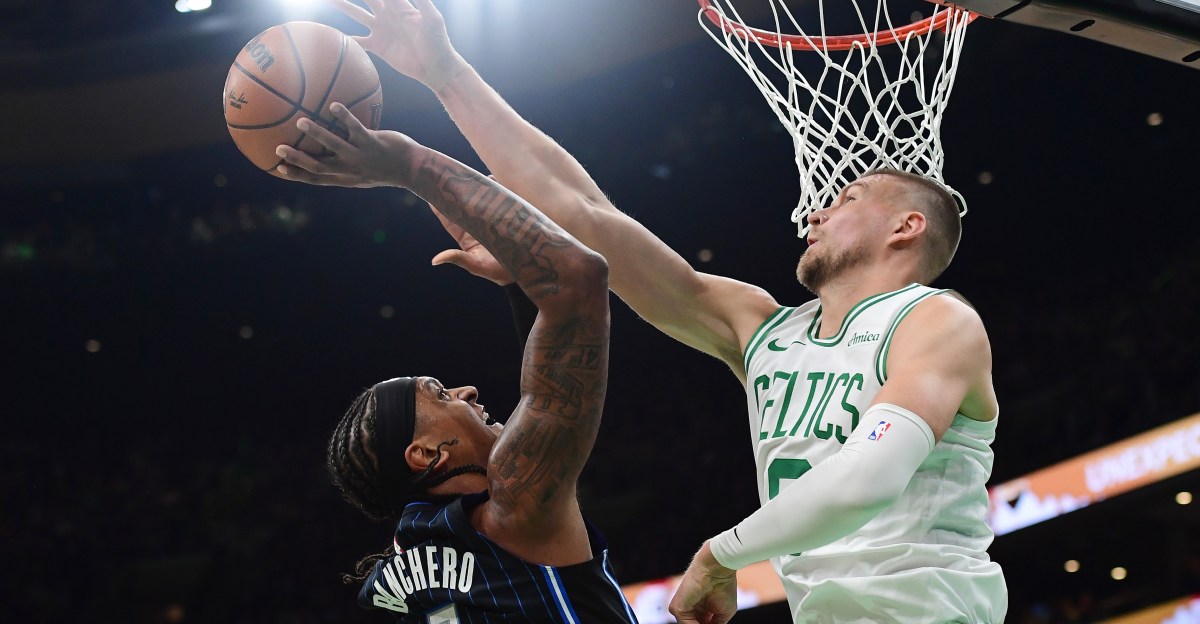
Porzingis is still an elite shot block artist on a per minute and per possession basis despite his availability issues. He’s averaged 3.0 blocks per 100 possessions and topped a 4.8% block rate (or blocks as a rate of two-point shots faced) the past two season. Both marks in both seasons would have placed him in the top 10 in the NBA had he qualified for having enough minutes.
As a pure drop big, he can shut off the path to the rim as the last line of defense with the upper echelon of rim protectors in the league:
And here, you can see his still has the mobility to trail most bigs handling the ball from the top of the key:
You can still blend in some hard hedging or momentary double teams to get the ball out of the hands or more dangerous ball handlers. And Porzingis’ mix of awareness and recovery speed can still help him close down space fast:
A Young-led offense is still going to feature a large load of pick-and-rolls as well, but Quin Snyder has worked in a lot of off ball movement as well. Porzingis is still a threat to finish around the rim with his huge catch radius, but having a skilled stretch-big opens up absolutely everything else on the court.
Just imagine Dyson Daniels or Zaccharie Risacher making timely cuts into space without a teammate standing in the dunk spot. Or Young being able to turn the corner with the opposing center pulled away from the rim.
Add to that the ability to mix and match on defense with a host of 6-foot-8 or taller defenders who can switch and scramble to cover for the smaller players among them.
There’s no guarantee Porzingis will stay healthy enough to provide this impact night in and night out, but he is a player that can raise Atlanta’s ceiling on both ends when he’s on the court. There’s an argument that he does this the best out of any player that switched teams this offseason — an offseason that also saw Kevin Durant move to Houston.
While it’s unlikely that Porzingis has an All-Star worthy campaign like Durant is probable to have, this move could bring new wrinkles to Hawks basketball. And with the path in the Eastern Conference as open as ever, who knows what heights Porzingis and the Hawks can hit.