
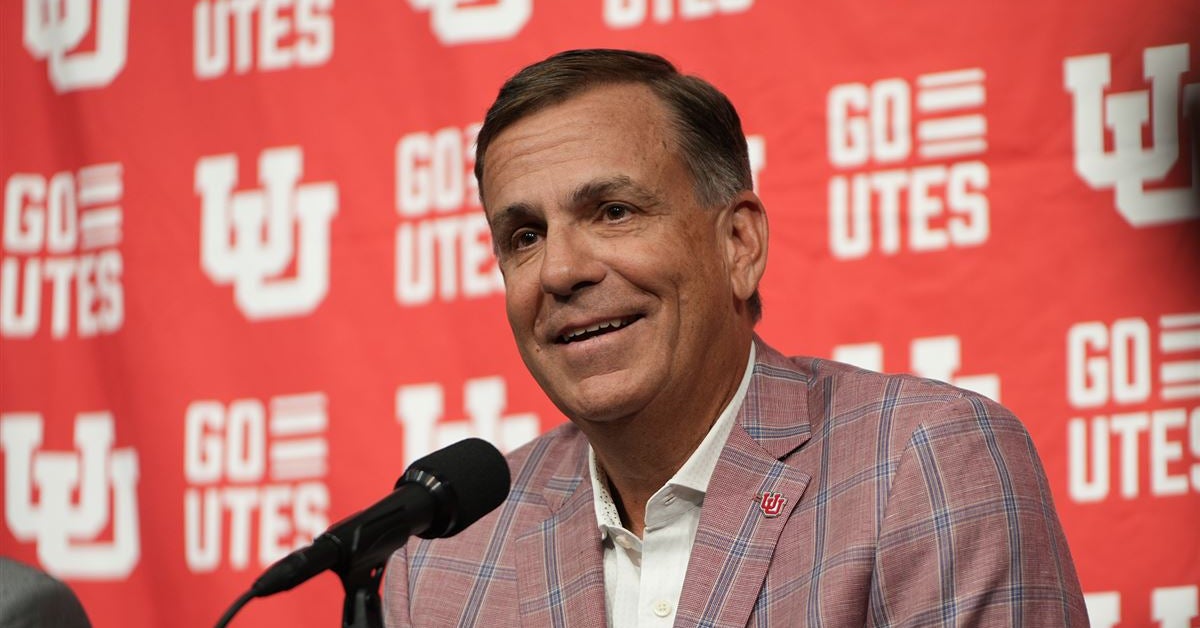
On Saturday, Utah Athletics Director Mark Harlan hosted a town hall connected to this year’s Fan Fest event. Harlan and Jason Greco, who is the Executive Senior Associate Athletics Director for Governance and Brand Strategy, took questions from the community regarding where Utah stands in the new world of revenue sharing. In total, Harlan and Greco spoke both with the public and separately with the media for over an hour about this topic.
WHAT DID THE SETTLEMENTS SAY?
College athletics entered a whole new world on July 1 of this year, as schools are now allowed to share up to $20.5 million with their student athletes across all their programs. But that isn’t the only lawsuit that was settled regarding NIL and revenue sharing. Harlan spoke about the other lawsuit the NCAA was involved in, which requires member institutions to pay $2.9 billion in punitive damages over the next decade. For Utah, they will be paying around $850,000 a year for the next 10 years, according to Harlan.
“That will come out of less distribution from the NCAA basketball tournament. For those of you who don’t know, 98% of the operating revenue of the NCAA comes from that three-week period in March. So that will be less going forward for 10 years,” Harlan said.
But the big talking point was revenue sharing, which has been seen as a way to level the playing field in the NIL world.
“University of Utah being in the power four conference, and knowing that our goal is to graduate students and win championships, and as such, we knew that something like this was coming a few years ago, and we decided then, with the Board of Trustees and our incredible president, Taylor Randall, that we were going to be all in on this settlement at the full amount,” Harlan said.
Harlan added that the amount of money each athletic department is allowed to distribute will go up by 4% each year for the 10 years of the settlement.
WHO IS REGULATING REVENUE SHARING?
The College Sports Commission is the governing body over revenue sharing and is being overseen by Bryan Seeley, a former lead investigator for the MLB. With this new commission, there is a hope that the process becomes more streamlined than with the NCAA.
“This process probably is more aligned to that pro sports model where Bryan is the CEO, and at the end of the day, there’s still going to be an appellate area that you can navigate. But it goes to him, and 45 days from the violation, a decision has to be made, and then whatever he says is basically quasi-final. So it’s almost like that Commissioner type role that’s a lot different from the model that we’ve been in the past,” Greco said.
Violations could include going over the cap, student athletes not submitting their deal to NIL Go, institutional complicity, and more.
Harlan says that the CSC is still working on the full list of punishments, but they could include student athletes missing games, coaches serving suspensions, and possibly athletic director suspensions for up to six months.
WHERE DOES THE MONEY COME FROM?
This money is coming from multiple sources, according to Harlan. Donors and corporate sponsors are two of the bigger areas where the money will be coming from. Harlan said it is also an added benefit that University President Taylor Randall is the former Dean of the Eccles Business School, as he ‘loves this stuff.’
“We’re also looking at our costs. What things can we do differently? We’ve certainly taken some measures to break down our costs. But, you know, we also spend almost $20 million on the university. We pay for our own scholarships, we do all that stuff. So we’re working with the university. So what things can we look at? We rent the stadium, for example, like we had to rent the room tonight. It’s just the system. I’m not complaining. Is that really the smartest path going forward?” Harlan said.
But the bottom line is, Harlan says, they will do everything they can to not price the everyday fan out of getting tickets to see the Utes play.
“There’s a number that we can hit out there in ticket sales that will, we will see people stop renewing at the level. We’re very, very well aware of that, so we have to be very cautious as we proceed with that,” he said.
WHAT IS NIL-GO AND HOW DOES IT WORK?
While revenue sharing is going to be one of the primary areas where student athletes can earn money this year, they are still allowed to seek out third-party NIL deals. While it used to be the wild west with those deals, NIL Go is now in place to make sure that the deals being signed are appropriate and at market value.
“It has the range of compensation that we’ve all heard, so every deal that gets submitted gets valued off that range of compensation. That’s a moving target, because I’ll say this at a higher level, there’s about 30 different variables, but the better our teams do, the better our visibility is, the higher that range of compensation for those teams and those student athletes will go,” Greco said.
He then went on to say that there are currently 45 deals for Utah student-athletes, and a few are still in the approval process.
Utah has a program called Elevate U, which is helping student-athletes in this new world of college sports. The program’s focus is to ‘enhance education on how student athletes develop their brand, and use the university’s network to help find deals.
UTAH HAS SIGNED SELECT STUDENT ATHLETES TO MULTIYEAR DEALS
Without saying names or programs, Harlan did reveal that Utah has signed ‘some’ athletes to multi-year deals with the university to try to limit the constant transferring in the department.
“There’s language in these contracts that talks about possible loss of value if they leave. We’re just all going to play it out, and then how harsh is Jason going to tell me to be to really, I might love the kid, right? And I don’t want to hold kids back. I’m not in the business for that. So it’s we’re just going to have to kind of figure it out as we go,” Harlan said. “We just thought, hey, we can. We were told in the settlement that we could do a multi-year. So we tried it out. Some are absolutely not, but some might wish that they did. You just don’t know, but I think we’ll learn a lot over the next couple of years.”
He did add that with the possibility of transfer rules being changed again with the SCORE Act, there might be more momentum with multi-year deals.
“If we get back to a system where you can only transfer once, I mean, why wouldn’t you want a multi-year revenue contract. But as long as the portal is open, kids are going to get sometimes that’s good advice, sometimes that’s bad advice, but we’re very open, and we will be very flexible to do what’s best for the Utes going forward,” Harlan said.
WHICH UTAH PROGRAMS WILL BE RECEIVING THE MOST REV-SHARE?
Utah football and men’s basketball will be the two biggest benefactors of rev-share this year, but Harlan also mentioned women’s basketball, gymnastics, and even baseball as programs that will benefit from it as well. In total, Utah added 24 new scholarships across all sports for this year.
“I’m very, very happy from a competitive standpoint in what I’m hearing where our women’s basketball program is in particular. Our gymnastics program, in particular, I’m very excited about that. I’m also excited that we’ve added scholarships for baseball, particularly with the opening of our new stadium coming up here shortly,” Harlan said. “I’m very, very excited where we are. I think Charmelle [Green] and her team, and Jason included, spent a lot of time on this, on how we divide things up. And feel like we ended a really good spot for this year.”
Harlan revealed in a media-only session after the town hall that the Utah football program had about $8 million in NIL deals last season. He then went on to say that Utah has ‘significantly increased’ that number for the 2025 season.
“There’s not a team that doesn’t have more this year,” Harlan said.
Harlan did say that while this model is still in its infancy and the amount distributed to each team might change from year to year, the football program has already seen some benefits from this new model.
“We’ve already seen some of that impact,” Harlan said. “This year in recruits that maybe would have gone somewhere else if they felt like the price was higher. So far so good, as we’ve kind of moved to a more equal cap, particularly within the Big 12.”
Not a subscriber? Sign up now to get access to everything UteZone has to offer, including daily content from the largest staff covering Utah athletics and access to the largest and most active community of Ute fans on the Web. Don’t forget to sign up for our UteZone Newsletter. It’s free and a great way to get daily updates on Utah football, basketball, and more delivered straight to your inbox. Like us on Facebook. Follow us on X.