
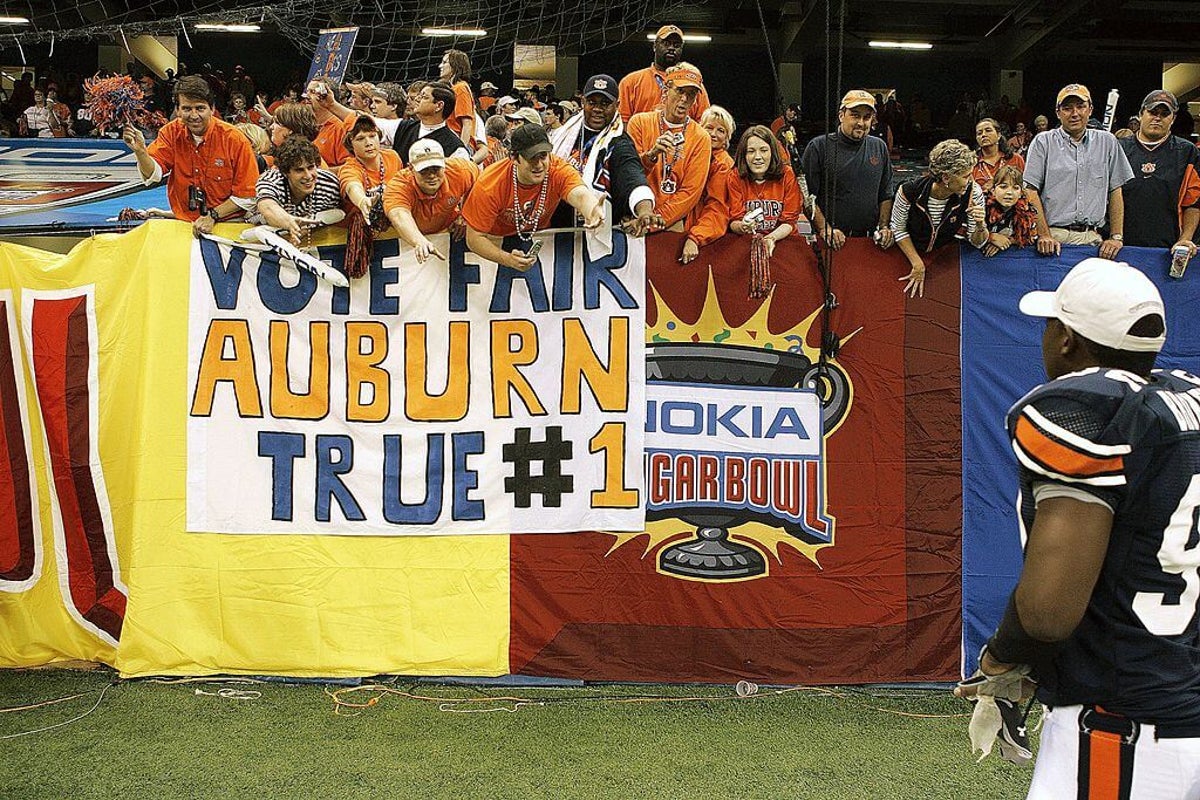
Not so long ago, in a land not so far away, what sounds like a fairy tale was reality.
An SEC team won every game it played. It beat four top 15 teams. Only two wins came by single digits.
The BCS computers said, “Thanks, but no thanks,” and tapped undefeated USC and Oklahoma teams to play for the national title.
That was 2004. Two decades later, Auburn is — why now? who knows! — rewriting history.
Tuesday, it announced plans to recognize that 2004 team as a national champion, one of seven new titles the program will now commemorate. With one decision, it also added national championships 1910, 1913, 1914, 1958, 1983 and 1993, taking it from two to nine all time.
It might be absurd. But I say let Auburn cook.
College football has never made sense. It’s never been fair that a team can win every game on its schedule and not get to compete for a national title on the field.
It’s infuriating. It’s unlike other sports. It’ll likely never happen again after the College Football Playoff expanded from four teams to 12, a new world from the two-team BCS National Championship Game that locked out Auburn 21 years ago.
Auburn’s decision Tuesday harkens back to a bygone era of the sport, where national championships could routinely be claimed and disputed. Ironically, in 2017, Auburn failed to end UCF’s undefeated season in the Peach Bowl, which gave the Knights the impetus to controversially hang “2017 National Champions” signage in the Bounce House after the season.
Auburn, welcome to the club.
“For too long, Auburn has chosen a humble approach to our program’s storied history — choosing to only recognize Associated Press National Championships,” athletic director John Cohen said. “Starting this fall, we have made the decision to honor the accomplishments of our deserving student-athletes, coaches, and teams from Auburn’s proud history.”
The 2004 team, led by future first-round picks Jason Campbell, Ronnie Brown and Cadillac Williams, could make a case. Not all of the seven new titles are as legitimate.
In 1993, Terry Bowden led the Tigers to an undefeated season, but the program was under NCAA sanctions and unrecognized by the coaches’ poll and bowl games. It ranked fourth in the AP Top 25.
I’ll begrudgingly allow it.
The 1910 Auburn team, which went 6-1, was named champion by the Maxwell Ratings and College Football Rankings. It’s important to note that neither of these rankings existed at the time. They’re run by Loren Maxwell and Kyle Matschke. They are not grizzled pre-World War I college football sickos who died decades ago. They’re men living in 2025 who built ratings systems and crowned retroactive champions. Now, a school is recognizing them.
The same is true of the Howell Ratings System, which gave Auburn the 1914 title.
Auburn lost a game in 1910. Champion Pitt did not. It tied a game in 1914. Champion Army was unbeaten and untied.
But a sport with no one in charge has no mechanisms to prevent teams from claiming titles out of thin air. And while the legitimacy of Auburn’s titles is questionable, it’s not like those teams went head to head. There’s at least some debate, even if it’s being spawned by ratings models decades later.
It’s all silly, but credit to Auburn for recognizing it and giving their program more things to celebrate and honor from the past.
Don’t hate the player. Hate the game.
Alabama fans — so long as no one takes a closer look at the dubious claims behind many of their 18 titles — will laugh. So will fans of other rivals like Georgia.
Anyone associated with Auburn should ignore the complaints and derision and join the parade.
Hundreds of players from the proudest teams in Auburn history are more revered than they were yesterday. Ultimately, that’s what this is about. That and making Jordan-Hare Stadium feel a little cooler and more historic.
Come and take the signage down. Try it. They’ll just put it back up again.
Auburn got a little prouder on Tuesday.
And there’s nothing anybody can do to change that.
(Photo: David E. Klutho / Sports Illustrated via Getty Images)