
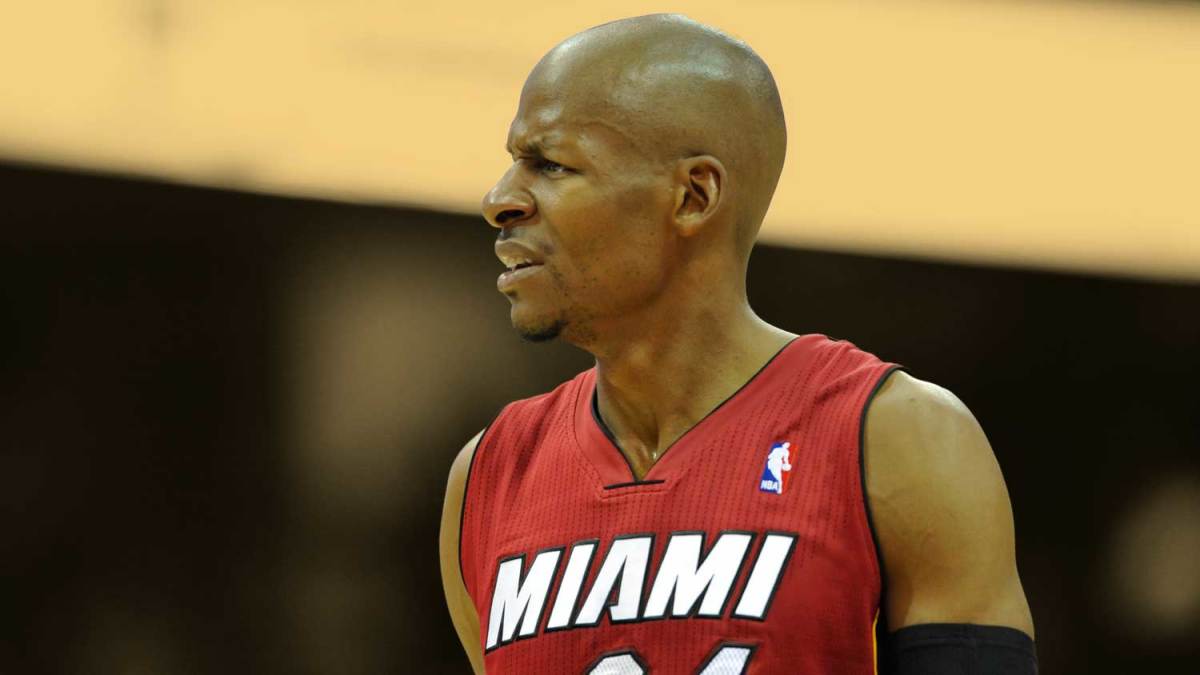
Ray Allen said Celtics mistreatment led to his move to Heat: “I understand where you’re placing my value” originally appeared on Basketball Network.
In March 2018, Ray Allen spoke about something nearly everyone experiences at some point: the sting of going from valued to overlooked.
Advertisement
Most people quietly accept it. The Hall of Famer didn’t. When he slipped — or at least felt he had — down the Boston Celtics’ pecking order, Allen drew his own conclusion, making a bold move to redefine his 10-time All-Star career.
2012 move to the Heatles
Few departures in Celtics history have sparked as much debate as Allen’s during the 2012 NBA offseason, after five seasons in Massachusetts.
Some saw it as a huge mistake — even a scandal — when the 2008 NBA champion in green joined the Miami Heat, raising questions not only about his loyalty but also his competitiveness.
Advertisement
Allen had been a cornerstone in Boston, earning respect and admiration. But by joining the team the Celtics couldn’t beat in the 2012 playoffs — a roster already stacked from top to bottom — his move felt like a shortcut to success.
In a way, it mirrored Kevin Durant’s 2016 decision to join the Golden State Warriors, a move that has also been widely criticized as blatant ring-chasing.
Famously, in the aftermath of Allen’s move to the Heatles, Kevin Garnett and Paul Pierce — who together had formed Boston’s Big Three — didn’t hold back in their criticism. Then-head coach Doc Rivers also voiced his disappointment.
Advertisement
Allen saw the writing on the wall
Allen’s decision wouldn’t have sparked so much debate if there weren’t another perspective to consider — one that the former 6’5″ shooting guard revealed himself.
In a candid interview with the Boston Globe, he explained that his choice was far from ring-chasing or dismissing loyalty. It was a direct response to how his long-time franchise had begun to treat him.
Advertisement
For instance, Allen said that as he approached his mid-30s — an age when most players start to decline — younger teammates were gradually taking some of his minutes. Avery Bradley, drafted in 2010, was a clear example. In the 2011–12 season, his average playing time rose from 21.4 to 28.7 minutes, while Ray’s dipped slightly from 36.1 to 34 per game.
The same pattern, the California native noted, showed up in contract talks.
“Once they started signing everybody else, they pushed me down, and I can see it,” he recalled. “My agent kept saying, ‘They’re not calling me back and they’re saying we’re going to wait and do your contract.’ You’re not placing any value on me to get anything done.”
Advertisement
While other Celtics players were re-signed quickly, his own 2012 free agency talks dragged on with little to no urgency.
The others were paid first, and he got the leftovers — that’s how it felt to Allen. Naturally, it didn’t sit well with the iconic sharpshooter, and he drew his conclusions.
“Once I realized they were going to give me what was left, I understand where you’re placing my value. It’s time for me to go,” he emphasized.
For Allen, the writing was on the wall. After years of service, Boston had set different priorities — ones that didn’t include him, or more precisely, left him far down the pecking order.
Advertisement
With that in mind, leaving made sense, and in many ways, his move to Miami proved it. The now 50-year-old found a clear role in South Beach, where he was valued and could shine, winning the second NBA championship of his career in 2013.
This story was originally reported by Basketball Network on Aug 20, 2025, where it first appeared.