
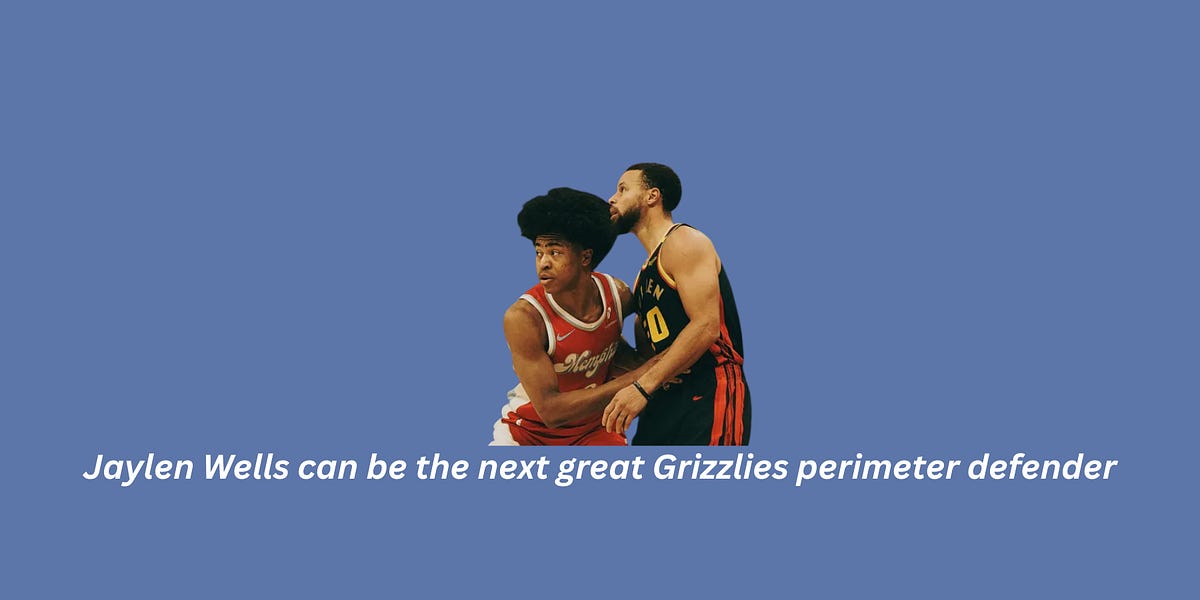
In the Grizzlies’ 25 years in Memphis, they’ve been fortunate with a wealth of great perimeter defenders. Tony Allen is the most prolific of all — the one who became the best defender Kobe Bryant ever faced, and a 6-time All-Defensive team member (three appearances on 1st team). Before him was Shane Battier, a versatile perimeter defender who was a pioneer for the analytics in scouting reports. Though Grizzlies fans tried to dub a “Grindson” to follow in Tony Allen’s footsteps, Dillon Brooks took the torch into the 2020’s as smash-mouth perimeter defender that had a burning desire to guard the league’s greatest.
Could Jaylen Wells be next?
Let me be clear, in today’s NBA, teams need multiple great perimeter defenders. Look at the Conference Finals. Between Alex Caruso, Lu Dort, and Jalen Williams, the Thunder have three guys that’d likely be the best perimeter defenders for a good chunk of teams throughout the league. Andrew Nembhard and Aaron Nesmith helped charge a Finals run with their defensive intensity. The Timberwolves had Jalen McDaniels, Anthony Edwards, and Nickeil Alexander-Walker. The Knicks have Mikal Bridges and OG Anunoby.
The Grizzlies have pieces with Kentavious Caldwell-Pope, Scotty Pippen Jr., and the possibility of either Cedric Coward or Vince Williams Jr. Jaylen Wells, though, has the tools to be the lynchpin of the Grizzlies’ perimeter defense.
The 39th overall pick in the 2024 draft was originally going to play significant minutes with the Memphis Hustle, an admission from Zach Kleiman in numerous press conferences. However, Wells won the starting job, in large part due to his standout defense. He quickly took on the challenge of guarding the opposing team’s best perimeter player each night, and did so with flying colors. The Grizzlies didn’t hold back on testing him — All-NBA talent, bigger guards, smaller shifty players, wings with size.
In the process, Wells became one of the best perimeter defenders in the association, a finalist for the Rookie of the Year award, and a prospect that could be a long-term starter for the Memphis Grizzlies.
You may be stuck on my statement: Wells became one of the best perimeter defenders in the association.
Well, let’s look at the numbers.
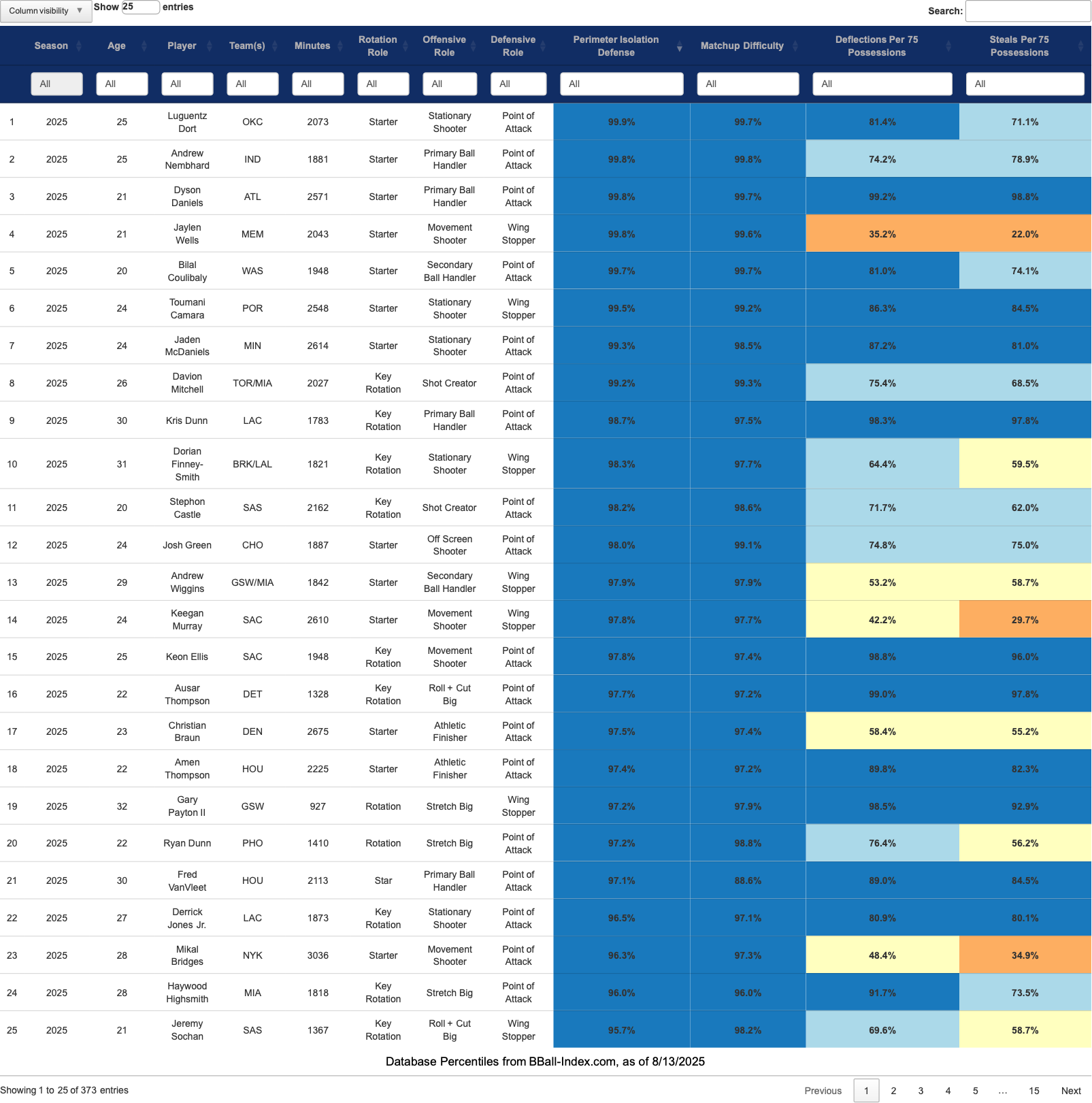
Last season, he ranked fourth in the B-Ball Index’s perimeter isolation defense — only trailing Lu Dort, Andrew Nembhard, and Dyson Daniels. There were only nine players that ranked in the 98th percentile in both perimeter isolation defense and matchup difficulty — those four players, Bilal Coulibaly, Toumani Camara, Jaden McDaniels, Davion Mitchell, and Stephon Castle. Spanning from 2014 — the beginning of the database — his perimeter isolation defense mark (2.85) was also first among all rookies, and 16th overall.
Last season, he was the only rookie to be a positive in both offensive (+0.2) and defensive (+0.6) EPM, per dunksandthrees.
While there’s not a ton of metrics that truly capture on-ball defense — most advanced metrics favor defensive activity in the form of steals and rebounding — Wells’ defensive impact can be traced to both the eye and these particular numbers.
The Memphis Grizzlies had Jaylen Wells guard any type of player in the NBA. He mainly dealt with primary ball-handlers, serving as the Grizzlies’ main point-of-attack defender.
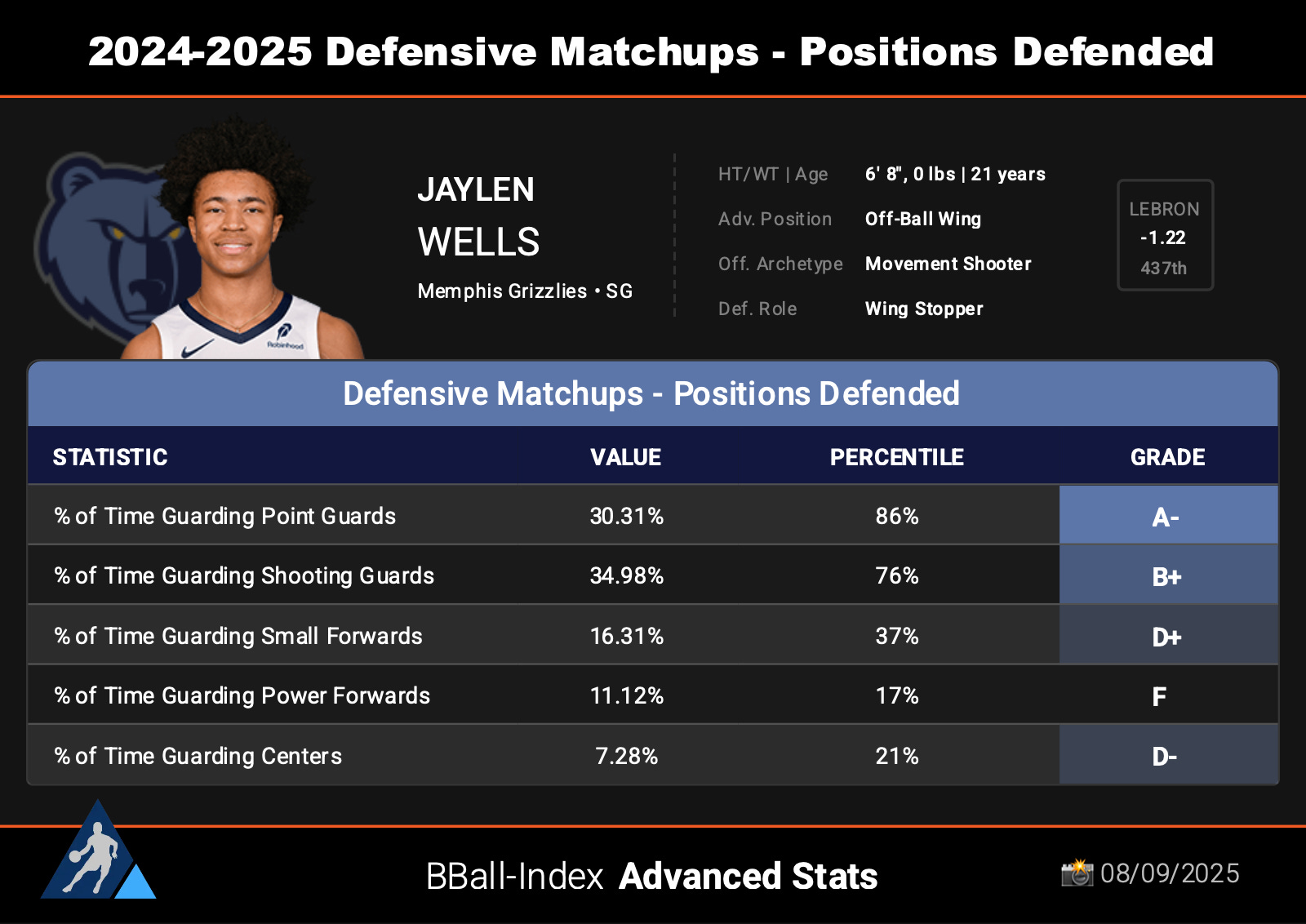
In this film study, I want to capture his performance against these types of players — as it showcases the skills that fueled his strong rookie campaign, and projects where he can grow as a perimeter defender.
Before running the tape, let’s look at who Wells spent his most time guarding based on matchup minutes and field goal attempts as the primary defender.


Let’s start with his first main assignment: Damian Lillard.
With the Dame assignment, the pressure stands out the most. The MO for Lillard throughout his entire career is his limitless range. The Bucks ran ball screens out for him near the half-court logo. Wells’ screen navigation stands out here — getting skinny on ball screens, and reacting quickly to recover back to him. The contests were always tight, as he kept a hand in his face and was physical at his hips when getting downhill — without fouling. The last two clips brought encouraging levels of activity. In the first one of the pair, he switched with Jackson, then rotated on the drive to block the shot. In the last one, his hands were incredibly active to knock the ball out in the trap and dive on the floor for the loose ball.
With De’Aaron Fox, I liked the “KYP” — know your personnel — element to this. Here, he plays more to Fox’s lackluster jumper, while also not giving him a clear path to turn on the Jets to get downhill.
Wells saw a lot of time against guys like Devin Booker and James Harden — two guards that are heavily skilled and crafty, but don’t provide much rim pressure. This archetype fared the best for Wells.
Wells’ defense against guys like Booker and Harden probably doesn’t pop off the page as much as other performances — the Lillard’s or Curry’s of the world. However, his technical precision against two decorated, skilled guards was encouraging. Rather than burst and athleticism, Harden and Booker like to create separation and advantages with their handle and physicality — leveraging bumps to draw optimal space. Wells absorbs the contact and keeps high, active hands to account for their pull-up shooting prowess. In addition, he stays present at the hip in order to deter them from their spots downhill.
Another list of players within this archetype coming from the Kings with DeMar DeRozan and Zach LaVine. Over the years, they’re putting less pressure on the rim. Against DeRozan, he keeps a nice contest on his jumpers, as he’s one of the most decorated mid-range artists in the game. Against LaVine, he has a bit more burst and wiggle. Wells initiates contact at the hip well in drives. I show some makes here simply because sometimes there will be cases of “great defense, better offense.”
The Green matchup was a bit more difficult for Wells, given the opponent’s combination of speed and athleticism. While his screen navigation is good, maneuvering around Houston’s screens that are arguably the best in the league is a task — worth noting for a matchup with Amen Thompson. When facing guards of Green’s physical tools, he has to level up the physicality and not create too smooth of a driving lane.
A fun skill within Wells’ defensive toolset is how he top-locks his opponents. For a player like Anthony Edwards — a dynamic wing that’s the highest volume shooter in the league — this is an effective strategy when reducing the amount of actions the Wolves can run to free him. Again, his navigation is great, as he aims to not give him a sliver of daylight.
These next few videos are more of swing skills that could further enhance Wells’ defensive ceiling and impact.
If you want to get to the Finals as a Western Conference team, all roads run through Oklahoma City. Wells is a defender you want to throw against either Shai Gilgeous-Alexander or Jalen Williams. Both players fight for separation with subtle contact and with fading away from the contest. To combat it, the defender has to absorb contact and maintain high hands — all while remaining smart with avoiding too much contact, mainly in the case of Gilgeous-Alexander. In this matchup, Wells showcased both of those skills at a high level.
One of the more underrated matchups that caught my attention was against Lauri Markkanen. Wells isn’t necessarily a small wing, and in this matchup, he offered strong contests and slithery screen navigation to avoid clean looks for Markkanen. Likewise with Trey Murphy III, he’s persistent in the matchup — screen navigation, tight ball pressure with respect to his outside jumper. Wells will have to draw some of these matchups every now and then. While it’s not perfect due to the height disadvantage, Wells’ pressure and high hands offer formidable resistance to these taller flame-throwers.
As a bigger wing, he’ll draw the assignment of these jumbo point forwards that play with a lot of physicality. These matchups highlight the need for more strength, his sound technicality when holding his spots defensively, and his level of upside within these physical matchups as he adds more muscle to his frame.
The most impressive matchups of the season for Wells came against Steph Curry and Tyrese Haliburton. With Curry specifically, Wells held him without a field goal — the first time the future Hall of Famer played a game without a field goal, among games he played 20 or more minutes. His top-lock defense and screen navigation were divine, ensuring neither guard could see a sliver of daylight to control the game and create momentum. The off-ball pressure was relentless.
Through these matchups, Wells built a foundation for his prowess as a perimeter defender. His size enables matchup versatility. He’s a smart defender with active hands, while keeping his man in front of him — or at least staying present at the hip. He’s a solid screen navigator on and off the ball. He absorbs contact pretty well, and it should only improve as he adds more to his frame.
Wells already has everything you want in a primary defensive stopper.
When identifying Wells’ areas of growth defensively, it ties closely to his off-ball activity.
Wells’ off-ball defensive activity is relatively low. Per Databallr, Wells is the 10th percentile in steals per 100 possessions (1.0) and 4th percentile in deflections per 100 possessions (1.6). His block numbers are low too — 0.2 blocks per 100 possessions, 3rd percentile — as he doesn’t have the length or vertical explosiveness to be a frequent wing shot-blocker. However, he should look to be a bit more adventurous in passing lanes to generate steals and deflections. He has the tools to do so, as his top-lock defense is a barometer for his aggressiveness off the ball. While it doesn’t say everything about defensive impact — after all, Dillon Brooks didn’t create a ton of chaos in this department — this facet of his game is a trend for the league’s best perimeter defenders.
Wells should look to crash the defensive glass a bit more. He generated a 9.3 defensive rebounding percentage last season, falling in the 15th percentile — per dunksandthrees. Improvement in this area is critical for the Grizzlies for a few reasons. They want to play fast — crashing the defensive glass unlocks transition offense. They won’t have Zach Edey for a decent amount of time through the season. It helps win the possessions game.
Wells’ screen navigation is good, but I just ask that he avoids more of these blindside screens.
Finally, Wells’ point-of-attack defense should only grow as he adds more strength and muscle to his frame. It’ll allow him to absorb contact better, a key skill for guarding some of the league’s elite players. In addition, it should expand his defensive versatility to cover bigger matchups on a more frequent basis.
Wells is already a standout defender with the tools, technique, and production to be one of the best stoppers in the league. These areas of improvement should help him sharpen his skillset.
Wells’ ceiling-raising skills are going to be tied to his offensive development. The next big step for him is improving shooting consistency. The rookie wall felt evident in his jumper last season, as he made 30.2% of his threes after the All-Star break. He should trend closer to being a 40% three-point shooter overall.
I like the willingness he showed at Summer League to make himself uncomfortable and be thrusted into a creator role. With the departure of Desmond Bane, the Grizzlies have a secondary playmaking hole in the starting lineup. I’m not projecting a massive leap here, but he should continue testing the horizons of his creation skills — getting downhill off screens or handoffs, rising and firing in the mid-range, making reads off next actions, and keeping the decel step in his bag.
Back to the main thing… defense. I’m eager to see how Wells builds upon his marvelous rookie season defensively. With how the Grizzlies’ re-shaped the roster — bringing in Kentavious Caldwell-Pope, drafting Cedric Coward, and presumably having a larger role for Scotty Pippen Jr. — I’m intrigued with the matchups Wells covers with the defensive chess pieces around him. Another component in this development is the desire from Tuomas Iisalo to provide full-court pressure, which plays into Wells’ favor as a stout point-of-attack defender.
It’s going to be a big year for Jaylen Wells. He’s now projected to be in the starting lineup with a bigger role, and expectations come with it. He should see more offensive responsibilities and has a chance to show real growth in this department. However, I’m still so drawn to his defensive upside with where the league is going. Teams need multiple bodies to throw at opposing teams on the perimeter — providing relentless pressure all 94 feet, and focusing on making life uncomfortable for the opposition’s best players. Wells fits the bill for this trend.
Jaylen Wells made his first impression with his excellence as a point-of-attack defender. In the process, he wasn’t quite as loud as his predecessors, Tony Allen and Dillon Brooks, operating more as a silent assassin. Building upon a strong rookie season could keep him chugging down the same path as these players as great perimeter defenders that impacted winning for the Memphis Grizzlies.
If you choose to support my Substack, SubTsakalidis — aka “SubTsak” — follow this link to my Allie’s Allies St. Jude fundraiser page. If you choose to subscribe, all proceeds will go towards St. Jude Children’s Research Hospital.