
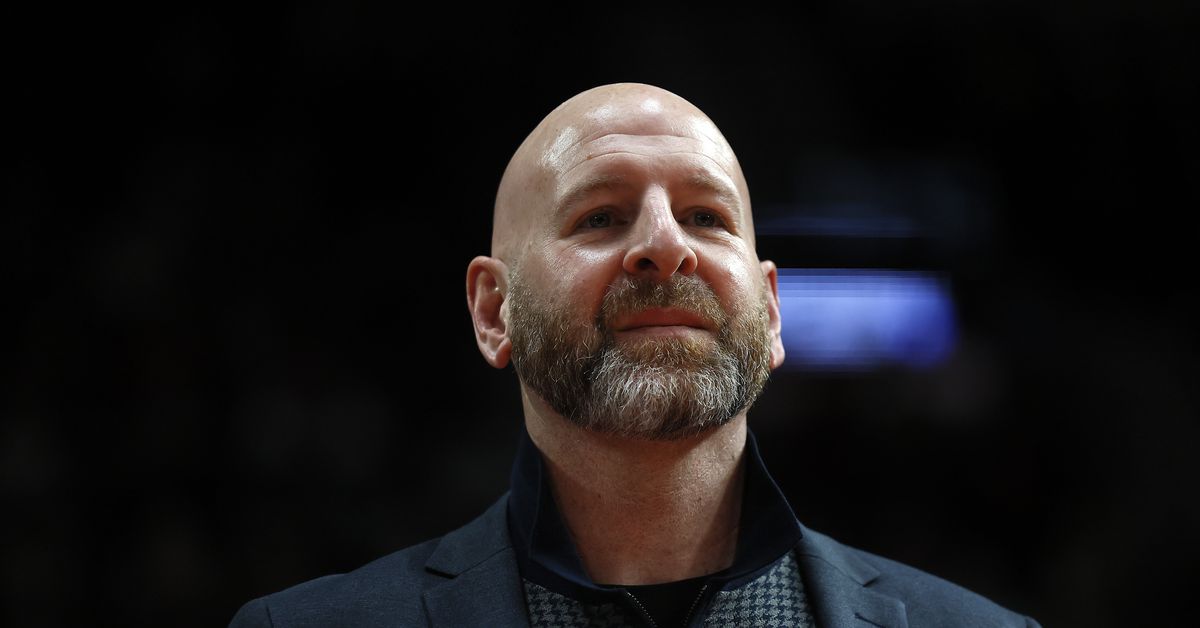
Yesterday we answered a question about Portland Trail Blazers’ current season in our Blazer’s Edge Mailbag. Even edited, the question was so extensive that we needed a second part to it, this one about recently-re-signed General Manager Joe Cronin.
For context, here is the question in question!
Dave,
What the heck? I don’t know what you were thinking with your Cronin analysis but I want to know how you think anything is going to change. Here’s what I see. Joe’s been here for four years. We haven’t gotten better. Don’t tell me we got more wins this year because we tanked last year and many of those wins have come with asterisks. Let’s not even go there. You know this team isn’t really going forward.
Tell me how anything is changing or how the team going to be anything more than what it is. It hasn’t changed in four years. It’s not going to change now.
I defy you to tell me even one thing this season that really mattered besides some player development that should have happened anyway. I know this sounds harsh but I’m really asking. Make some meaning of this because I just don’t get it.
William
As I’ve suggested several times over the past few weeks, the next 18 months for the Blazers are going to present different opportunities than the past few years have. They’re entering a completely different phase of their growth curve. In fact, one could argue that this is the place where the growth curve starts. As such, their actions over the last four years do not necessarily predict their actions over the next four. That’s not to say they’ll change automatically. For all we know, they could keep on doing the exact same things. But we don’t know that they will because this will be the first time during Joe Cronin’s tenure that he’s had a true opportunity to make some of the changes he’s going to be presented with.
Think of hopping in your car going on vacation. Let’s say you’re rural and start out on a gravel road. You stop in a small town to gas up and get some snacks. Then you’re going to head out on a two-lane highway for 50 miles until you join the interstate. As you arrive in the small town, someone in the back seat says, “Wow, you sure like to drive slow. We should be taking this trip at 75 mph. You must be a super conservative driver.”
That’s not entirely incorrect. Up until now you have been driving at 35 mph, max, because you’ve been on a gravel road. How you drove that road will have only partial bearing on the next leg of your journey onto the two-lane highway, where you’ll go 60. Then when you hit the interstate, it’s going to be 75 or 80 just like the back-seat driver suggested. But you can’t go 80 on gravel. Them not understanding that environment and situation change how you drive is not an indicator of your driving choices as much as their perception.
The Blazers are just pulling out of the gas station now after Cronin’s first years on duty, which were much like the gravel road and pit stop. They’ve stocked up on a couple snacks, filled up the car, and now they’re going to merge onto the highway. If he’s still driving the franchise at 35 mph two years from now, there will be plenty of room for criticism. But presuming that he’ll do so in the future because he did so up to this point is silly.
Let’s give a concrete example: Anfernee Simons’ contract.
Back in 2022, Simons was a 22-year-old guard coming off the fourth year of his rookie-scale contract. He averaged 17.3 points per game while shooting over 40% from the three-point arc on almost 8 attempts per. That was his first season playing regular minutes and he acquitted himself very well. His ceiling was as yet unknown, but he looked like a potential star alongside aging, and very expensive, Damian Lillard.
Joe Cronin, meanwhile, was in his first months as the permanent GM after being named Neil Olshey’s interim replacement the fall prior. The new GM had inherited his roster from Olshey, of course, along with a reasonably-hefty price tag. Cronin had already traded guard CJ McCollum to the New Orleans Pelicans to reduce Portland’s salary obligations and, presumably, to make way for Simons to blossom.
When considering Simons, Cronin had a couple options. He could trade him as he had McCollum. That would have been a seismic move and dicey because of Simons’ age and recent production. He could have made a one-year qualifying offer to Simons, which would have given Portland the right to match any salary offered to the guard as a restricted free agent. (Failing that, Simons could have played out the single year and become an unrestricted free agent the following summer.) Or Cronin could negotiate an extension with Simons.
It’s worth noting that whatever Cronin chose to do, the Blazers were far enough above the salary cap line at that point and for the foreseeable future that even letting Simons walk for nothing would have given them no usable cap space. He would have been abandoning the player for zero gain.
It’s also worth noting that the audience for this new GM included not only Blazers fans, but franchise superstar Lillard—interested in building a contender and not likely to be patient with anything less, particularly a rebuild—and ownership. Dame wanted to see progress. The figures above Cronin had their own priorities, to this day unrevealed, but which no doubt included keeping Lillard at least semi-happy and not breaking the bank.
So now, given all these forces at work, what choices did Cronin have? Cutting Simons was not productive in any way. Letting him play out the final year of his rookie contract would have been just as bad. Trading him wasn’t going to move the team forward unless a better player replaced him, and in any case might have been a tough sell since the Blazers spent the last four years developing him and he was still young, a potential star. That left an extension, which Cronin got for four years at what turned out to be a perfectly reasonable deal.
The end result of the process is not as important for our purposes as understanding the constraints Cronin was under. We can say, “Joe Cronin was the GM and he made that Simons contract decision!” but the decision was 90% made for him before he got to the bargaining table. Under those circumstances, with that array of clients to please, the team structure as it was, and the salary cap rules in place, there was only one way to go. Had Cronin wanted to do something different, he likely couldn’t. He was driving on a gravel road.
Now Simons is about to enter the last year of the extension he signed back when Cronin was brand new. Once again, the General Manager—signed to another multi-year deal himself—will need to decide what to do with the guard. But look at the difference in the environment.
Lillard is long gone. The team is rebuilding.
Cronin himself is comfortably established with a roster in place that he helped develop.
Simons is three years farther along in his career. We know more now about what he is and isn’t.
The Blazers are still capped up right now, but in the Summer of 2026 they have the potential to open up significant cap space if they don’t retain some of their more expensive veterans. That leaves trading, extending, or simply not re-signing Simons all as viable options.
Anyone who says the Simons situation in 2025 is comparable to the one in 2022 isn’t looking very hard. Anyone who says that decisions are going to be made the same way now as then just because Cronin will be sitting in the GM seat for both doesn’t understand how this works. Cronin’s options are far broader, his position more secure, and his knowledge more complete now than they were during the initial Simons extension.
Now, Cronin may indeed decide to re-sign or extend Simons. Nobody can guarantee that one way or another but him. But he’s definitely more in the driver’s seat. The potential for change is greater now. He can viably choose to trade or release Simons and he has the power to do so, or at least more than he did back then.
You can replicate this story for most of Portland’s decisions over the coming year and a half. A new roster, future picks, the end of Lillard’s primacy, the potential for cap flexibility…all of these give Cronin flexibility he simply didn’t have before. The Blazers didn’t get a new GM, but they do have a new field in which the incumbent GM can operate. That’s not exactly the same thing, but at least now they’re driving on the highway, towards the freeway, instead of spinning tires in that gravel.
That’s why it’s pretty easy to say that the Blazers have more potential for change in the coming months than they have had over the last few years. Since Cronin has already made some huge changes to the roster since he took over, I’m leaving open the possibility of him making more now. At the very least, I think it’s foolish to say that he won’t because he hasn’t in the past.
The Blazers have a new horizon in front of them. Let’s see if they get a new GM, at least functionally, along with it.
Thanks for your question! You can always send them to blazersub@gmail.com and we’ll try to answer as many as we can!