
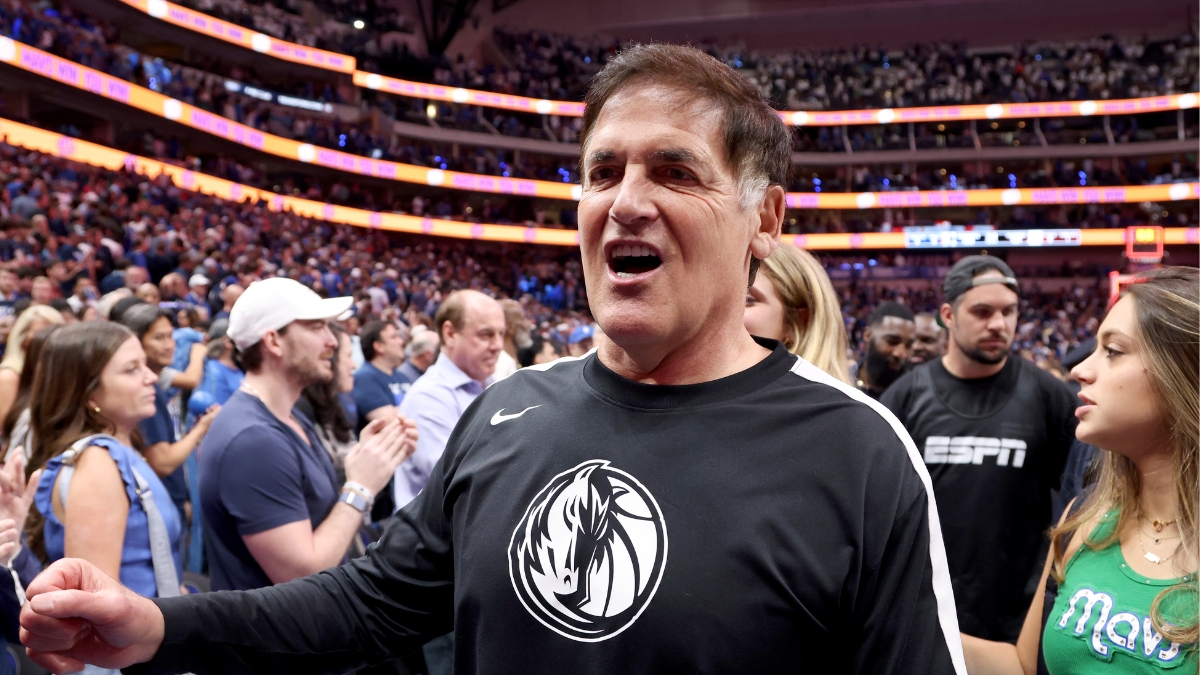
While the NBA has publicly acknowledged studying the possibility of expansion, Dallas Mavericks minority owner Mark Cuban isn’t convinced it makes financial sense. Instead, he believes the league’s next phase of growth could come from outside the United States.
Commissioner Adam Silver said in July that owners instructed the league office to conduct an in-depth analysis of expansion, which has fueled speculation about new franchises in Seattle or Las Vegas. Cuban, who sold a majority stake in the Mavericks to the Dumont family in 2023 but remains a minority owner, outlined why he thinks expansion would be a mistake.
Expansion Fee Called a Mirage
Cuban began by questioning one of the biggest selling points of expansion: the massive fee paid by a new ownership group. He said that while the number might look impressive, it ultimately functions as a loan that comes back out of the pockets of existing teams.
“The expansion fee is just a loan,” Cuban said during an appearance on the DLLS Mavs Podcast. “You loan me let’s say it’s $6 billion and I pay back that loan. I give you 1/31 — because there’s 30 teams now, there will be 31. I get 1/31 of the TV money, and then it’s only a question of how long it takes. So if the TV money, let’s just make it an easy number, is $100 million, and it’s $6 billion so that means in 60 years the loan will be paid off with no interest. So why split up the pie any further?”
By his calculation, the short-term cash infusion would be offset by decades of reduced revenue sharing from broadcast deals, leaving owners no better off.
Collective Bargaining Impact
Cuban also pointed to the league’s collective bargaining agreement as another major obstacle. He said expansion would lower the salary cap because basketball-related income would be divided among more teams.
“When you calculate the cap, now you’re divided by 32 teams,” he said. “If it’s one or two teams, you’re reducing the cap. So literally, in a second apron era, the cap goes down, and the second apron goes down, and the teams are f—–. It just doesn’t work.”
The NBA’s new CBA includes stiff penalties for teams that cross the second luxury-tax apron, restricting trades, free-agent signings, and roster flexibility. Cuban argued that adding more franchises would shrink the cap further, making those restrictions even harsher to navigate.
NBA Players Could Lose Money
Beyond ownership, Cuban said expansion would hit players as well, particularly those on maximum contracts.
“So think about it if you’re a player, and now all of a sudden you’re a max player and because they added two expansion teams, there’s just not as much money to go around to the players,” he said. “So the players would have to decide, do we want to take less money in cap room, or do we want extra jobs?”
He suggested that the NBPA would be forced to weigh whether the benefit of additional roster spots outweighs the reduced earning power of the league’s top stars.
Possibility of CBA Opt-Out
Cuban went a step further, predicting that the financial squeeze created by the current labor deal could eventually lead to a renegotiation.
“I would not be surprised if the players take the opt out,” he said, referring to the union’s option to exit the CBA after the 2028-29 season.
That possibility looms as the league continues to navigate rising revenue, increased tax penalties, and a more cautious approach to spending from ownership groups.
Europe is Viewed as a Better Opportunity
Although skeptical about U.S. expansion, Cuban said he would welcome the league’s reported interest in launching a European competition.
“That’s just a new source of revenue, and we’re a global sport,” Cuban said. “So I think that’s a net positive if they can make it work.”
In recent years, the NBA has staged regular-season games in Paris and preseason exhibitions in Abu Dhabi, part of its strategy to build a larger international footprint. With stars like Giannis Antetokounmpo, Luka Dončić, and Victor Wembanyama carrying global followings, Cuban said the European market represents a logical next step.
For now, though, Cuban believes the math makes one thing clear: expansion in the United States would divide the league’s money too many ways, while Europe could open the door to new revenue altogether.
Latest Dallas Mavericks News & NBA Rumors