

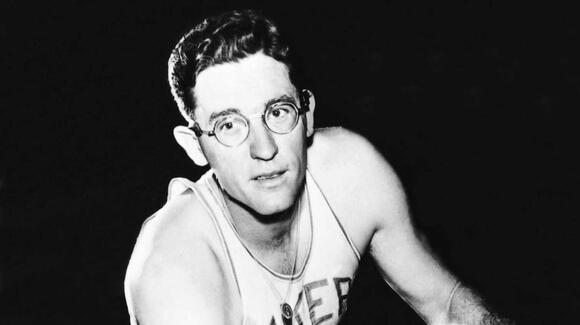
The late George Mikan is one of those legends who built his legacy with a franchise that no longer exists in the form he knew. Naturally, this came with its share of obstacles.
The challenge is clear whenever NBA fans dive into the Los Angeles Lakers‘ history. Too often, Mikan and his Minneapolis teammates are left out of the conversation — a point the man himself, “Mr. Basketball,” emphasized back in October 2001.
The forgotten championships
Shortly after the turn of the century, when you looked up at the Staples Center (now Crypto.com Arena) ceiling, you saw Lakers championship banners from the 1960–61 season onward. Missing, however, were the five titles won when the iconic franchise from California was still called the Minneapolis Lakers.
For Mikan, the driving force behind those early BAA/NBA championships, that absence was hard to swallow. After all, he, according to the Los Angeles Times, said it would be “wonderful” if those victories were finally recognized by the organization, then run by General Manager Mitch Kupchak and owner Jerry Buss. Mikan’s reasoning was simple and unyielding.
A four-time NBA All-Star, three-time scoring champion and one-time rebounding leader, Mikan stressed that the Minneapolis and Los Angeles championships were part of the same Lakers legacy, noting he and his teammates were “also Lakers” and that the only thing separating the eras was “distance” — roughly 1,500 miles across the country.
Mikan added that today’s Purple and Gold players would benefit from what his generation had built and wondered whether young people were actively overlooking the franchise’s roots.
“We were there first,” the iconic 6’10” center explained.
Honoring or ignoring the original Lakers?
While some Lakers fans overlooked — and still do — the organization’s early era, the team’s leadership at the time advocated the opposite. Buss, for instance, noted that honoring those Minneapolis titles had “been brought up and discussed before” and promised it would be something to “explore at some point.”
Bob Steiner, Buss’ publicist, added that hearing Mikan’s perspective had sparked genuine interest.
While he said, “We think it would be a good thing to do,” Steiner also highlighted practical challenges: whether the banners were displayed or not, the Lakers had won 13 championships in total, and limited wall space could lead to congestion among banners and retired jerseys.
While it was certainly a problem every NBA franchise is happy to have earned, retiring Mikan’s No. 99 jersey — the one he wore from 1948 to 1956 — added an extra layer of complexity.
Steiner explained that “as a matter of principle,” retiring that number would also require honoring all Hall of Famers from those Minneapolis teams, further complicating the wall space issue.
Today, Crypto.com Arena displays 22 championship banners — the NBA’s Lakers, the NHL’s Kings, and the WNBA’s Sparks — yet the Minneapolis ones remain absent.
However, at least Mikan finally received his due date. Having waited far too long, he passed away in 2015 and never saw the honor himself.
Nearly twenty years after his comments, George’s jersey was retired during a 2022 Lakers pregame ceremony, the ultimate recognition for an outstanding player who never officially played as a Laker but, as he insisted, had done more than enough to deserve it.