
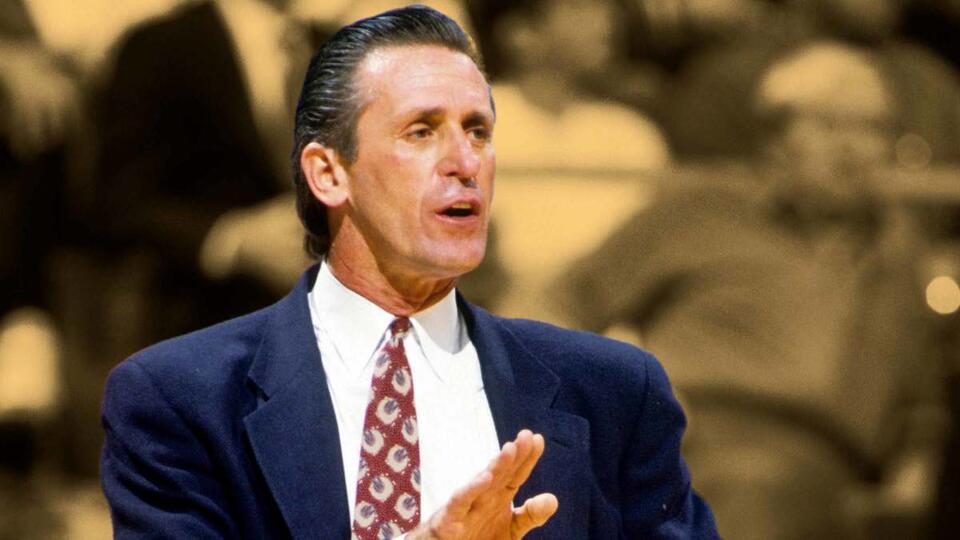
During his nine seasons as Los Angeles Lakers head coach, Pat Riley established himself as one of basketball’s ultimate winners, securing four championship rings amid the franchise’s iconic Showtime era.
While The Godfather is still rightfully celebrated for that, what often goes overlooked is another major achievement he pulled off — one behind the scenes. Without it, it’s safe to say that none of the above would have happened as it did.
No Kareem, no problem?
Almost every iconic NBA team thrives on a lethal point guard–big man duo. Riley’s Showtime Lakers in the 1980s were no exception, with their two most vital pieces being playmaker Magic Johnson and center Kareem Abdul-Jabbar.
Off the court, their relationship wasn’t the best, but it didn’t matter. The two future Hall of Famers quickly developed unprecedented on-court chemistry, which was crucial as the team captured their first title together in Magic’s 1979–80 rookie campaign.
By the first quarter of the 1981–82 season, however, challenges emerged.
Kareem was sidelined with a foot injury for six games, but that wasn’t the real challenge. After all, the Purple and Gold went undefeated, even boosting their scoring to 117.6 points per game during that stretch. Amid that dominant run — prompted by Magic running the floor and getting more touches on offense than ever — the real “challenge” came in another form.
As often happens in LA, it was the media, with reporters jumping at the chance to stir up headlines – headlines that focused on one question: were the Purple and Gold actually better without six-time MVP Abdul-Jabbar?
The Lakers’ potential turning point
Trade the aging superstar for the rising phenom? In NBA history, it wouldn’t have been the first — or last — time a lethal duo faced the threat of being broken up amid such considerations.
However, Riley, who had taken over as head coach at the start of the season, wasn’t having it. Facing the media, he made his stance clear, stating that “Everybody was getting carried away” with how Magic was dazzling without any constraints.
The now-Miami Heat team president acknowledged that when Kareem was on the floor, the Lakers sometimes became too predictable by simply feeding him in the post, and that they had lost a few games because of it. Still, trading the 1971 Finals MVP was not on the table.
It’s safe to say Magic wasn’t thrilled to hear that. After all, the then-22-year-old was already imagining how the Lakers would look with him as the focal point — a thought he didn’t hide from the press when asked about how it felt to play without Cap.
“When he [Abdul-Jabbar] leaves, you’ll be able to see the real Magic show. I’ve had to change my game because of the big fella. I’m just waiting my turn. My time will come,” said the future 12-time All-Star.
Of course, this remark only fueled the debate about Kareem’s future in LA. The chatter was loud, but the man himself wasn’t about to stay silent.
“I’m not dead yet,” Kareem told a TV interviewer. “The reports of my demise have been greatly overrated.”
While the Big Fella saw it that way, there was arguably a decline: after his last MVP season in 1979–80, his stats began to slip and the league took notice.
Approaching his mid-30s, Abdul-Jabbar still earned All-Star nods every year, but he was no longer considered among the league’s top players. Up until his retirement in 1989, his highest finish in MVP voting was fourth — a result almost unthinkable given Kareem’s dominance during the early part of his storied NBA career.
The Godfather stepped in
The Lakers were showing cracks before even having the chance to build the dynasty they were poised to form, and it was clear that action had to be taken — action only The Godfather could take.
Frustrated by the public chatter as well as reports that some players had quietly aired grievances to the press, the New York native faced the issues head-on. He called the team together and, according to the LA Times, asked the question that hung over everyone’s heads.
“Who here thinks we can get along without Kareem?” challenged Riley.
He then reminded the locker room that anyone who felt that way would be the “one to go.” However, before any rash decisions were made, Riles insisted that everyone speak their mind immediately — no matter what, “we’ll discuss it,” he added.
Still, there was one line Pat refused to let anyone cross: internal matters could not leak to the outside world.
“If you’re gonna start giving information like that to the media, allowing them to use it against us, then we’re on our way down,” warned the future three-time Coach of the Year.
The response from the players? Silence — a quiet that spoke volumes, as by the end of the meeting, it was unmistakably clear: the Lakers were not better without Abdul-Jabbar, and the legendary center remained absolutely indispensable going forward.
For anyone doubting Kareem’s lasting impact, history tells the story. Alongside Magic, he led the franchise from sunny California to four more titles on top of the one they had already won in 1980. It became the iconic run the basketball world celebrates today — one that likely wouldn’t exist without Riley stepping in to settle the matter before it spiraled out of control.
As they say, no matter how great the players on the court are, you need a true leader to hold it all together. The Purple and Gold in the 1980s were lucky to have both.