
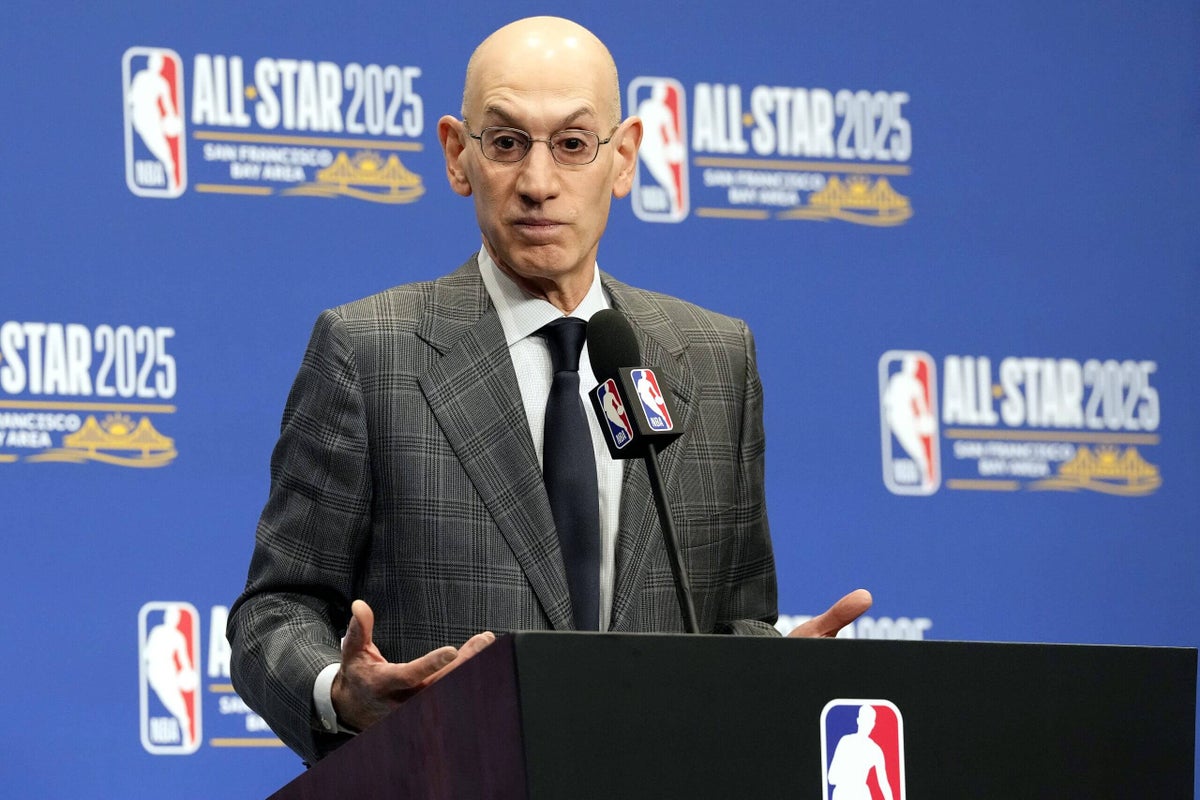
If the NBA can collect enough evidence against Los Angeles Clippers owner Steve Ballmer proving he indeed circumvented the salary cap regarding Kawhi Leonard’s contract, then commissioner Adam Silver has no choice but to throw every hammer in his bag at the Clippers: a fine in the millions, loss of draft picks and perhaps even voiding the remaining two years and $100 million on Leonard’s deal.
But we’re a long way from that point. The reality is we might never get there despite the evidence revealed by Pablo Torre’s recent podcast episode on “Pablo Torre Finds Out.”
The league announced this week that it is launching another investigation into Leonard and the Clippers. This is at least the second peek into their business practices after the league poked around in 2019 and found no evidence of wrongdoing. Torre certainly did his part in opening new paths to explore. Yet my first reaction upon hearing about the new investigation was simply: Who will hear the evidence? Will Ballmer be brought before a jury of his peers? (Imagine Joe Lacob and James Dolan sitting together in a jury box.)
The most compelling question is what burden of proof must be met before action is taken against Ballmer? What is the threshold of evidence? This isn’t a court of law. This is the court of Adam Silver.
The collective bargaining agreement explicitly states in Article XIII that a violation of cap circumvention “may be proven by direct or circumstantial evidence, including, but not limited to, evidence that a Player Contract or any term or provision thereof cannot rationally be explained in the absence of conduct.”
That appears to give Silver a fair amount of runway should he choose to take it, because what Torre uncovered is absolutely circumstantial evidence.
Sports leagues are often ill-equipped to handle such investigations. They are either conducted by league employees or “outside investigators” who aren’t really on the outside at all.
Baseball granted the Houston Astros full immunity at the start of its investigation into sign stealing. The NBA’s investigation into disgraced referee Tim Donaghy focused more on damage control than actually learning whether Donaghy’s actions affected the outcome of games. Former Commissioner David Stern is the one who hired respected attorney Lawrence Pedowitz to investigate Donaghy and then supplied him with three members of the NBA’s officiating department to work directly with him. Not exactly an outside investigation.
The NFL paid for the Ted Wells investigation into Deflategate and the New England Patriots — again, hardly an outside investigation — turning a minor equipment issue into a saga that spanned nearly two years. The NCAA so badly butchered its investigation into the University of Miami in 2018 that it had to investigate itself — no, seriously — over improperly gathering evidence against the university.
At its core, sports is an entertainment business, not a judicial system, and leagues are often more concerned with protecting their revenue streams (i.e., their brand) than they are with seeking justice. They are also vulnerable to backlash and public opinion.
The NFL is famous for this. The league initially botched the Ray Rice investigation so badly that Roger Goodell ultimately created a Personal Conduct Policy in response. Rice was only suspended for two games before video of him punching his fiancée and dragging her unconscious body out of an elevator became public. The NFL hired former FBI director Robert Mueller to investigate the matter. Mueller concluded that, while the league did not have knowledge of the video before its release, it should have done more to conduct a thorough review of the evidence.
Now the NFL has an independent arbiter, former U.S. District Judge Sue L. Robinson, to hear cases that may violate the policy.
Still, Goodell holds final authority, and the verdicts don’t always follow case precedent. When the Cleveland Browns traded for quarterback Deshaun Watson in 2022, knowing Watson faced more than 20 civil cases of sexual misconduct related to massages, the Browns pursued him, believing he was likely facing a suspension ranging from four to six games.
Indeed, Robinson’s initial ruling was six games based on precedent. She believed it was the stiffest penalty she could administer under the league’s policy. Goodell, perhaps sensing the growing public vitriol against Watson and ultimately the NFL’s shield, had the authority to appeal Robinson’s ruling under the collective bargaining agreement. Watson was ultimately suspended for 11 games.
Of course, none of that applies to owners, who are essentially the bosses of the league commissioners. And what the NBA is dealing with now is a competitive advantage issue rather than behavior.
“Steve is really intelligent,” one front office executive told me this week of Ballmer. “I don’t believe he’s dumb enough to wire $50 million to a company, just to have that company turn around and give it to Kawhi. I don’t believe it.”
At the root of the league’s investigation will be the $28 million contract Torre uncovered that now-bankrupt fintech company Aspiration held with Leonard for seemingly no work. Torre learned that Ballmer partially funded Aspiration with a $50 million investment in September 2021. Less than two weeks later, the Clippers announced a $300 million partnership with the same company.
Players striking up relationships with team sponsors isn’t unusual. Steph Curry has been a brand ambassador for JPMorgan Chase since 2016, the same company that owns the naming rights to the Golden State Warriors’ arena.
However, a sum of $7 million a year from Aspiration to Leonard seems like an exorbitant figure for such a deal and one that the Clippers and/or Leonard might struggle explaining away, particularly since Torre reported that Leonard provided no services to the company. Though Ballmer gave his version of events in a Thursday night sitdown with ESPN, this doesn’t seem at all normal and is certainly an arrangement worthy of an investigation.
However, Ballmer could simply tell investigators, “I made an investment in a company I believed in. How was I supposed to know what they were going to do with the money?”
Is it flimsy? Absolutely. Now figure out how to prove him wrong.
Ballmer told ESPN that the Clippers introduced Leonard to Aspiration (which is legal under NBA rules) in November 2021, three months after Leonard’s extension with the Clippers was signed. Torre’s research revealed that the agreement between Leonard and Aspiration was signed in April 2022.
Ballmer said the Clippers recently went through all of their paperwork and text exchanges with Aspiration executives as part of investigations by the Department of Justice and the Securities and Exchange Commission.
“We’d already gone through all this stuff because it was part of document production in their (DOJ and SEC) investigations,” Ballmer told ESPN. “We even found the e-mail that makes the first introduction. It was early November. I don’t remember the exact date. So, where could any of this circumvention have happened? It didn’t. It couldn’t have.”
In order to punish Ballmer and the Clippers, the league will have to do better than a few disgruntled employees from the finance department of a company that was actively defrauding investors — including Ballmer — of nearly $250 million, and whose co-founder, Joseph Sanberg, pleaded guilty last month to two felony counts of wire fraud that could land him in prison for up to 40 years. These are not exactly high-character witnesses.
Also unexplained in all of this is why the Clippers even needed a sweetener to land Leonard, who was already going to miss the 2021-22 season with a partially torn ACL. If the evidence uncovered this week dated to 2019, when the Clippers first landed Leonard, the dots would connect themselves. The period in question is after Leonard had already played two seasons in Los Angeles.
Investigators will presumably have to prove that Ballmer set all of this in motion and deposited money into an account strictly for Leonard, a player whom he had agreed to pay $176 million over four years, knowing he was going to miss one of those seasons recovering from a major knee injury. It might be more difficult to prove than it appears.
Court is in session. The Honorable Adam Silver is presiding. All rise.
(Photo: Thearon W. Henderson / Getty Images)