
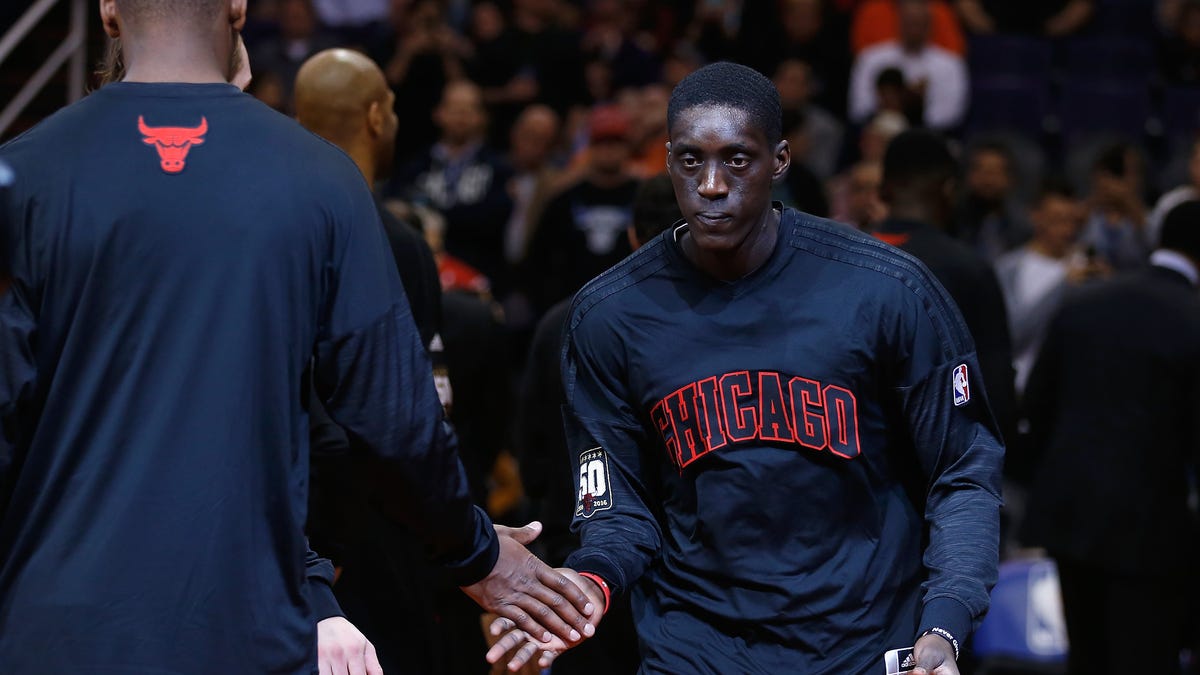
Tony Snell, former NBA player and current member of Boulazac Basket Dordogne in France, has been on a unique and winding professional journey since being drafted in 2013. The 3-and-D specialist, who spent nearly a decade in the NBA with teams like the Chicago Bulls and Milwaukee Bucks, recently decided to move his family to France to continue his basketball career overseas. In a recent exclusive interview with HoopsHype, Snell opened up about adapting to life and basketball in Europe, his love for the game, his personal growth since his public autism diagnosis in 2023 and more.
How does your first week compare to your previous experiences in the NBA?Tony Snell: Well, the jet lag kind of got me coming here. Coming in, not really 100 percent, doing tests and all kinds of stuff and eating their food, it’s a really good experience for me to expand my horizons and see what’s new out here. But yeah, the experience so far has been really good.
Did you get advice from friends who’d been abroad before you came?
TS: I’ve been around a couple of foreign guys, I had a guy from Australia, a couple of players from Australia, Hugh Greenwood and Cameron Bairstow. I learned from how they take care of their bodies and how they move and operate. Nikola Mirotić, I had him with the Bulls. Just understanding how differently they operate, I kind of like that style. It kind of fits with who I am. So yeah, I took a couple of pointers from there. During my process of getting to know a couple of veterans who played overseas, I just picked their brains about their experiences. Some were good, some had different situations, but the majority of them were really good, and I wanted to explore this for myself.
Why did you choose Boulazac, and how do you see yourself fitting in there so far?
TS: I told my agent I was done with the G League life, so I wanted to go overseas. I said, ‘Any spot you can find for me, I’ll take it.’ And he said Boulazac was one of them. It’s in France, and my wife knows a lot about France, so I feel like it’s a win-win. She knows a lot of things around here, and I’m new to it, so it’s a win-win. So far, I love it.
What excites you about competing against European teams?
TS: This is a lot more physical than I thought. It kind of reminds me of how physical the league was when I first came in back in 2013, especially in the playoffs, very hands-on, very physical. I love that aspect of the game because I’m a very physical guy. There’s a lot of team ball, a lot of ball movement, and a lot of cutting. You have to be in tip-top shape to play in this league, and I respect the players here. I’ve embraced it and I love it. I can’t wait, I feel like I’ll be my best self out here. I’m going to be in the best shape because I have coaches, teammates, and an organization pushing me every day. So, I’m really looking forward to it.
What did you learn about leadership from playing with Giannis, Dame, and Jimmy?
TS: Both Giannis Antetokounmpo and Jimmy Butler are big on mastering their craft and their spots. Specifically, Jimmy is really big on bringing confidence to his teammates. They’re always encouraging their teammates to shoot the ball, be aggressive, and play their own game. They always uplift their teammates using their voices, but not only their voices, they show it with their actions. I’m here to do the same thing, learning from them.
In your NBA career, what was a defining moment? Was it a major game, a personal breakthrough, or a challenge you overcame?
TS: Honestly, it’s just about embracing the journey, not the destination. It’s about going through your journey with its ups and downs. You’re going to be tested, and whether it’s good or bad, you have to have a positive mindset that you will overcome any challenges thrown your way. It happens to the best, it happens to everybody. They get thrown with some adversity, but they stay consistent. Being consistent overcomes anything that comes your way. So, just being consistent, keeping my confidence high, staying in the gym, encouraging other teammates and even coaches, is a way of life because it’s not going to be perfect. But as long as you stay consistent with your work, you can overcome the sunshine and the thunderstorms.
How has your autism diagnosis shaped your perspective on basketball and life?
TS: It made me, honestly, it gave me a clarity of who I am. I always questioned, you know, ‘How do I belong in this world?’ and ‘Who am I?’ I never understood why I operated the way I do. But it’s just who I am. I never understood it until my firstborn got it. He is a blessing in my life. If it wasn’t for him, I probably still wouldn’t know why I operate the way I do. But now that he and my youngest are here, they have both given me clarity about who I am. And it’s okay to be myself. I want to share that with the world and bring awareness to autism, to people who are on the spectrum, just awareness of how our brains operate and that it’s okay to be ourselves. So I want to really push people just to be themselves, and you’ve got to accept it.
What do you mean by “how you operate” regarding your autism?
TS: In the past, I was a mute. I spoke very rarely until I got to know a person. But the way I see things in life, for example, I have never owned an iPhone. I don’t like the concept of having everything on one device. That scares me personally because it’s a lot of distractions in one device. I’ll always use the example: ‘nine plus one is 10, and five plus five is 10.’ People get the job done in different ways. So for me, I’ll probably have a phone, an iPod for music, and an iPad for social media. I have different things because I like to organize things differently. If I have everything on one phone, I have to rely on that one phone, and I don’t like that kind of power. I like to have my things organized. So that’s an example of how my brain operates. It works for me, and that’s just what it is.
Since your sons have been diagnosed with autism, do you see yourself in them as a child?
TS: Absolutely. I think my firstborn is literally my twin. When he was tested and diagnosed with autism, I realized, ‘Man, that’s how I move. That’s how I was.’ So he gave me the courage to think, ‘Hey, maybe I have it.’ That’s how I found out, just by having him tested, because I operate the same way he does. It’s like watching myself all over again. It’s the best thing ever. Now, for him, I want to pave the way and show that it’s okay for him to be himself. I want him and his brother, Kenzo, to be themselves. I want to bring awareness to the world that, you know, it’s okay.
Would the resources available to your sons today have made a difference for you as a child?
TS: I think when I was younger, at their age, they’re talking way more than I ever did. I didn’t start talking until I was maybe four or five. My oldest is four right now, and he’s talking up a storm. My youngest is three, and he’s the same way. They’re talking way more, which is a blessing. At their age, I didn’t talk at all; I was a mute. I could understand things, but I couldn’t speak them back. So for them, they have speech therapy to help them understand what’s going on and talk it out. As for me, I was just an actions guy. I didn’t say anything, but I showed it with my actions. So, it’s good for them to have both. I don’t think back then I would be where I am today because it was still an unknown thing. But thanks to technology, I can use my platform to help spread awareness.
After you didn’t get signed for your 10th NBA season, what led you to move your family to France?
TS: Exactly. I want them to, I mean, I’m grateful for basketball because I’ve been able to see different states and different cultures, and I thank God for that. But now I want to see what’s on the other side of America, and I want my boys to experience the same thing with me. I want them to understand different languages and see different cultures and why their cultures are the way they are. I want to expand their minds. I don’t want them to be boxed in with one thing. So I want them to continue to always want to learn and get better.
Of the NBA cities where you’ve lived, which one was your favorite?
TS: I’ve had different experiences. I obviously have the Chicago Bulls in my heart because Michael Jordan is my favorite player forever. He’s my role model, and he’s the reason I picked up a basketball and gave me the motivation to do what I do. Chicago will always have my heart. Playing with Jimmy Butler and Derrick Rose was also great, shout out to Derrick Rose, who’s getting his jersey retired. He’s been one of my best mentors. I thank that whole organization and group for embracing me and giving me an opportunity to be me.
I also love Milwaukee. I think that’s where I branched out a little more in my career. I loved the experience I had playing with Giannis, Khris Middleton, and Matthew Dellavedova, one of the nicest guys ever. Those two teams gave me a great experience. The run I had with the Atlanta Hawks, with Bogdan Bogdanović, Danilo Gallinari, and Trae Young, where we made it to the Eastern Conference Finals, was a special experience with those guys. I’m grateful for all the teams I went to, Detroit, New Orleans, and the Portland Trail Blazers. I’m very grateful for my journey and my experiences with those teams, but I think my heart is in Chicago.
So your GOAT is Michael Jordan?
TS: For sure. That’s my GOAT forever. I don’t care what anybody says; that’s my opinion.
Who’s your favorite teammate from the NBA?
TS: I’m going to go with Jimmy Butler. He took me under his wing. In the summer, he brought me to L.A. to train with his trainer at the time, Chris Johnson. He took me in, showed me his way, helped me get my confidence, and pushed me to be better. He’s such a great role model. That guy is amazing, and I thank him for putting me under his wing and showing me the way. So, yeah, I would say he’s one of my favorite teammates.
What was so special about that 2021 Hawks team that made a deep playoff run after Nate McMillan took over?
TS: It’s the personnel. We had a lot of versatile, lanky guys. We had Cam Reddish and De’Andre Hunter, two young guys who were both 6-7 and could play on both ends of the floor. That starting lineup with them was pretty dangerous. You had Bogdan Bogdanovic who could shoot, and Gallinari with his experience, a 6-10 guy who could shoot. Trae Young was one of the best point guards, and Clint Capela was protecting the rim. We had a really good balance and great chemistry on that team.
I think we had Rajon Rondo at the time, but then he went to the Clippers and we brought in Lou Williams, who was a natural scorer off the bench. I was a 3-and-D player, and we also had Solomon Hill. We had a really, really well-balanced team. We mastered our roles and figured things out. It wasn’t luck. We got the Knicks in the first series, then the 76ers in a really tough series that we pulled off. We lost to the Bucks, but yeah, that was a special team for sure. I think when Trae went down, that kind of hurt us. But yeah, that was a special year for sure.
Before Trae Young’s injury, did you believe the team could beat the Bucks and reach the NBA Finals?
TS: Yeah, I think we believed we could win the whole time, especially after that Knicks series. We had a chip on our shoulder because no one expected us to be there. We had Kevin Huerter who stepped up big time against the 76ers. I think it was Game 5 or 6 at their house, and he stepped up big in the fourth quarter. He really put his name on the map and helped the team win.
That gave us a lot of confidence going into the Milwaukee series. That was a tough one. I think Giannis went down with his knee, and we felt like we had a chance. But then, in the next game, I remember something just clicked for Khris Middleton and Brook Lopez. They took over that game at our house. Their experience helped, and unfortunately, we lost that series. But we always believed and had that chip on our shoulder, and we felt confident.
Do you think it’s difficult to replicate that kind of team chemistry and success in a new season?
TS: I think it doesn’t matter what your roster looks like, if you don’t have chemistry, it’s difficult. That year with the Hawks, we just clicked somehow, especially after the All-Star break. I remember we were on a good winning streak and just started clicking. That’s what it comes down to: your chemistry and playing off each other’s strengths. Because the roster might look good, but if you can’t play together well, it really doesn’t matter. So I feel like it was important that we had chemistry off the court, too, hanging out, maybe a team dinner or something like that, and trying to click as much as possible. I think that helped us a lot.
Is that special kind of team chemistry a rare thing to find in a career?
TS: Well, I’ve clicked with pretty much everyone on my team, so I can’t really tell you. But for me, I click with everybody. I like to get to know other people, their experiences, and their journeys. I’m just a guy who likes to help others get better. I’m one of those guys who loves basketball so much that I just love to compete. I’ve always loved this game. I want to try to be like LeBron and play until I’m 41. You see what he’s doing, still flying high. You can see the love he has for the game, and I want to be the same way. I just love it. So yeah, I’ll keep going until I can’t anymore.
What hobbies do you have to relax or use to get away from basketball?
TS: I play a lot of chess. I picked up on it when ‘The Queen’s Gambit’ came out, and I’ve been hooked ever since. I can’t wait until my boys get a little older because I’m going to teach them, too. I wish I had learned at a younger age.
I think chess is not only great for your mental state but also for your life. It keeps your mind sharp on how to navigate life. You might make a bad move, but that doesn’t mean you’ll lose. You have to find a way to overcome it. I think with chess, whether you make a bad move or not, you still have to move on to the next play or move three steps ahead. That’s what I love about chess: you have to think three steps ahead.
Have you played chess with Derrick Rose?
TS: Yeah, he invited me to Vegas. He invited me to the Wynn, and he brought all of the top chess masters to play against some NBA players. We all came together for a day. I learned a lot from the masters; they showed us the game. It’s called freestyle chess, a different kind of chess that I can’t really explain. It’s kind of an even playing field because there are 960 different openings. I think it’s a new way of expanding the game for chess players, even the masters.
I had a great time. When he invited me, I said, ‘Of course, I’m there.’ I was nervous, probably more nervous than I’ve ever been. I’d rather be at the free-throw line in a championship game or have to beat the Celtics to win than do that chess thing because my heart was about to beat out of my chest. But it was definitely a good experience.
If you didn’t play basketball, what would you be doing career-wise if you had to choose looking back?
TS: To be honest, basketball is everything to me. I remember this like it was yesterday: my mom always told me, ‘What’s your plan B?’ I told her, ‘My plan A is my plan B,’ which is basketball. That’s just who I am. I can’t see myself doing anything else.
But now, since I’m toward the end of my career, I’m still trying to find that passion. It’s hard; I’m still struggling. But I think I’m still going to be that old man who’s still playing in rec leagues. That’s just who I am. I’m a hooper for life. I love basketball; it’s my therapy, my escape, it’s just who I am.
But now I’m trying to figure out what I want to do. I’m probably going to be a guest speaker to raise autism awareness for people on the spectrum. I definitely want to be one of those guys who speaks in different places to get that awareness out. But basketball is in me forever.
Do you see yourself ever being a coach or anything like that?
TS: I’m open to it. A lot of my coaches say I could be a great coach because I guess I’m good at motivating my teammates. Pretty much every team I’ve been on, they’ve said, ‘Hey, I think you’d be a great coach.’ I mean, I’m open-minded to it. I don’t know. I guess we’ll find out.
Who was the toughest player you ever guarded?
TS: It’s always the quick ones, like Russell Westbrook; that guy’s speed is just… I have to back up because he’s too fast. All the guys who are quicker than me, I give them credit. And even guarding Derrick Rose when I first came in, even after his ACL injury, he was still quick. I can only imagine guarding him before his ACL. Oh man, that dude was fast. Yeah, pretty much anyone who’s fast kind of gets me, but I feel like if you’re not that fast, I have a chance.
Who would be on your all-time starting five?
TS: All-time starting five? I’m putting Jordan in there, of course; that’s a no-brainer. I’ll probably put Shaquille O’Neal at the five. Very dominant. Jordan at the two. I’m probably going to put John Stockton at the one. I’m a ’90s guy, and I love the way he played; he was just a scrappy dude. That dude played 19 seasons. Yeah, I’m putting John Stockton at the one, Jordan at the two, Shaq at the five. I’m a Bulls guy, so I’m putting Pippen at the three. I mean, that dude does everything. And I’m putting Tim Duncan at the four.
Do you think 90s basketball was better than today’s game?
TS: Yep, I’m old school, man. That’s what I grew up on. That’s just who I am. Yeah, I’m putting that in 100 percent for sure. The fouls they had back then, I don’t know how they came out alive, honestly. Getting elbowed and pushed and all that, it was really, really physical, and I like that. So, yeah, that’s my answer, and I’m sticking to it.