
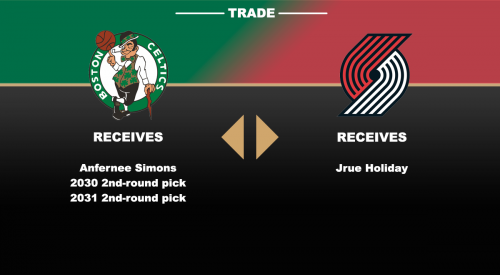
At this time a year ago, the Boston Celtics were still basking in the glow of winning their record-setting 18th NBA championship. Now, Boston is beginning to break up that title team by shipping Jrue Holiday off to the upstart Portland Trail Blazers for Anfernee Simons.
Here are the particulars:
Boston Celtics acquire: Anfernee Simons, 2030 Knicks second-round pick, 2031 Trail Blazers second-round pick
Portland Trail Blazers acquire: Jrue Holiday
Let’s dive in!
(Note: This trade is legal as part of the 2024-25 league year, but we’re going to look forward starting with 2025-26 for the analysis of the deal.)
Incoming salary: $27.7 million in 2025-26
Anfernee Simons (SG/PG, one year, $27.7 million)
Outgoing salary: $32.4 million in 2025-26
Jrue Holiday (PG/SG, three years, $104.4 million (player option for final season))
The Boston Celtics were always going to face the challenges of being a second-apron team eventually. If they were coming off back-to-back titles, Boston probably would have mostly kept this team together and dealt with the roster restrictions, frozen picks and enormous tax bills to chase a third straight championship.
As it is, the team lost in the second round and superstar forward Jayson Tatum is likely to miss all, or at least most, of next season. That meant making changes to lessen their tax burden, while pursuing getting under the second apron entirely, were going to happen sooner, rather than later.
The Celtics have now started that process by trading Jrue Holiday.
In this deal, Boston saved about $4.7 million dollars on the cap sheet and towards their apron amount of over $20 million. In terms of real dollars saved, as a very expensive, tax repeater, Boston knocked about $40 million off their tax bill.
As none of us are writing the luxury tax check, the key figure to focus on here is the second apron amount. This trade didn’t get Boston under the apron in one fell swoop, but that was never likely to happen. Moving salaries in excess of $30 million was always going to happen with some money coming back onto the books. But chipping away at the apron is a good thing. Boston is now $18 million away from getting under the second apron.
Why is that so important? The Celtics don’t want to be saddled with the various restrictions that come with being a second-apron team. Crucially, the team has already seen their 2032 first-round pick become frozen, meaning that it can’t be traded and it will drop to the end of the first round of that year’s draft. They don’t want the same to be true of their 2033 pick. Also, if Boston can dodge the second apron this year, it will begin the multi-year “thawing” process of unfreezing that 2032 pick. And, they’ll have far more flexibility to operate with their roster in the immediate.
In addition to the savings this year, Boston lopped off the $72 million owed to Holiday through the 2027-28 season. Some of that money will come back on the books, as the Celtics re-sign other players (perhaps the one they just acquired). But that long-term savings is significant for a team that is carrying a lot of long-term money.
Being very realistic, this trade (and others the Celtics are likely to make this offseason) was about the second apron. It was only sort of about actual on-court basketball. But there are actual basketball reasons for this trade too.
It can’t be understated how important Jrue Holiday was to Boston winning the 2024 title. He was everything they needed to complete that team, and he put together a very good first season in green. Last season, Holiday’s play did slip some. That meant that the combination of age, ability and contract status made him one of the most likely Celtics to be traded this offseason.
In his place, Boston adds a very different, but still effective player in Anfernee Simons. Holiday is an impactful, switchable, versatile defender. Simons…well…to be kind…isn’t that kind of defender. That means the Celtics defense takes hit, but that was always likely to happen with Tatum out and others on the trade block.
This upcoming season, Boston is likely to play a lot faster, with more of an offensive focus. That’s where Simons will fit in quite well.
Over the last four seasons, the 6-foot-3 combo guard has become a starter and taken on a bigger role for Portland’s offense. During that time, Simons has averaged 19.9 points on 44/38/90 shooting splits. A stat that will make Celtics coach Joe Mazzulla smile: Simons hit that 38% from deep on 8.5 three-point attempts per game.
The last two seasons, without Damian Lillard leading the offense, have taught us that Simons has some on-ball playmaking chops too. However, he’s not really a point guard. Without Lillard around, Simons’ efficiency has suffered some.
In his last two seasons playing off Lillard, Simons had an effective FG% of 55.1%. In the two seasons without Lillard, that’s dipped to 52.2%. That, combined with an uptick in turnovers, tells us that Simons is a good second or, ideally, third option, but not a great number one option.
Here’s the good news: Boston doesn’t need him to be the lead guy on offense. This season, Simons will get to play off Jaylen Brown and Derrick White, who will handle the bulk of the on-ball playmaking. Should Simons stick around past this year, he’ll slot in behind those two, plus Tatum. That will put Simons in his ideal role as the second or third option in most lineups, and often as a very overqualified fourth option.
Given how much offense the Celtics will lose with Tatum out, getting someone like Simons is huge. Yes, the defense takes a real hit, but the offense should be better than expected, even if it will look quite a bit different.
Thinking long-term, Simons is extension-eligible throughout the upcoming season. In the immediate, Boston could offer Simons an extension worth up to $104.6 million from 2026-27 through 2028-29. That’s an AAV of nearly $35 million. It’s unlikely the Celtics would go quite that high, given one of the goals here was to clean up the cap sheet moving forward.
After six months, Boston will be able to offer Simons even more in an extension, but that’s also unlikely to come into play. Expect things to play out on-court a bit before an extension is broached. The Celtics have been aggressive in extending their own players in recent years, but they’re living in a different world now. There’s no reason to rush into another big money deal with Simons before seeing how he looks in green first.
The Boston Celtics were always going to have to break up their 2024 title. It’s happening earlier than most expected, but it is happening. This is just the first in a series of moves Brad Stevens will make over the next year to get the books in line. Getting players like Anfernee Simons, who can play and fill a need, while also netting savings is huge. In addition, the Celtics somehow got two future second-round picks in this deal. Those could come into play as trade chips or for adding talent down the line. While it hurts to see Jrue Holiday go, this is a pretty solid return in what was essentially a “must-trade” situation.
Incoming salary: $32.4 million in 2025-26
Jrue Holiday (PG/SG, three years, $104.4 million (player option for final season))
Outgoing salary: $27.7 million in 2025-26
Anfernee Simons (SG, one year, $27.7 million)
It probably got missed by most, because the Portland Trail Blazers were a bad team toiling in the relative obscurity of the Pacific Northwest, but they played pretty good ball in the second half of the season. Over the final 41 games, the Blazers went 23-18. That’s given the team confidence that this group is turning the corner towards playoff contention.
That second-half success is part of what landed GM Joe Cronin and head coach Chauncey Billups contract extensions. It’s also why the team is willing to add Jrue Holiday to continue that push toward being a playoff team.
Holiday immediately becomes the best defensive guard on the Portland roster (Matisse Thybulle is expect to pick up his player option, but he’s a wing and not a true guard). That’s not saying a whole lot, as both Shaedon Sharpe and Scoot Henderson heavily lean towards the offensive side of the ball, as most young guards do. But Holiday will help shore things up on that end of the floor. Now Billups can deploy extremely switchable, versatile defensive lineups that include Holiday, Toumani Camara, Deni Avdija and Jerami Grant, with Donovan Clingan protecting the rim behind them. That group will be pretty tough to score on.
In addition to improving the defense, this was about helping the Blazers mature a bit. They’ve got an odd mix of mid-career vets, but had a lot of young players in key on-ball roles. Now, things can rebalance a bit, with Holiday helping to settle them down. Look at this trade as similar to the addition the Houston Rockets made by adding Fred VanVleet. That trade brought composure and normalcy to a Rockets team that was often frantic and scattered on offense. Portland hopes Holiday will do the same for them.
Of course, since it happened once already, we need to note that the Trail Blazers could flip Holiday in a subsequent trade. However, initial intel is that the team plans to keep Holiday for themselves this time around. If they do seek to trade the veteran guard, there were several teams interested before Boston sent Holiday to Portland.
On the cap sheet, this deal adds about $4.7 million to the Blazers books. They’re still about $6.6 million under the luxury tax and $14.7 million under the first apron. That’s with 14 roster spots accounted for. That means Cronin has plenty of wiggle room to shape the roster with further trades, and possibly to use the MLE (either the $14.1 million Non-Taxpayer or the $5.7 million Taxpayer variety) to round out his roster even more.
Long-term, Portland gave up some spending power. There was a world where the Trail Blazers could have hit the summer of 2026 with north of $70 million in cap space. Now, they’ll probably operate as an over-the-cap team, pending what happens with extension talks for Sharpe.
That’s not the end of the world for the Blazers. They’ve got solid pieces in place, and a handful of their veterans are on expiring contracts. This roster doesn’t feel finished with this one trade. Expect Cronin to continue tweaking it, especially in an overstuffed frontcourt. Something has to give with Deandre Ayton or Robert Williams III (both are on expiring deals), as Clingan is the hopeful long-term answer at center.
It’s also important to note that sacrificing future spending power for Holiday is essentially a trade-off from what Simons would have gotten in his next deal. He probably would have gotten somewhere in the range of what Holiday is set to make to stay in Portland. Letting Simons just walk for cap space wasn’t likely to be the play, as he’s too good for that. So, there’s probably not realistically all that much flexibility given up by acquiring Holiday now.
The Portland Trail Blazers are betting that they are even better than the team they showed in the second half of last season. They’ll need to be, because cracking the Western Conference postseason picture is quite the task. Trading for Jrue Holiday should make the Blazers better for next season. Enough better to jump several teams for even a spot in the Play-In Tournament? Let’s see what Portland does next before we answer that question.