
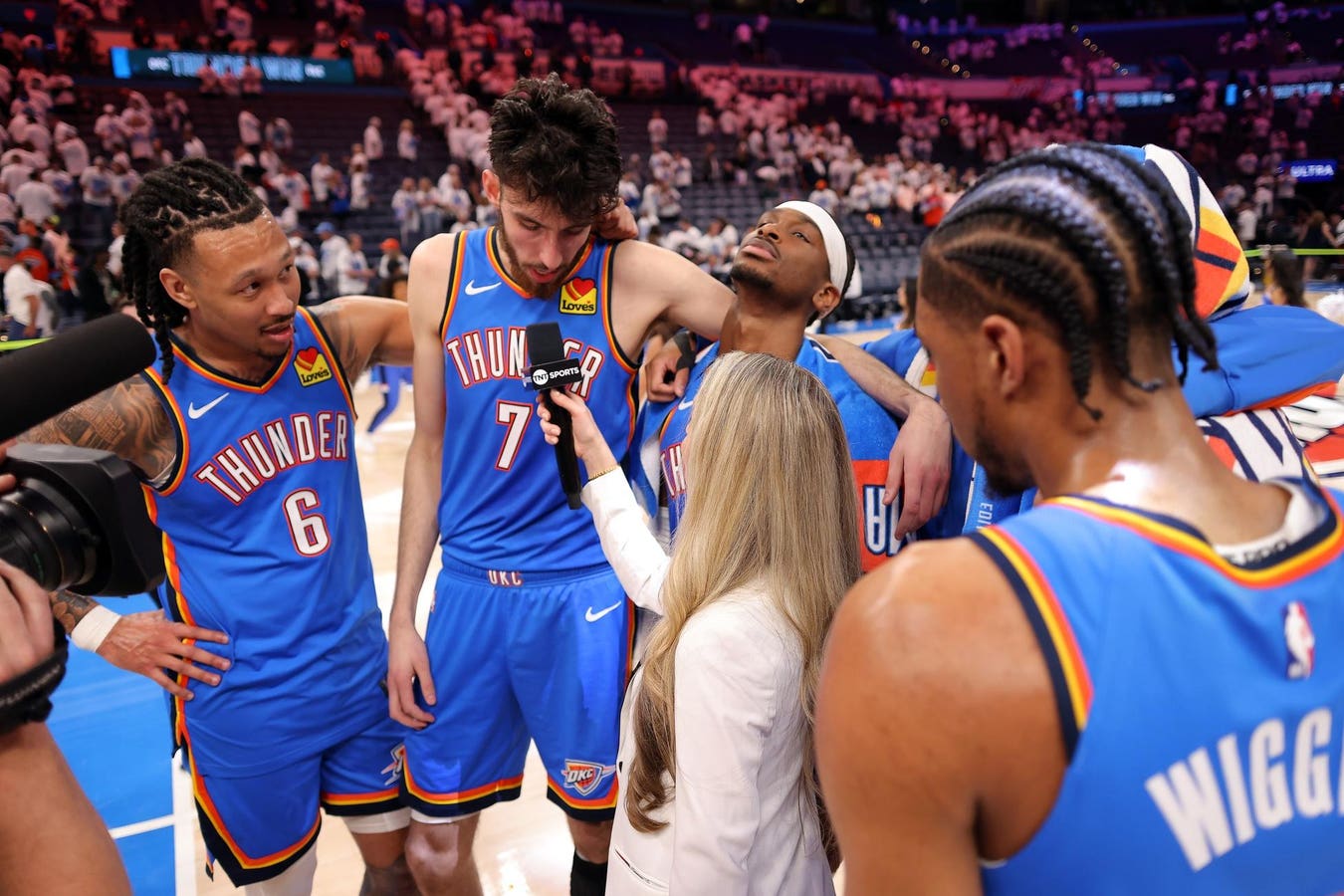
OKLAHOMA CITY, OKLAHOMA – APRIL 24: Chet Holmgren #7 of the Oklahoma City Thunder and teammates are … More interviewed following game two of the first round of the NBA playoffs against the New Orleans Pelicans at Paycom Center on April 24, 2024 in Oklahoma City, Oklahoma. (Photo by Jamie Squire/Getty Images)
Getty Images
As the NBA playoffs heat up, one of the league’s youngest teams is making waves—and not just for what they’re doing on the court.
After every Oklahoma City Thunder win something remarkable happens. As is typical for sports teams, the star of the game is asked to stay for a post-game interview. But rather than head to locker room as they do in other venues, after an OKC win the entire team stands behind whichever player is being interviewed, arm in arm. There are no scripts or cues, just the presence of the team. Sometimes the players even bark.
Chet Holmgren, Oklahoma City’s tough-minded power forward, first brought this tradition to life when he played in the NBA’s Summer League. After a standout game, an interviewer mentioned having a “dog mentality.” Chet barked. The team laughed—and then something unusual happened. It stuck.
OKLAHOMA CITY, OKLAHOMA – MAY 7: Jalen Williams #8, Jaylin Williams #6, and Chet Holmgren #7 of the … More Oklahoma City Thunder celebrate during the first half of game two of the Western Conference semifinals against the Denver Nuggets at Paycom Center on May 7, 2025 in Oklahoma City, Oklahoma. NOTE TO USER: User expressly acknowledges and agrees that, by downloading and or using this photograph, User is consenting to the terms and conditions of the Getty Images License Agreement. (Photo by Joshua Gateley/Getty Images)
Getty Images
“Chet kind of started it by accident,” said teammate Jalen Williams in an interview with Sports Illustrated. “It kind of just took off from there.”
Now these postgame moments are a ritual, even part of the Thunder’s identity. Instead of leaving the court, the Thunder players celebrate whoever had a big night and rally around him. Sometimes players wrap towels around their shoulders like capes, crowning the interviewee as the superhero of the night. Others silently stand guard, a wall of support that turns every postgame moment into something bigger than one individual.
You might think it’s all fun and games. Draymond Green of the Golden State Warriors certainly does. He’s criticized it, saying it proves OKC isn’t serious. Green is missing the point. The Thunder’s postgame activities are not about antics. They are about alignment. The Thunder players choose—night after night—to show up for their teammate. It’s a unique, even an inspiring, way of building the culture of the newest NBA team. Some of those guys in the background have never been interviewed, and perhaps they may never be. It would be easier and more convenient to slip into the locker room, beat the media traffic, and move on. But that’s not where the culture lives.
Culture lives in those unscripted moments when you decide what matters most. Oklahoma City’s players get this, choosing to be there for their teammates. They chose to honor the success of a colleague, even when they had little spotlight of their own. That’s the kind of selfless consistency every organization wants but few are willing to commit to. While the Thunder might be the newest team in the NBA, it has not stopped the franchise from teaching the rest of us about leadership.
OKLAHOMA CITY, OKLAHOMA – APRIL 24: Chet Holmgren #7 of the Oklahoma City Thunder and teammates are … More interviewed following game two of the first round of the NBA playoffs against the New Orleans Pelicans at Paycom Center on April 24, 2024 in Oklahoma City, Oklahoma. (Photo by Jamie Squire/Getty Images)
Getty Images
As Oklahoma City shows, culture isn’t built by the star player. It’s built by the ones who choose to stand behind him, arm in arm.
It’s easy to celebrate someone when you’re the one holding the mic. It takes humility, discipline, and emotional intelligence to celebrate someone else from the background—especially night after night, without expectation. That’s what makes it special. That’s what makes it sustainable.
This tradition—and culture behind it—could have easily faded away. The Memphis Grizzlies used to do something similar, but it went away. Maybe, just maybe, things are different in Oklahoma City. Perhaps the current players will be able to ensure their culture goes the distance, long after they have all moved on or retired.
In the meantime, people across the NBA are starting to notice. Tas Melas, co-host of the “No Dunks” podcast, put it nicely. “I think OKC has got the best postgame interview team in the history of the National Basketball Association,” he said. “Who does it better?”
In a recent piece at Forbes, Leyda Lazo, the founder and CEO of Human Capital Consultants International (HCCI), offered some of the reasons why this kind of team dynamic is important, no matter your business.
“In today’s rapidly changing business landscape, organizations that prioritize team dynamics don’t just improve productivity; they create resilient, adaptable teams that drive innovation and long-term business success,” Lazo wrote. “Strong team cohesion can reduce turnover, accelerate problem-solving and ensure companies navigate disruption with agility and confidence.”
OKLAHOMA CITY, OKLAHOMA – APRIL 24: Chet Holmgren #7 of the Oklahoma City Thunder and teammates are … More interviewed following game two of the first round of the NBA playoffs against the New Orleans Pelicans at Paycom Center on April 24, 2024 in Oklahoma City, Oklahoma. (Photo by Jamie Squire/Getty Images)
Getty Images
Each of us has a vital role in shaping our team’s dynamics. When a teammate is being recognized or celebrated, where do you choose to stand? Are you stepping into the spotlight beside them, or are you standing just behind—shoulder to shoulder with your team—applauding their success and lifting them higher? Because those small decisions—those “bark in the background” moments—are what build legacies that last.
In the meantime, even if the Thunder come up short this year, Williams thinks the players will keep the postgame traditions going. “Once Oklahoma gets wind of something like that, they usually stick with it,” Williams said.