

Emmanuel Perkins/Niner Times
The Charlotte Hornets landed the fourth overall pick in the 2025 NBA Draft after entering the lottery tied for the best odds at the No. 1 selection. It marks just the second time in franchise history that Charlotte will draft at No. 4; the team selected center Cody Zeller in 2013.
It is no doubt a disappointing result, but not a disaster. Charlotte still has the opportunity to land a high-level prospect who can contribute immediately and help steer the franchise toward sustained success.
But the sting is real, especially with the Dallas Mavericks, who owe the Hornets their 2027 first-round pick, now holding the No. 1 selection. The expected addition of Duke University forward Cooper Flagg could solidify Dallas as a playoff mainstay, potentially diminishing the value of that future asset.
To complicate matters, the teams directly ahead of Charlotte—the San Antonio Spurs and Philadelphia 76ers—remain unpredictable.
The Spurs, who hold the No. 2 pick, are reportedly testing the market for a blockbuster deal involving Milwaukee Bucks forward Giannis Antetokounmpo. That selection could become a centerpiece in a superstar trade, reshaping the top of the draft board.
Meanwhile, the 76ers own the No. 3 pick but are firmly in win-now mode. Whether they aim to use the pick to move off forward Paul George’s contract or acquire a ready-made contributor to support center Joel Embiid and guard Tyrese Maxey, Philadelphia’s decision could have ripple effects.
For the Hornets, the realistic player pool at No. 4 appears to have narrowed to four names: Baylor University guard V.J. Edgecombe, Rutgers University forward Ace Bailey, Duke forward Kon Knueppel and University of Texas guard Tre Johnson.
Each prospect brings a distinct identity and upside, presenting Charlotte with a critical opportunity to add a foundational piece to its young core.
Whether the Hornets value athleticism, shot creation, floor spacing or scoring versatility, these four players stand out as the most viable options at No. 4.
Courtesy of Baylor University Athletics
V.J. Edgecombe, guard, Baylor, 6’5
Edgecombe is one of the most dynamic athletes in the draft, showcasing explosive leaping ability, quick-twitch defensive instincts and an unteachable motor. He averaged 15 points, 5.6 rebounds and 2.7 stocks (steals plus blocks) per game for Baylor while standing out on the international stage with the Bahamian national team.
Defensively, he reads plays with the timing and awareness of a seasoned pro, regularly disrupting passing lanes and contesting shots well above the rim.
Offensively, he is still refining his game—his handle can be inconsistent, and he occasionally plays too fast for his own reads—but his off-ball movement, transition finishing and willingness to defend at the point of attack give him a clear path to early rotation minutes.
As his jump shot continues to develop, particularly off movement, Edgecombe’s two-way upside makes him a compelling long-term investment.
Ace Bailey, forward, Rutgers, 6’8
Bailey has long been viewed as a top-three talent in this class, and there is a real chance he falls to No. 4 depending on Philadelphia’s plans.
A fluid 6-foot-8 wing, Bailey thrives as a pull-up shooter and secondary shot creator. His scoring profile—17.6 points per game on 54% true shooting—is built around tough midrange looks and polished footwork.
He struggled with decision-making under pressure, finishing the season with more turnovers than assists.
His handle remains loose, and he rarely gets to the rim or the free-throw line. Still, he flashes real defensive potential with timely help-side rim protection and smooth movement.
In Charlotte, Bailey would bring immediate length and offensive versatility to the wing, fitting well alongside forward Brandon Miller and star guard LaMelo Ball.
His ability to provide spacing, secondary scoring and off-ball impact could boost the lineup from day one.
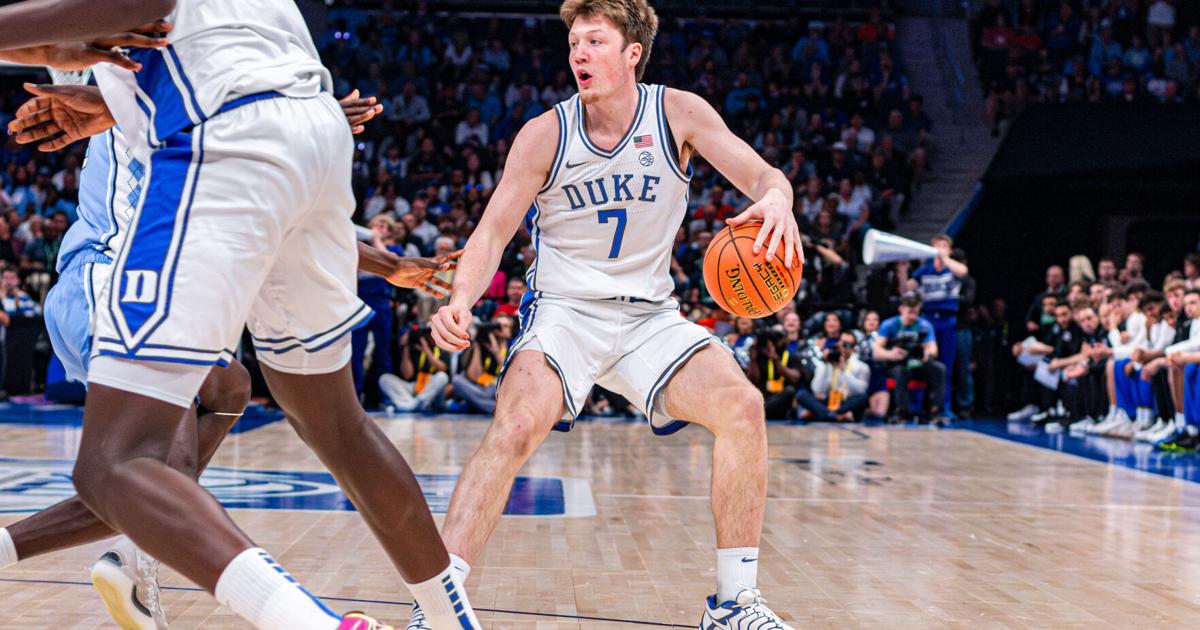
Kon Knueppel, forward, Duke, 6’7
Knueppel is the best pure shooter in the draft, connecting on nearly 47% of his spot-up 3-pointers as a freshman at Duke.
Built like a modern forward with an old-school feel, he combines physicality, high IQ and sharp passing to generate offense without dominating the ball.
While he lacks elite athleticism and can struggle defensively in space, Knueppel’s shooting gravity, off-ball movement and feel make him a strong floor-raiser for a Hornets team that ranked near the bottom in offensive efficiency.
He may not project as a future star, but as a connecting piece with elite shooting and unselfish instincts, Knueppel would give Charlotte a skill set it currently lacks.
Tre Johnson, guard, Texas, 6’6
Johnson is the most polished scorer in the class, averaging 19.9 points per game with a deep and versatile offensive arsenal.
He excels in isolation, off screens and in transition, using his size and smooth handle to create space and convert tough shots. His pull-up jumper is among the most advanced in the draft, making him a constant threat with the ball in his hands.
Johnson’s rim pressure is limited, and he tends to settle for jumpers. Defensively, he is inconsistent, showing lapses in screen navigation and off-ball awareness.
Even so, Johnson brings immediate scoring punch and could carve out an early role as a sixth man or complementary bucket-getter alongside Charlotte’s core.
Hornets’ draft outlook
In addition to the No. 4 pick, Charlotte owns the No. 33 and No. 34 overall selections in the second round. The Hornets are slated to make three picks in the top 35; only the Brooklyn Nets, with four, hold more choices within that draft range.
The first round of the 2025 NBA Draft will take place June 25 at Barclays Center in Brooklyn, N.Y., beginning at 8 p.m. The draft’s second round will be held the following night, June 26, at 8 p.m.