
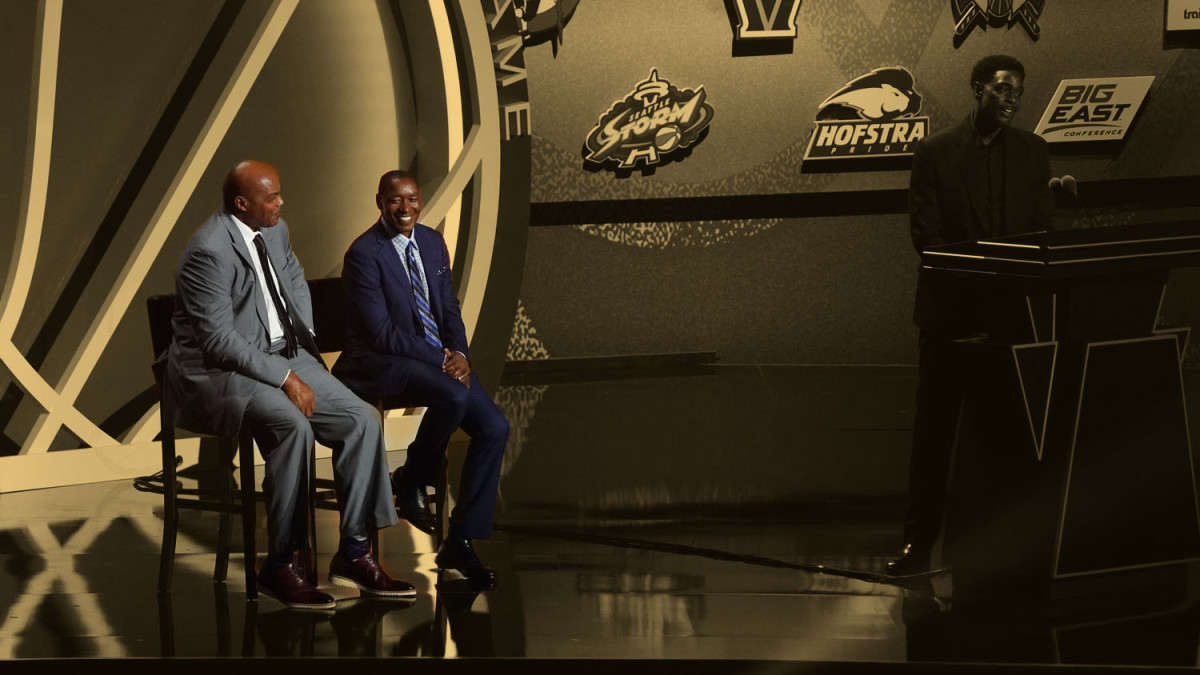
Usually, when a franchise cornerstone develops his game to the level where he is consistently earning All-NBA Team selections, the organization tends to build around his strengths to shape the team’s identity better.
However, in the case of the Detroit Bad Boys Pistons in the late 1980s, their approach was completely different. Instead of molding the team entirely around Isiah Thomas‘s offensive peak, they deliberately went in a different direction.
Advertisement
For Charles Barkley, this was a strategy worth praising. Even though Isiah was continuously registering campaigns over the 20-points-per-game mark, Detroit focused on becoming a defensive juggernaut, which battled with grit and used intimidation as its foundation to attain success.
Barkley hailed the Pistons for sticking to their plans
Between the 1982-83 and 1986-87 seasons, Isiah collected five straight All-NBA Team nods after averaging 21.3 points per game during that span. On paper, he was one of the wittiest and most versatile scoring guards in the league.
Advertisement
But the Pistons’ front office recognized the limitations of chasing a title through offense, especially after they suffered an excruciating loss at the hands of the Boston Celtics in the 1987 Eastern Conference Finals.
As a result, Detroit focused heavily on improving its defense and physicality. With enforcers like Rick Mahorn, Dennis Rodman and John Salley complementing the already rugged Bill Laimbeer, this group instilled fear across the league with their hot-headed intensity.
Over the next three years, the Pistons reached the championship round each time, largely courtesy of being a top-three defensive team in each of those campaigns.
Advertisement
For Barkley, this vision from Detroit was remarkable, especially because he understood how tough it was to commit to such a rigid blueprint as the league-wide villains. Put simply, the fact that the Pistons were content with Isiah’s scoring average falling under the 20-points-per-game mark, but their defensive gameplay being their identity was something Sir Charles had never seen before.
“When Isiah was way up there in scoring, they went from an all-offensive team to a defensive team. When they had their offensive team with Isiah, Kelly Tripucka, John Long and those guys, that’s when Isiah had those crazy handles,” Chuck said on an episode of NBA Open Court. “But it always amazes me how that team went from all-offensive, trying to outscore people, to becoming a defensive juggernaut.”
Advertisement
Bad Boys deserve more respect
Perhaps that was why Barkley insisted that fans acknowledge the Pistons’ greatness. Coach Chuck Daly’s team embraced the criticism, leaned into the hatred and only wholeheartedly weaponized it.
They did not care about being labeled as bullies who ruined the game with their unnecessary physicality; rather, they only cared about winning. As a result, by refusing to compromise, Detroit captured back-to-back championships in 1989 and 1990, proving that discipline and unwavering belief in a vision could topple even the league’s most glamorous dynasties.
Advertisement
And, given how Barkley never experienced his Philadelphia 76ers team develop such a dedicated commitment towards a blueprint throughout his prime, he understood the value of it.
Today, when the rules have changed so much, it’s safe to say we will never see a team play with that kind of defensive tenacity as those Detroit teams did.
This story was originally reported by Basketball Network on Oct 4, 2025, where it first appeared in the Old School section. Add Basketball Network as a Preferred Source by clicking here.