
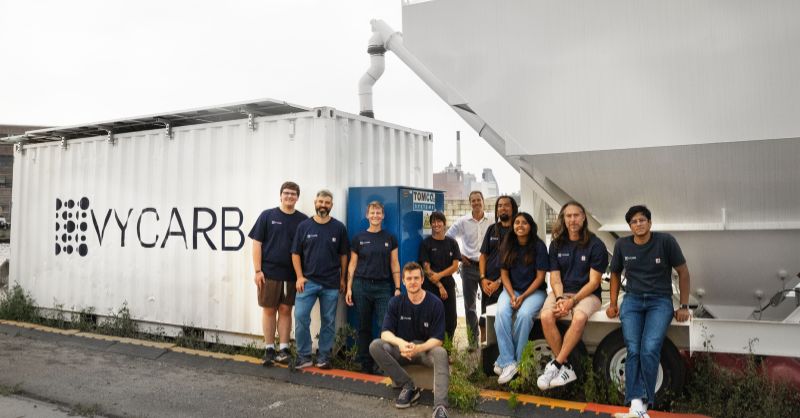
Industries like cement, steel, and shipping are under growing pressure to cut their carbon footprints, but traditional carbon capture and storage (CCS) technologies often come with big price tags and heavy infrastructure demands. Vycarb, a Brooklyn-based climate tech startup, is stepping into this gap with a distributed, water-based solution that captures low-concentration CO₂ emissions right at the source.
Vycarb’s technology converts CO₂ into a stable bicarbonate form (HCO₃⁻) using natural waters and common minerals, eliminating the need for costly purification or pipeline transport. This method slashes both capital and operational expenses, aiming for a carbon removal cost under $100 per tonne.
The company just closed a $5 million seed round led by Twynam, with backing from MOL Switch, Hatch Blue, Clocktower Ventures, Idemitsu, and SGInnovate. The funds will accelerate Vycarb’s push to commercialise its sensor-driven carbon storage systems, fully measurable and deployable on-site at industrial emitters.
Making carbon storage “permanent, fully measurable, and scalable
Vycarb was founded in 2022 by Dr Garrett Boudinot, a chemical oceanographer who developed the core technology while researching ways to speed up natural carbon cycling processes at Cornell University. His urgency around verifiable climate solutions led him to participate in the DOE-backed Activate Fellowship, where Vycarb took shape.
Vycarb’s technology rests on two core innovations: a CO₂ neutralisation process and a real-time sensor system. The neutralisation process combines CO₂ with water and alkaline minerals, such as calcium and magnesium, to instantly form bicarbonate, a stable form of carbon that remains sequestered for 10,000 to 100,000 years.
Compared to alternatives like Running Tide, which relies on sinking kelp with uncertain sequestration metrics, or Climeworks’ energy-intensive direct air capture, Vycarb offers a more affordable, verifiable, and ocean-friendly solution that also helps reduce ocean acidification.
What’s next?
With fresh funding in hand, Vycarb plans to expand its deployment pipeline and scale its flagship pilot on New York’s East River, which is already capturing roughly 100 tonnes of CO₂ per year.
Looking ahead, the startup aims to adapt its tech to handle a wider range of industrial exhaust streams and deepen ecological impact assessments to ensure environmental safety as it grows.