
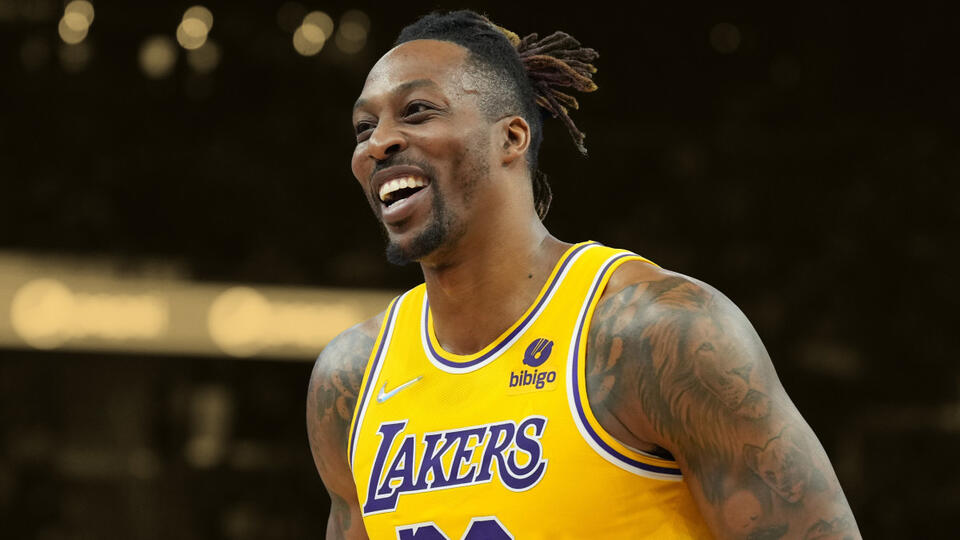
In March 2013, Dwight Howard made his first return to Florida, revisiting the Kia Center — the arena where he had spent the first eight seasons of his Hall of Fame career. Normally, such a return offers time for reflection, and Howard did exactly that — though not without controversy.
Speaking to the press, he described his former Orlando Magic squad as “a team full of people who nobody wanted,” where he was the leader who took on that role each day with a smile on his face.
Revisiting the Magic
Being an NBA superstar means knowing how every word can ignite controversy. Even the slightest slip in phrasing can turn a harmless comment into a headline — and Howard, just months into his first of two stints with the Los Angeles Lakers, learned that firsthand after describing his former Magic team.
At first glance, his remark about having played with “a team full of people who nobody wanted” sounded like a dig at his former teammates, as if he’d carried players the rest of the league had written off and he and the Magic were simply stuck with them.
However, as Howard later clarified, his words were about perception, not disrespect. After he had joined the Magic straight out of high school as the number one pick in 2004, he encountered many teammates who were veterans nearing the end of their prime, often overlooked or underestimated by other franchises. He meant that the group that fought its way to the 2009 NBA Finals simply wasn’t built on star power.
It was a fairer perspective — and one grounded in reality. During his Orlando run, Howard shared the floor with players like Steve Francis, Grant Hill, Cuttino Mobley, Hedo Turkoglu, Rashard Lewis, Jameer Nelson and Vince Carter. All were elite talents in their time, but by then some were past their peaks, others battling injuries or trying to revive their careers.
D12 faced criticism
Howard later clarified that “underdogs” would have been a more accurate description than his original phrasing, emphasizing that his Orlando team was often overlooked and underestimated in league discussions. They thrived on that perception, using it as motivation to exceed expectations, he added.
Even so, Howard’s comments sparked an immediate backlash from former teammates. Now Lakers head coach J.J. Redick, for instance, didn’t hold back.
“I’m not surprised by it,” he said. “I would be more surprised when Dwight starts taking responsibility. That would be the most negative thing I can say, but that’s the truth. You can’t take all the credit and not accept any of the blame.”
Jameer Nelson, once one of Howard’s closest allies in Orlando, called the remarks disappointing, noting that some things are better left unsaid.
Rashard Lewis, a key member of the 2009 Finals squad, labeled the comments “disrespectful.”
“We helped Dwight become the player he was,” the then-Miami Heat forward noted. “We made a good run. Hell, look at those (conference and division) banners hanging in the stands. They don’t say Dwight Howard on them.”
Howard’s words clearly hit hard for the Magic core, which turned Orlando into a contender. The three-time Defensive Player of the Year quickly sought to clarify, insisting the media had taken his comments out of context and that he had nothing but respect for his former teammates. By then, however, the quote had already reopened old wounds and undermined Superman’s reputation as an extraordinarily talented player who often let off-court distractions unnecessarily get in the way of his game.