
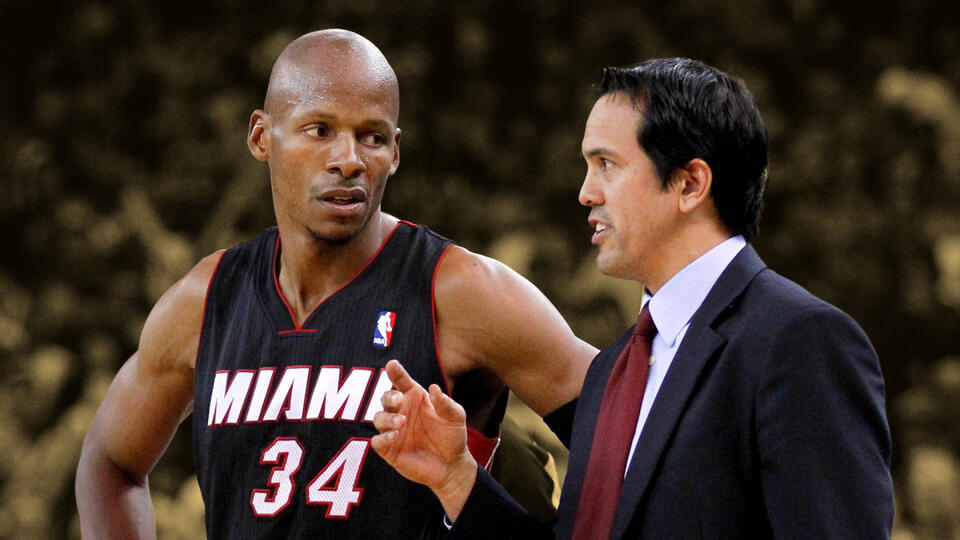
Ray Allen was already in his twilight years in the NBA when he joined the Miami Heat. Despite being in his late 30s, Allen still demonstrated an unmatched work ethic. His admirable commitment to excellence did not go unnoticed as Heat coach Erik Spoelstra quickly acknowledged it.
According to Spoelstra, what Allen brought to the Heat culture was nothing like he had ever seen before. He is no stranger to witnessing dedicated players, but he put Allen above the rest in the work ethic category.
In fact, Spoelstra and the Heat even came up with a very fitting moniker for Allen during his time at South Beach. One that speaks volumes about his unbelievable trait as a player.
“Our nickname for him is ‘Everyday Ray,'” Spoelstra told NBA.com of Allen. “It’s every day. It’s not every other day. It’s not some days. It’s every single day, Ray. His work ethic and his discipline are in the top percentage in this league. Ninety-nine percent of the players do not have that type of consistent work ethic.”
Spo credits Allen’s work ethic for his iconic 3-point shot in 2013
As expected, Allen also left his mark on Spoelstra when he cold-bloodedly hit the corner 3-pointer in the dying seconds of Game 6 of the 2013 NBA Finals. That shot became one of the most iconic moments in Finals history and arguably the greatest shot Ray-Ray has ever made in his entire career.
True to form, Allen’s iconic shot sparked passionate discussions among NBA analysts and aficionados. Some say Allen has long been very capable of hitting those types of shots, while others claim it was all about luck and timing.
However, Spoelstra revealed that it was Allen’s work ethic that made that shot possible. As it turned out, the veteran marksman had been working on it over and over again way before the 2013 Finals.
“[I’m] grateful for Ray and his obsessive-compulsive work ethic to work on that shot thousands and thousands of times, when everybody else would think that was too ridiculous a circumstance to actually try to practice something like that,”Spoelstra remarked.
Ray knew there was no shortcut to greatness
It’s hard to disagree that Spoelstra was right about Allen. Many players achieved greatness, but not everybody could commit to the process quite like Allen did throughout his career.
In fact, it’s exactly how Allen himself described his legacy. Every time he looked back on his journey, Ray-Ray couldn’t help but credit his hunger to get better for everything he had accomplished. He had always believed that there’s no shortcut to greatness, and he wants other players to realize it as well.
“When I look back at the jerseys I wore, I think to myself: ‘What a ride it has been.’ The truth is, it wasn’t easy,” Allen once reflected. “There were haters then, and there are haters now. But none of that mattered — because I put in the work. And that’s the secret: when you give everything you have, it doesn’t matter what someone else says about you…”
Truth be told, Allen deserved every recognition written all over his resume as a player. By putting in time, work and effort since Day 1, Allen collected an array of accolades that reflect his impeccable work ethic.
Among those were a consensus First Team All-American selection, Big East Player of the Year, USA Basketball Male Athlete of the Year, 10 All-Star selections, two All-NBA selections, NBA 75 team selection and a well-deserved Hall of Fame honor.