
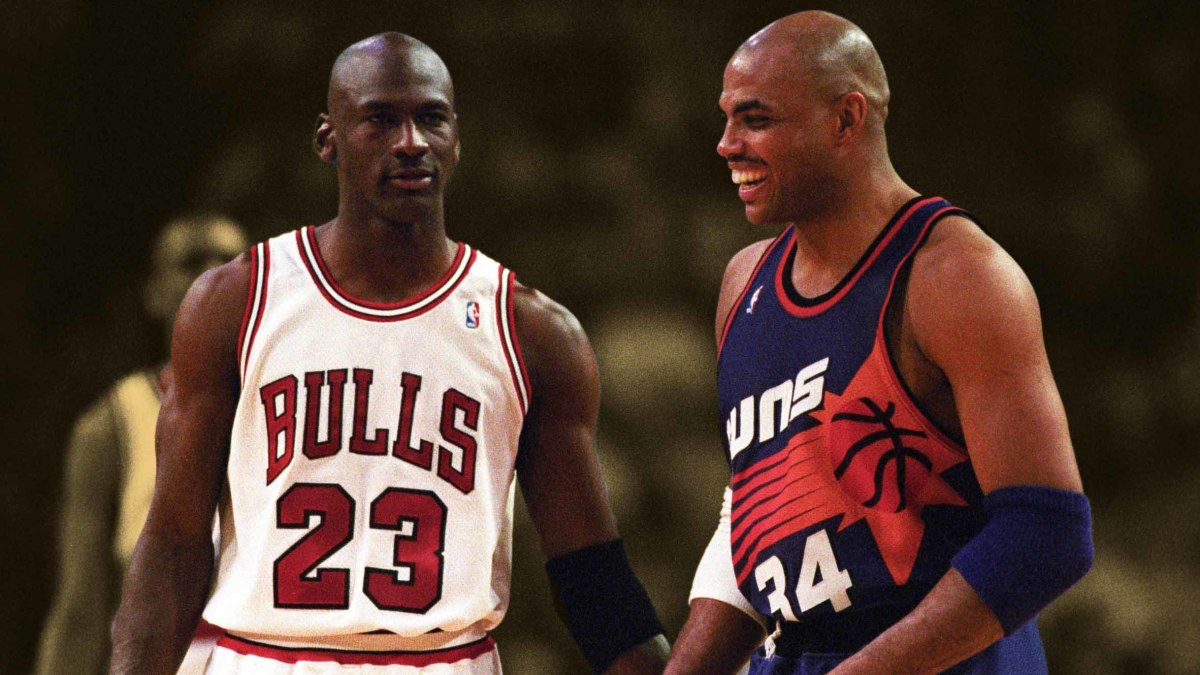
Michael Jordan left a trail of broken championship dreams on his path to building a dynasty for the Chicago Bulls. And one of the most painful casualties was his friend and long-time competitor, Charles Barkley.
Their relationship — equal parts brotherhood and rivalry — was tested in the summer of 1993, when the Phoenix Suns stood face-to-face with the Bulls in the NBA Finals.
Advertisement
For Barkley, it was more than a shot at a title. It was a personal war against a legend he’d refused to bow to for over a decade.
Facing Jordan
The Suns star convinced himself that he’d get the better of Jordan when they met and with the ring on the line. He believed he had the talent. What he lacked as the franchise cornerstone of the Philadelphia 76ers, he felt he’d finally found in Phoenix, a team good enough to stand toe-to-toe with the best.
“When I got to Phoenix, I told those guys the first day, I said, ‘Guys, we’re going to the Finals, we’re gonna play that motherf****r in Chicago,” Barkley said. “I said, ‘I’m sick of people telling me that he’s better than me. I just didn’t have no help in Philly.'”
Advertisement
The Barkley who arrived in Phoenix in 1992 wasn’t the same one who had battled in Philadelphia for eight years with little playoff reward. He was older, still explosive, but now laser-focused on changing the narrative. He’d heard the comparisons for years. The Jordan praise, the G.O.A.T. talk.
That 1992-93 Suns roster, led by head coach Paul Westphal, was built to run and shoot teams off the floor. With Kevin Johnson at point, Dan Majerle providing spacing and Barkley crashing every board and bullying defenders on the low block, they stormed through the regular season with a 62–20 record, the best in the league.
Barkley, in his debut season with the Suns, averaged 25.6 points, 12.2 rebounds and 5.1 assists per game. His impact was immediate and total, earning him the NBA Most Valuable Player award. But what loomed ahead was Jordan for a shot at an elusive championship.
Barkley’s realization
Just months before that MVP run, Barkley and Jordan had worn the same jersey, representing Team USA in the 1992 Barcelona Olympics. The Dream Team rolled through the tournament with clinical dominance, but beneath the surface of camaraderie and global fame, a quiet hierarchy was being acknowledged.
Advertisement
Coach Chuck Daly, who had coached the Bad Boy Detroit Pistons to multiple championships, knew talent when he saw it. He pulled Barkley aside during the Games and told him that he was the second-best player in the world. After Jordan.
It wasn’t a slight but a challenge. Barkley didn’t argue. But inside, he burned to shift the order. And for a while, it seemed possible. His regular-season dominance had carried Phoenix to the Finals. Jordan and the Bulls, meanwhile, were seeking their third straight title. This was the collision course Barkley had predicted from day one in Phoenix.
What followed was one of the most high-octane, emotionally draining NBA Finals of the decade. Jordan averaged 41.0 points per game across six contests — still a Finals record. Barkley put up 27.3 points, 13 rebounds and nearly six assists per game in the series.
Game 3 went into triple overtime. Game 6 came down to a John Paxson 3-pointer and a Horace Grant block on Kevin Johnson. It was blood and brilliance, and it broke Barkley’s heart.
Advertisement
“We got there and they beat us,” Barkley said. “And that was the first time I ever said in my life, ‘Damn, I think there’s somebody better than me at basketball.'”
For a man who had clawed for respect for years — through stacked rosters in the East, through MVP-worthy campaigns, through public criticism of his weight, attitude and lack of rings — those words carried weight. Barkley had always believed he could outrun and outfight the narrative. But Jordan, once again, rewrote the script.
The Suns never made it back to the Finals during Barkley’s tenure. And while his career remains a Hall of Fame blueprint, the 1993 Finals became his personal ceiling — the moment he realized even greatness had its shadow.
That summer locked in Jordan’s three-peat and sent him into temporary retirement. Barkley, meanwhile, kept chasing. But deep down, he already knew.
He’d swung as hard as he could. And Jordan hadn’t flinched.
Related: “I’m motivating Charles to get on my level” – MJ on why he could say anything to Barkley