
The Nuggets rallied
for an impressive Game 1 win; the Thunder won big in Game 2. Who
has the advantage heading back to Denver in the second round of the
NBA
playoffs?
Now, the real chess match begins with a critical Game 3.
With the NBA playoff series between the Oklahoma City Thunder
and Denver Nuggets tied, the battleground for the next two games
shifts to the Mile High City, where altitude, crowd noise and
routine give the Nuggets one of the league’s true home-court
advantages.
Each team has won in dramatically different fashion: Denver’s
Game 1 comeback showed the composure of a team that’s been to the
mountaintop, while Oklahoma City’s Game 2 demolition was a
blueprint in how youth and urgency can smother even the most
experienced rosters.
Game 1 was a grind. Nikola Jokic put up a 42/22/6 line, Aaron
Gordon delivered a 3 in the final seconds and the Thunder unraveled
late despite leading by 11 with under five minutes to play.
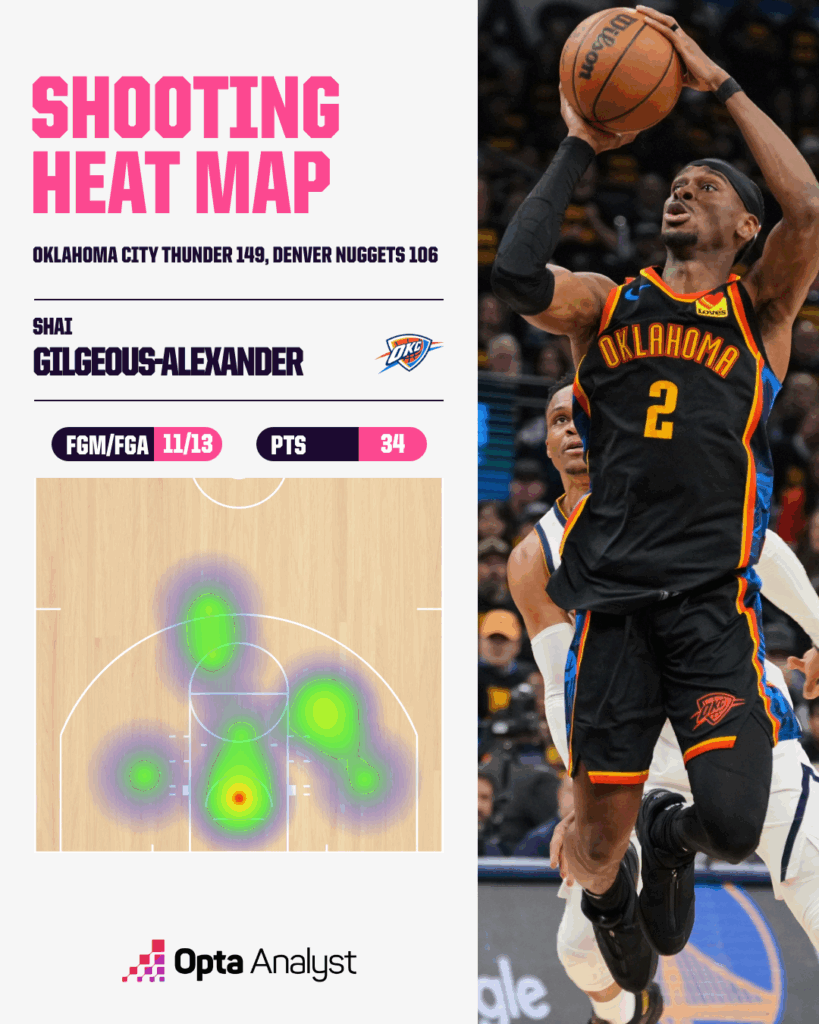
In contrast, Game 2 was a haymaker. The Thunder dropped 87
points in the first half – an all-time playoff record – behind a
master class from Shai Gilgeous-Alexander and strong bench
play.
As the Western Conference semifinal resets to Denver, the focus
shifts to execution under pressure. Can Denver reassert control
through structure? Can the Thunder bring their force to the road
and string together stops?
The spacing adjustments of Mark Daigneault’s team paid off in
Game 2. Pulling Jokic away from the rim opened driving lanes for
SGA and kick-out 3-pointers. Denver tried multiple defensive
coverages, including zone, where it had some success in Game 1. But
the Thunder found ways to puncture it, often with smart relocation,
decisive passing and deep spacing that forced Denver into difficult
closeouts.
Such improved offensive performance against the zone provides
the Thunder with another lever to pull from, especially if Denver
leans on that defense to protect foul-prone lineups or buy rest for
Jokic. The Thunder, meanwhile, haven’t been
aggressive in doubling Jokic, but they’ve consistently shown
early help and forced him to operate in a crowd. The goal is to
shrink his vision and make him play through bodies – sometimes even
before the catch.
That strategy worked well in Game 2, but Denver’s supporting
cast tends to play better at home. Daigneault may need to adjust
the time and rotation of the Thunder’s help principles to avoid
giving up rhythm 3s and keeping Jokic off balance.
Game 2 showed OKC’s depth is a real weapon. Now the Thunder must
prove they can weather momentum swings on the road.
No Adjustment Too
Small
A subtle but telling glimpse into how OKC handles variability
can be traced back to a tactic known as “flipping the court” – when
a team opts to defend in front of its own bench in the first half
rather than the second. It’s a decision the road team controls,
though few regularly use it.
The San Antonio Spurs, under Gregg Popovich, made it a staple,
and teams connected to his coaching tree have adopted it in turn.
In Game 6 of the 2016 Western Conference finals, it was the Golden
State Warriors – not previously known for using the tactic under
Steve Kerr – who made the decision. Facing a raucous Thunder crowd
and needing a win to force a Game 7, the Warriors flipped the court
to play defense in front of their bench early.
That subtle adjustment, combined with their second-half poise
and precision, left a lasting impression on then-Thunder assistant
Mark Daigneault. He saw how a minor structural shift could help a
team steady itself in chaos.
Since becoming a head coach, Daigneault has leaned into that
idea – occasionally flipping the court himself, and more broadly,
challenging his team with altered environments so it’s always ready
to adjust. The Thunder’s ability to stay composed through changing
matchups and game flow reflects that foundation, and it also
underscores Popovich’s enduring imprint on how the game is
coached.
On Denver’s side, the adjustments are less available, and the
curiosity lies in how interim head coach David Adelman navigates
the moment. This is his first postseason at the helm, and with the
Thunder showing their willingness to change coverages and schemes
throughout games, how he responds – especially in tight moments –
will matter.
Expect Oklahoma City to continue to try to pull Jokic into space
and test his lateral movement in high pick-and-rolls. Adelman will
need to find ways to limit the All-Star center’s defensive
exposure. But even that won’t be enough without help around the
edges.
Denver’s depth is a known concern, and the burden Jokic is
carrying – not just to produce, but to orchestrate every possession
– has begun to show. He’s still putting up numbers, but it’s the
mental toll that stands out. Every possession matters, every
mistake feels amplified, and with inconsistent contributions around
him, that weight grows heavier.
Adelman must find ways to insulate him, not only by surviving
non-Jokic minutes, but by getting real production from the
supporting cast. Whether it’s Gordon facilitating in the middle of
possessions, Braun as a live-wire cutter, or Porter as a spacer
with decisiveness, Game 3 is when Denver must shift the tone and
put pressure back on OKC.
Chet Holmgren remains a swing piece: He fouled out in Game 1 and
followed with a double-double in Game 2. Denver will continue to
test his frame and decision-making.
Gordon, the Game 1 hero, was overwhelmed in Game 2. He sets
Denver’s defensive tone.
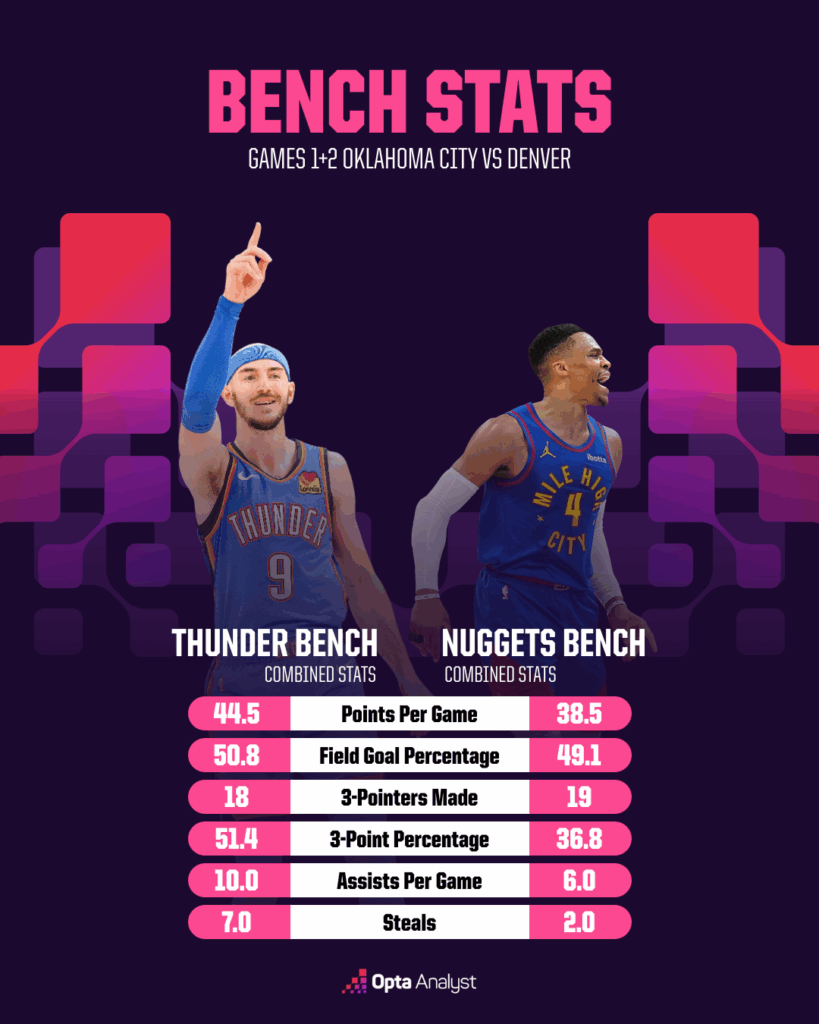
OKC’s bench – namely Isaiah Joe, Alex Caruso, Cason Wallace, and
Aaron Wiggins – was outstanding in Game 2. If those players
maintain that level on the road, it’s a major advantage.
What Will Turn the
Tide?
There are three things to watch closely in Game 3.
First, the opening six minutes. In playoff basketball, early
tone-setting can tilt the emotional and tactical balance,
especially in a new environment.
Second, how OKC challenges Jokic defensively. The Thunder will
likely test him in space with more 1-on-1, forcing him to defend
without fouling.
And third, how Adelman can generate clean looks for Jamal Murray
and Michael Porter Jr. If Denver is going to open the floor, it
starts with those two finding rhythm. Murray’s two-man game with
Jokic remains a constant, but they need to find easier, earlier
touches for Porter – especially against a Thunder defense that
closes space quickly in rotation. Adelman’s ability to make those
reads could shape the series.
We’ve seen what both teams can do. Now it’s about who can
adjust, execute and endure. Denver has the experience. OKC has the
legs.
The next two games will reveal who’s more adaptable – and more
composed – when it matters the most.
For more
coverage, follow along on social media on Instagram, Bluesky, Facebook and X.