
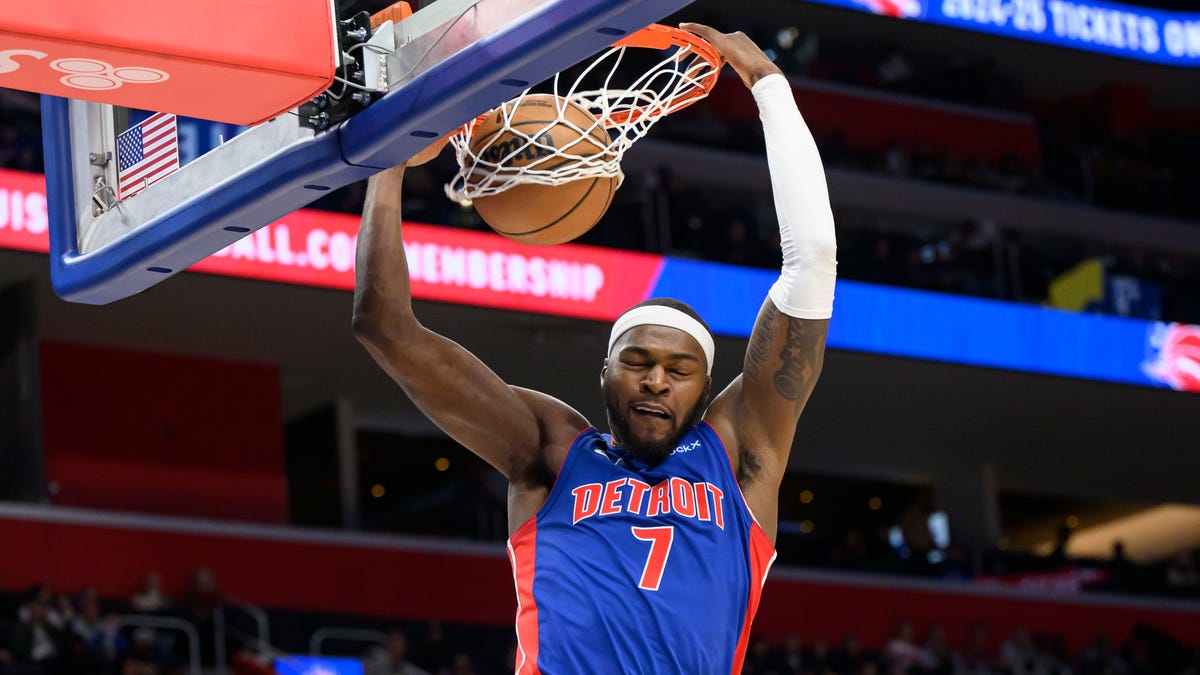
Chicago — After every game, one of the first things Paul Reed does is grab a scorebox, similar to many of his teammates and colleagues around the league. He isn’t looking for the number of points he scored that night, nor is he searching for his rebounding numbers.
Reed checks for his plus-minus number. The statistic gives him an indication of his overall impact and how the Detroit Pistons performed during his minutes on the floor.
“For a guy like me, I know I am not going to be the one who scores 30 every night; that is not what they want from me,” Reed said. “For me, it’s all about winning. I just try to play winning basketball. I try to be a plus every game. When I am on the court, making sure that my team is doing good.”
The NBA’s plus-minus statistic measures the difference in points scored by a team while a player is on the floor. The higher the number, the greater impact that particular player had on the game.
Ending each night with a positive plus-minus is one of Reed’s top priorities when he steps onto the court. It’s not about being self-absorbed; instead, it’s about his contributions to the Pistons’ success by focusing on underrated aspects of the game — such as setting screens and making the extra pass to create better shot opportunities for his teammates.
“Paul Reed is one of those guys who is always ready,” Jalen Duren said. “That is a skill within itself. To not know when you are going to play, but to always be ready when your number is called and you are producing. He never misses a beat. Credit to him. He is a testament to the type of team we are.”
Reed became enamored with the statistic as a young second-round prospect as a member of the Philadelphia 76ers. During the early stages of his career, it bothered Reed each time he saw a negative number next to his name.
It motivated Reed to develop a unique niche that allowed him to influence the game in various ways. It was his way of accepting his role as a gritty, versatile big man to thrive at the NBA level. Reed’s fondness for plus-minus has also become the basis for how he has earned coach J.B. Bickerstaff‘s trust.
“He’s been phenomenal. Anytime he gets a chance, he presents problems,” Bickerstaff said. “I haven’t seen a big guy that’s as active as him on the perimeter, or in pick and roll, how he comes up with deflections and steals. He changes the game.”
Reed received a great deal of playing time during the preseason due to hamstring tightness that kept Duren out of the first two games. Reed played an average of 15.2 minutes, recording 7.0 points and 6.5 rebounds. He led the Pistons in plus-minus at 12.8.
Reed is accustomed to stepping up in a player’s absence, given it was his primary role for the Pistons last season. However, his preseason performance has forced Bickerstaff’s hand to find him a consistent role for the 2025-26 season.
Bickerstaff considers it a “great problem to have,” knowing that every time he calls on Reed, he is calling on a winning player.
“For me, it is all about making the guys around me better,” Reed said. “Making sure that guys like Duncan (Robinson) and Cade (Cunningham) are getting open looks because eventually, that is going to open up the game for me. … It’s all about winning, and winning isn’t easy in the NBA. You have to do the hard things sometimes.”
coty.davis@detroitnews.com
@cotydavis_24