
We spent all summer discussing how, with tempered expectations following a roster overhaul, it would be nice to enjoy a Boston Celtics season in which every loss didn’t feel particularly soul-crushing.
That lasted all of 48 minutes.
The new-look Celtics triggered some old fourth-quarter PTSD during their 2025-26 season opener on Wednesday night, fumbling away a 13-point lead as the visiting Sixers scored a ghastly 42 fourth-quarter points to escape TD Garden with a 117-116 triumph.
Boston’s janky final possessions — and general late-game unsteadiness — underscored what we already knew: This team is very much a work in progress. The term “Growing Pains” got thrown around so often in our postgame breakdown that you would have thought the Seaver family from the 80s sitcom was getting a 2025 reboot.
It’s going to take some time for the Celtics to figure out what life looks like — not only without all the talent that departed, but also without Jayson Tatum on the court in key late-game moments. Regardless, Boston absolutely should have won Wednesday’s opener, even with Sixers star Tyrese Maxey and rookie VJ Edgecombe combing for 74 points. We suspect it won’t be a very fun film session for players before the team travels to New York on Thursday.
If you take a step back, there were some encouraging signs for the Celtics. Derrick White looked like an All-Star, Neemias Queta was outstanding before he fouled out in the final moments, and a slimmed-down Xavier Tillman held up well against Joel Embiid (even if the former MVP was a shell of himself).
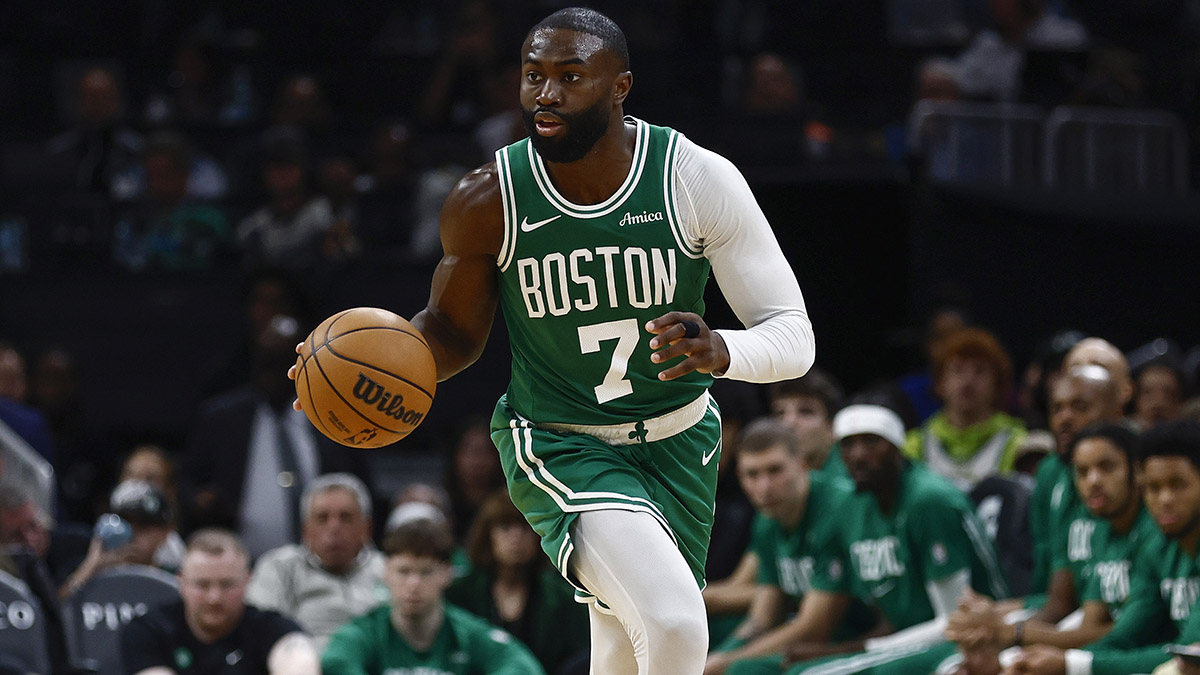
But the biggest reason for Celtics optimism ought to be the play of Jaylen Brown.
Brown played a composed game, quietly generating 25 points on efficient 9-of-18 shooting to go along with six rebounds, four assists, and only two turnovers in 36 minutes and 14 seconds of floor time. Brown attacked the basket with purpose and routinely tried to set up teammates with the attention he drew.
The Celtics simply did not make shots.
Brown finished with 15 potential assists, per NBA tracking. That was tied for the eighth-highest total across the NBA’s full slate of opening night games. That mark also nearly doubled his season average from last season (8.3 per game).
But the Celtics generated just 10 points off Brown’s four assists, an alarmingly low output when you consider that, as an example, Chicago’s Josh Giddey generated 28 assist points off his 15 potential assists (11 actual assists) in the Bulls’ opening-night upset of Detroit.
The NBA’s advanced tracking suggests that Brown’s passes led to 19 total shot attempts Wednesday night. The Celtics made just seven of those attempts (36.8 percent). What’s more, the trio of White, Payton Pritchard, and Anfernee Simons were just 4-of-15 shooting (26.7 percent) off of Brown’s feeds, and accounted for just one of his four assists overall.
It didn’t take long to be reminded that it’s a make-or-miss league. Boston has more issues than shot-making to tackle, with late-game execution chief among them. It’s disappointing that Brown didn’t get a chance to win the game in the final seconds, though both player and team have to work harder to get him that look.
But if you want to boil it down, the Celtics missed a whole bunch of shots, and Maxey/Edgecombe felt like they rarely missed. It was jarring that a rookie played with more poise than Boston’s title-tested core.
The Celtics generated a mere 16 assists on 41 field goals, or just 39 percent of their makes. That was Boston’s lowest home efficiency since a Nov. 27, 2013 loss to Memphis, per our stats guru Dick Lipe. That would have been Brad Stevens’ first season at the helm and a 25-win season for Boston.
Despite dealing with a hamstring tweak entering Wednesday’s opener, Brown held up well on both ends. The Sixers were 5-of-16 shooting (31.3 percent) when Brown was the primary defender, highlighted by Embiid being scoreless on 0-for-5 shooting with Brown defending.
Brown was credited with 17 drives (tied for 10th-highest on opening night), though he went just 1-of-4 with both of his turnovers off those plays. He passed on 58.8 percent of those drives and generated just two assists, yet again emphasizing how poorly Boston shot off the attention he drew. Last season, Brown topped Boston with 12.7 drives per game, shooting 51.7 percent and passing on 35.1 percent of those drive attempts.
We suspect that, if Brown plays with the sort of unselfishness we saw Wednesday night and the Celtics make their shots, Boston won’t be left sweating final possessions.
But the opener was a good reminder that the margin for error is so much slimmer with this team.