
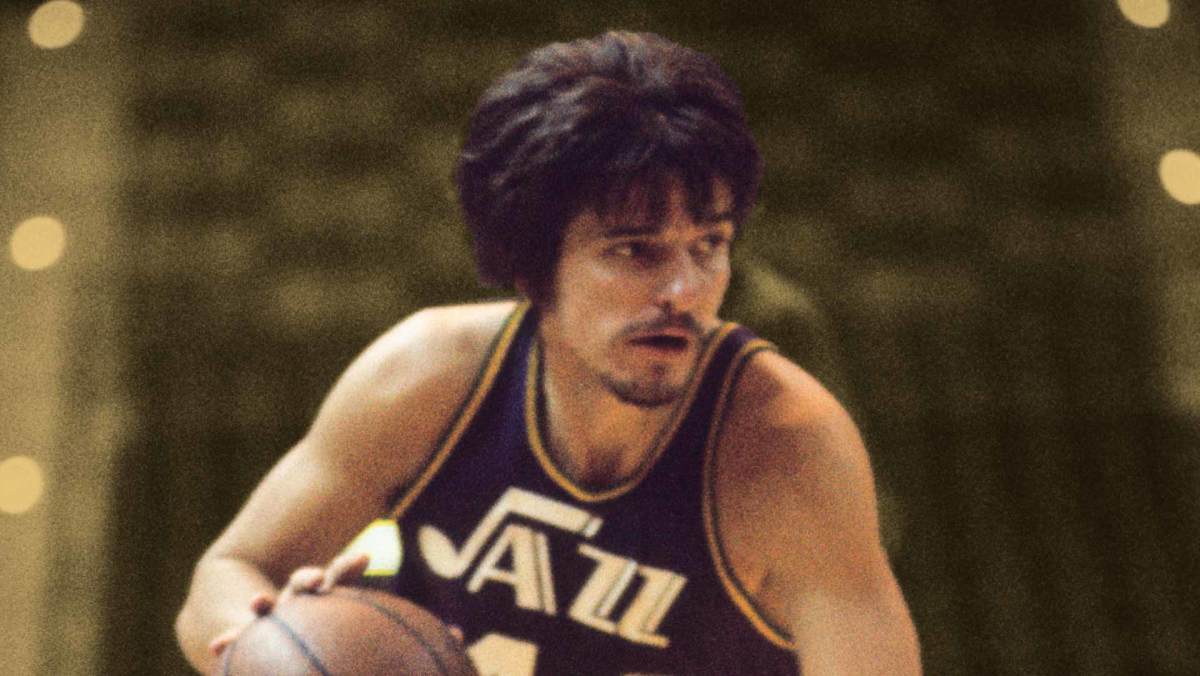
When you think of “Pistol” Pete Maravich and his dazzling brand of on-court wizardry, it’s easy to imagine every front office in the league bending over backwards to keep him happy.
In New Orleans, though, things didn’t always work that way. Instead of harmony, there came a stretch marked by rising friction — something Maravich clearly felt and eventually voiced, when he publicly criticized his Jazz general manager, sparking one of the NBA’s most infamous player–management feuds.
Advertisement
Maravich sparked the Jazz in early years
When Maravich joined the New Orleans Jazz in 1974 after being traded from the Atlanta Hawks, he arrived at a franchise still in its infancy. Like many expansion teams, the Jazz were struggling to find their footing — both on the court and in the front office.
The challenges were immediate. The Jazz entered the league without a hint of postseason pedigree, hosting home games in patchwork settings like Loyola Fieldhouse — a place where a net had to be strung along the sidelines just to keep players from tumbling into the crowd.
Advertisement
After a shaky introduction to the NBA, the former LSU Tiger settled into his groove in the Big Easy. By his third year with the organization, Pistol Pete had earned All-NBA First Team honors twice and even led the league in scoring in the 1976-77 season, averaging a blistering 31.1 points per contest.
Even as chaos engulfed the franchise, Maravich continued to mesmerize. Still, the brilliance of one of the game’s most electrifying players could not protect him from a move the front office plotted behind his back.
Exploding over trade talks
Tensions reached a breaking point when the then–Jazz General Manager Lewis Schaffel tried to trade Maravich without informing him, sparking a blistering public outburst from the 6’5″ point guard.
Advertisement
According to Sports Illustrated, Maravich tore into Schaffel, branding him a “lying, backstabbing son of a b—h” who had been out to get him from day one. He claimed the GM “didn’t know a basketball from a turkey bladder” and even quipped that Utah might reach the playoffs if Schaffel took a vacation — preferably to war-torn Iraq.
Taken on its own, Maravich’s reaction appeared extreme. Just keep in mind that franchises routinely explore trade possibilities, and even star players aren’t exempt. Furthermore, the Jazz even had some justification for gauging Maravich’s market value — after all, the former five-time All-Star was often as polarizing off the court as he was electrifying on it.
Maravich’s life away from basketball was a swirl of eccentricities and struggles: dabbling in multiple religions, professing belief in aliens — even painting “Take Me” on his roof to attract UFOs — and battling alcohol issues, with reports of him showing up to games under the influence. Moreover, his knees were deteriorating and while his flair-driven style thrilled fans, it didn’t always mesh with winning basketball.
Advertisement
It’s also not hard to see why the front office might quietly test the waters without alerting him. Letting a star know he’s on the market can backfire if talks go nowhere, leaving the player feeling unwanted — and eventually walking away at the end of his contract without the team getting any return whatsoever.
However, in fairness to Pistol Pete, Sports Illustrated noted that he was playing some of the best basketball of his career at the time, which sparked a rare 10-game winning streak for the Jazz. When you go from giving everything on the floor to suddenly feeling undervalued, it’s easy to see why Maravich’s remarks toward Schaffel cut so sharply.
This story was originally reported by Basketball Network on Oct 26, 2025, where it first appeared in the Old School section. Add Basketball Network as a Preferred Source by clicking here.