
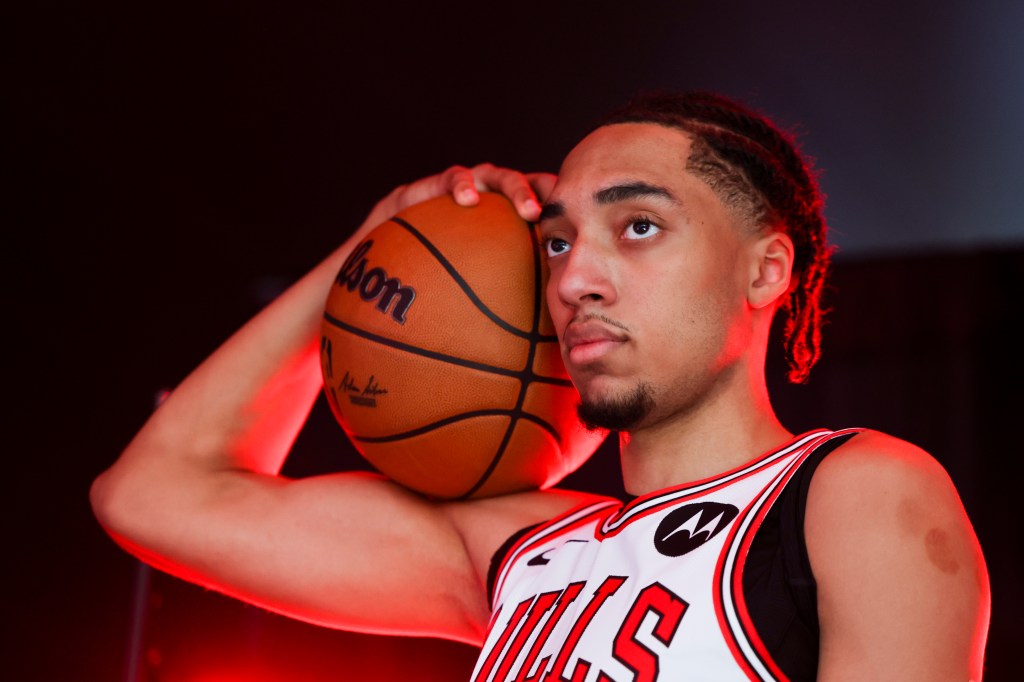
Ninety minutes before the Chicago Bulls season opener against the Detroit Pistons, Noa Essengue already had suited up in his entire uniform.
The rookie sank back in his chair tucked into the corner of the home locker room at the United Center. The room hung quiet with the pitter-patter of pregame preparation until Dalen Terry walked in. The third-year forward took one look at Essengue — jersey bunched under his warmup shirt, buttons snapped up along the sides of his tearaway pants — and burst out laughing.
“Look at this,” Terry said with a grin. “He’s ready to go.”
Essengue ducked his head in response. Sure, he was eager, but that wasn’t a source of embarrassment. Of course he was ready to go. He hd been ready since the Bulls drafted him with the No. 12 pick in June. Maybe even earlier than that. This wasn’t just the first game of his rookie season. It was his first time ever attending an NBA game. Essengue just wanted it all to begin — the game, his rookie season, the rest of his NBA career.
The waiting was the worst of it. Essengue soaked in the anthem and introductions. He sat patiently on the bench as the starting rotation carved out an early lead. Minutes ticked off the clock. Other low-rotation players — Terry, Julian Phillips — cycled into the game. Essengue remained stuck to the bench.
“Of course I was a little disappointed,” Essengue told the Tribune. “But being there, it was a dream. It was very fun. The game was really cool. And we got out with the win, so that was the most important thing.”
Four games later, Essengue is still waiting. The rookie did not play a single minute in the first week of the season as the Bulls started 4-0 entering their Friday night NBA Cup matchup against the visiting New York Knicks. This is an anomaly among rookies in the NBA, in which 50 other first-year players logged at least two minutes in the opening week.
It’s not for lack of faith in Essengue’s potential. The Bulls believe in the rookie. That’s why they selected him with a hard-won lottery pick that was secured as the cornerstone of a three-team trade that sent Zach LaVine to the Sacramento Kings at the deadline in February.
The Bulls think Essengue could be a building block for the future. So why isn’t he playing right now?
This isn’t the first time the Bulls took a laboriously deliberate approach with the development of a rookie. Last year, coach Billy Donovan kept Matas Buzelis on a strict regimen throughout the early months of the season, yanking the young forward off the court for minor mistakes and doling out extra playing time in measured increments.
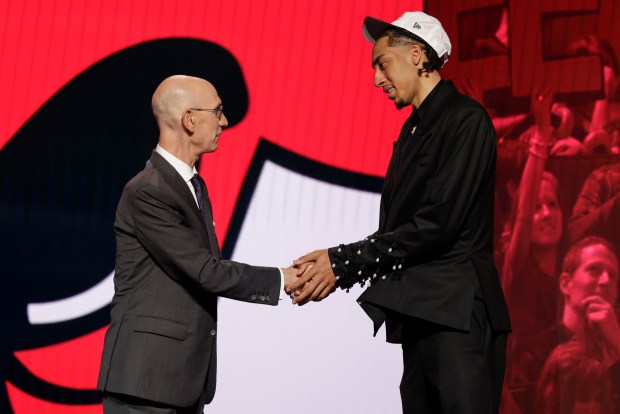 Noa Essengue greets NBA Commissioner Adam Silver after the Bulls selected him with the No. 12 pick in the NBA draft June 25, 2025, in New York. (Adam Hunger/AP)
Although it infuriated fans at the time, that method ultimately won out with the success of Buzelis’ development. Donovan finally dropped the short leash after the All-Star break, at which point Buzelis soared through the final stretch of the season with untethered confidence. And that somewhat truncated rookie season delivered Buzelis into his second year with the Bulls as a reliably consistent starter.
Donovan didn’t fully reveal the method behind his approach with Buzelis until midway through the forward’s rookie year. The coach has been more upfront about Essengue, whom the Bulls labeled as a “project” even on draft night.
By the time Essengue landed in Chicago, he knew that his first year as an NBA player would be limited. No matter how well he performed in preseason and practice, Essengue understood he would have to earn every second on the court this season.
“That’s the process,” Essengue said. “Take my time, acclimate with the league, learn the rules and the way people play, get used to the physicality. That means the first part of the season I don’t play that much. It asks me to prove to the coaches I’m ready to play.”
But even Buzelis saw more playing time than Essengue in the opening week of his debut season. He logged just under five minutes in last year’s season opener against the New Orleans Pelicans and missed only one game while averaging 13.2 minutes of playing time in the first two months.
Thirteen minutes isn’t much to work with, but it’s still better than nothing. So why isn’t Essengue getting the same rookie treatment?
The answer to most questions surrounding Essengue revolves around his age.
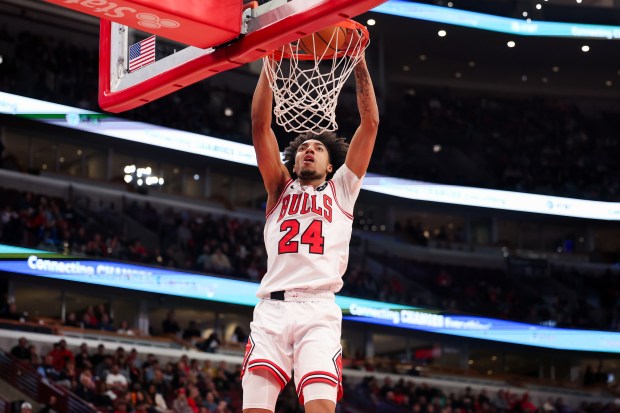 Bulls forward Noa Essengue dunks the ball in the fourth quarter in a preseason game against the Timberwolves on Oct. 16, 2025, at the United Center. (Armando L. Sanchez/Chicago Tribune)
Buzelis was green enough as a 20-year-old rookie. Essengue is a full two years younger, with a 19th birthday still more than a month away in December. That age gap is reflected on and off the court. Essengue is more introspective, a little less rowdy. His shooting form still needs to be honed. And his body still carries a boyish awkwardness accentuated by lanky limbs and a slender frame.
In the preseason, Donovan made clear that he believes Buzelis was further along than Essengue at this same point in his rookie season — more polished off the dribble, more explosive, more active. That’s not meant to discredit the promise of Essengue, whom Donovan also describes as a more instinctive defender than Buzelis. But the coach is blunt about the realities of developing a rookie this young.
“He’s got to invest a lot of time in his body,” Donovan said. “He’s got to learn to play a little bit lower to the ground because he does lack a little bit of strength. He doesn’t really do much off the dribble and when he’s cutting, the physicality is moving him off screens and out of place. Those will all be part of his development.”
The Bulls might eventually send Essengue down to get some playing time with the Windy City Bulls. But not yet. The G League season doesn’t even begin for another week. And for now, the Bulls believe there is a greater value in keeping Essengue close to the first team as he learns what it means to be a professional athlete at the highest level.
It’s difficult to quantify how much a rookie can grow by simply watching. Essengue is still learning how to eat and drink and sleep and sit and talk and listen like an NBA player. There’s too much to learn, a constant overflow of information. The only way to soak it all in is to slow down, to trust that eventually all of this will transform into a habit.
Essengue, for his part, embraces this learning curve. He wants to understand the court vision that makes Tre Jones a dynamic playmaker, the timing that puts Buzelis and Patrick Williams into the correct defensive positioning. Off the court, he studies the patterns and routines of veterans such as center Nikola Vučević.
And while Essengue’s teammates know he won’t be factoring into games early in this season, they welcome the opportunity to offer their own experience to a younger player.
“It’s just part of his growth,” Vučević said. “We all have to work through it. Sometimes we’re going to play, sometimes we’re not. But I think it’s good for him to be around us, practice with us, be involved in the games and just stay ready.”
Game days are still a grind for Essengue. The work just happens a few hours before tipoff.
At 4:30 p.m. on any given home game day, Essengue can be found on the court at the United Center. He’s typically flanked by assistant coach John Bryant and player development coach L.D. Williams, two members of the staff assigned to the rookie’s progression.
Pregame workouts for Essengue are more taxing than for other players. Bryant and Williams put Essengue through circuit drills — clear out to the 3-point arc, catch a pass, take a dribble, make a move, dunk at the rim, repeat 20 times.
If a coach knocks a shoulder into Essengue for an obvious foul during a one-on-one drill, no one comments on it. If the rookie drags his toe an inch too far while picking up his dribble, Bryant shouts out the travel call and forces him to start again. Every warmup session ends with sideline sprints, Essengue dropping his head to shake off fatigue as he runs alongside his coaches.
These workouts are the closest Essengue has been to playing on the United Center court over the last week. They take place almost an hour before fans are allowed access to their seats. Yet despite their anonymity, these sessions represent the work necessary for the rookie to earn his first minutes with the Bulls.
Essengue believes he has made progress since his Summer League games in July. He can read the game more quickly, take fewer dribbles before moving off the ball. The progress is slow, but that’s expected. And the same is true of his debut.
“There will be a time for me,” Essengue said. “But there’s a lot to do before then.”