
After an encouraging first three games, this week was the ultimate reality check for where the Charlotte Hornets stand as the young season unfolds. It began with bad news on forward Brandon Miller, who has no timetable to return from a shoulder injury, though tests ruled out the worst-case scenario.
Charlotte’s 3-4 record paints a clear picture: the Hornets can beat the league’s bottom feeders but still have work to do against the more physical, playoff-caliber teams. Their three wins have come against the Washington Wizards, Brooklyn Nets and Utah Jazz, all teams projected to finish near the bottom of their conferences.
Their four losses to the Miami Heat, Orlando Magic, Minnesota Timberwolves and Philadelphia 76ers followed a familiar pattern—three competitive quarters and one rough stretch that ultimately cost them the game.
That comes with being the youngest team in the NBA. The Hornets are still learning how to stack together full 48-minute efforts, and that should shape expectations for fans going forward. With how many inexperienced players Head Coach Charles Lee is relying on night to night, the spotty play at times is understandable, but so is the excitement about where this group could be headed.
Three losses, same story
Each loss this week followed a similar script. Charlotte competed early but couldn’t sustain the same defensive focus or composure long enough to close games.
The Hornets continue to struggle with size and physicality, especially at the point of attack, where too many drives led to open threes or uncontested looks at the rim.
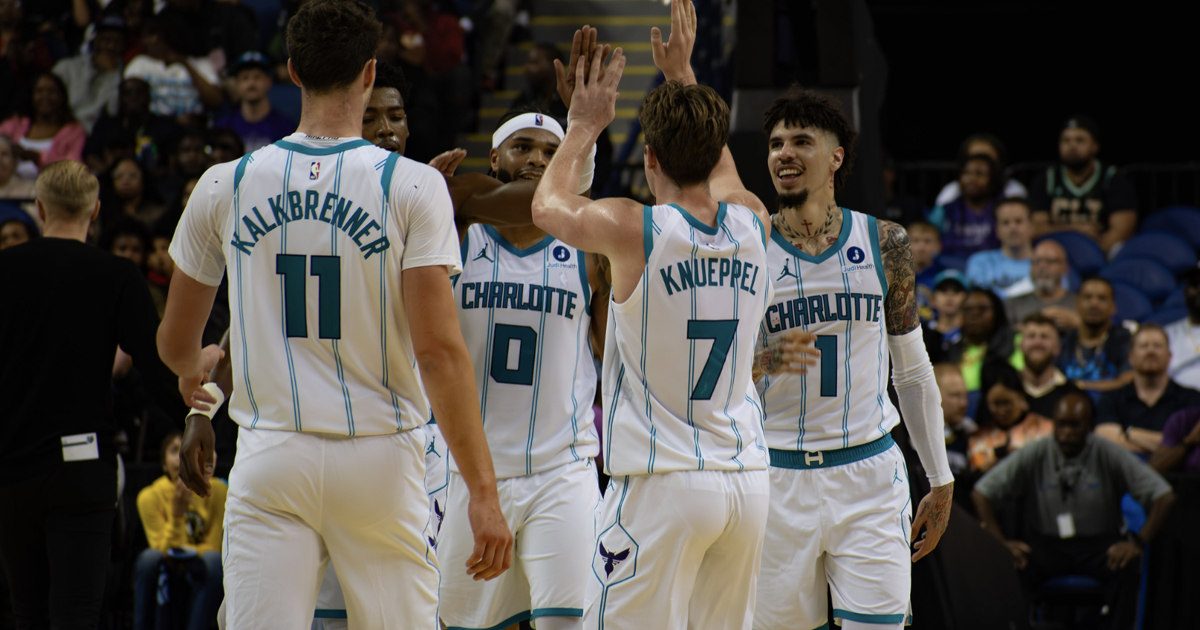
In the loss to the Miami Heat, star guard LaMelo Ball led Charlotte with 20 points, eight rebounds and nine assists, while rookie guard Kon Knueppel added 19. Per Stathead, Knueppel now holds the NBA record for the most three-pointers made through four career games (16).
Charlotte simply didn’t play a good enough defensive game whatsoever, and 18 turnovers made it worse, turning what was a close first half into a comfortable Miami win.
It was more of the same against the Magic. Charlotte played a competitive first half but let the rope slip in the third quarter and couldn’t make it a game again.
The Hornets struggled to contain Orlando inside, giving up 54 points in the paint on 69.2% shooting, including 80.0% at the rim. Turnovers were once again the difference, as the Magic used their size to win the takeaway battle 21-13 and turn those chances into 29 points.

Charlotte Hornets star guard LaMelo Ball is dove on by Orlando Magic center Wendell Carter Jr. during their Oct. 30 matchup.
Courtesy of The Charlotte Observer
Guard Collin Sexton led Charlotte with 19 points off the bench, while rookie center Ryan Kalkbrenner added 17 on 8-of-9 shooting. Orlando guard Anthony Black created havoc on Charlotte’s ball screens, hitting timely open shots and keeping the Magic offense in rhythm.
Second-half troubles continued against the Timberwolves. Charlotte entered halftime up 56-50 but was outscored 36-18 in the third quarter, losing control of the game for good.
Forward Miles Bridges led with a season-high 30 points, while Ball added 18 and reserve guard Tre Mann chipped in 16 off the bench. The Hornets shot 41.8% from the field and 28.9% from three-point range, while Minnesota connected on 47.2% of its threes (17-of-36), including 10-of-18 in the second half, to pull away late.
Rookies lead the response against Utah
The Hornets went into a back-to-back without their two best players and didn’t fold. Charlotte instead delivered its most complete performance of the season, a 126-103 win over the Utah Jazz to close the homestand.
Ball was sidelined with a right ankle impingement, but despite that, everyone who played contributed—it was a total team effort.
Bridges followed his 30-point night with 29 points and a career-high-tying 12-of-12 mark at the free-throw line. Knueppel was great on both ends and added 24 points, while rookie guard Sion James scored a career-high 15.
Forward Moussa Diabaté recorded a 17-point, 12-rebound double-double, and Sexton added 10 points and 12 assists, guiding an offense that moved the ball efficiently in the absence of its lead playmaker.
The Hornets shot 48.9% from the field, 41.9% from three-point range and a perfect 22-for-22 at the line. They also finished with 31 assists on 43 made field goals, marking their fourth 30-assist game of the season.
Kalkbrenner scored only two points but contributed four steals and four blocks, showing great verticality on defense that held Utah to 103 points on 43.5% shooting while forcing 18 turnovers.
It was the kind of game Charlotte wouldn’t have controlled last year. With rookies like Knueppel and James, along with Sexton now in the mix, the difference showed in how many players were able to initiate the offense and keep things organized when Ball wasn’t on the floor.
The good
Charlotte ranks No. 6 in offensive rating on the young season at 119.5, a mark that matches the expectations many fans had coming in. You have to be impressed with the individual shot-making and the variety of sets Lee is dialing up to get his players in the right spots to succeed.
The Hornets also rank No. 7 in assists per game at 28.1, a clear sign of how far their offensive flow has come. When the ball is moving and the spacing clicks, it’s some of the best offensive basketball Charlotte has played in years—and they’re only seven games in.
Ball has looked like his All-Star self, plain and simple. There’s not much to critique—he’s been outstanding on both ends.
The Hornets have a net rating of +32.1 when Ball is on the floor compared to when he sits, a number that underscores just how effective he’s been as the team’s offensive engine, even when the offense around him stagnates. He’s also been extremely active on defense, showing better awareness and effort than in past seasons, a promising sign for what could be his most complete year yet.
The rookie trio of James, Knueppel and Kalkbrenner has been everything Charlotte could have hoped for. Each has already started games and looked comfortable doing it. They’re almost always in the right spots and make the right decisions, playing well beyond their years—credit to the president of Basketball Operations, Jeff Peterson.
The not so good
Charlotte simply can’t keep guys in front on defense. They struggle to guard the ball, and if you can’t do that, you’re not going to have a good defensive unit. The issue comes down to personnel more than effort.
This roster leans skill-heavy and finesse-oriented, not built to win with size or physicality. The coaching staff will have to find creative ways to cover those weaknesses, especially with so many young players still adjusting to NBA defensive principles.
Forward Tidjane Salaün isn’t giving Charlotte much right now, and the team needs more production from the backup four spot. Forward Grant Williams is still working his way back from last year’s ACL injury, which has left the rotation thin in that area.
Salaün was a top-six pick, and at the very least, he has to show he can defend players his size at this level. Otherwise, it’s fair to ask what value he’s bringing at the moment.
Non-Ball lineups also have to be better, though the win over Utah may have been a step in the right direction.
Up next
The Hornets (3-4) will begin a two-game road trip against the New Orleans Pelicans (0-6) on Nov. 4 at 8 p.m. The matchup will be available on NBA League Pass and FanDuel Sports Network.