
Ever since I was a kid, I’ve pictured myself hitting big shots on the Toronto Raptors’ homecourt. Recently, I was able to make that dream come true, but I also learned hat I’m still a long ways away from playing in the NBA.
I tried “The Shooting Lab” at Scotiabank Arena, a research and development initiative created by Sports X, a MLSE Digital Labs and Amazon Web Services joint venture.
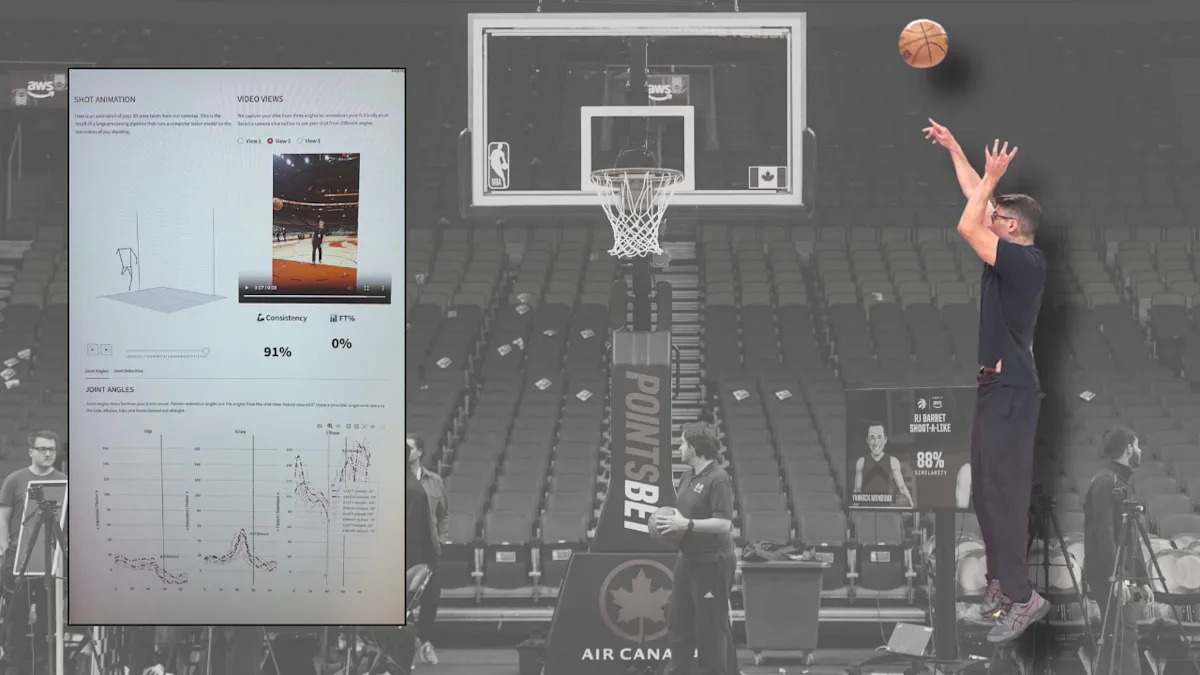
After I lined up at the free-throw line, I shaped a T-form, as four cameras scanned me and my surroundings. Then for four straight attempts, I received the ball, dribbled it twice, bent my knees and released it.
I ultimately missed all four attempts.
I was rusty — and embarrassed — but determined to live out my dream of hitting at least a shot on this court. Thankfully, there was some hope.
After my four misses, I went to a monitor that recorded my attempts. It analyzed my shot motion, featuring graphs of my joints, along with video and animation replays of each shot.
Despite my 0 FT%, I did register a 91% shot consistency rate. Clearly my shot wasn’t fully broken. But it was clear that I needed to focus on keeping a high enough release point.
You can imagine the pressure I felt stepping up to the line for the second time.
But this time, I channeled the ice in my veins, dribbled the ball twice, bent my knees, and I hit that next free throw. Damn, right.
I would go on to miss my next three attempts, but who cares, I had accomplished what I set out to do.
The Shooting Lab: From novice to the pros
The Shooting Lab is a simplified fan version of the same shot performance breakdown the Raptors use at their facilities.
Whether a game or practice, build-it cameras capture biomechanical data, providing highlights and insights into aspects of a shot like elbow velocity, release angle, stance width and trajectory.
Humza Teherany, MLSE’s Chief Strategy and Innovation Officer, says he wouldn’t be surprised if a similar version of the tech I tested out at the Shooting Lab would be widely available as a “system in box” in just a matter of two years. Surely, I’d be one to benefit from that.
Among those who witnessed my lacklustre shooting was Jamaal Magloire, a former NBA all-star and current assistant coach of the Raptors.
Among the pros, Magloire says the tech has been widely accepted, especially among players who are “hungry and want to get better.”
“At this level, we really don’t want to change too much. They’ve been very successful getting to this point,” said Magloire to Yahoo Canada. “But if they’re willing to learn, they’re willing to make changes, we’re willing to be there to aid in it.”
In terms of the Raptors player who’s benefited most from the “Shooting Lab” tech, Magloire says it’s third-year pro Gradey Dick. However, the title of being the best shooter on the team goes to veteran Garrett Temple.
Ultimately, for the players and him personally, it’s all about consistency and building muscle memory.
“Just keep shooting,” said Magloire, offering me a piece of advice after my initial 0/4 performance.
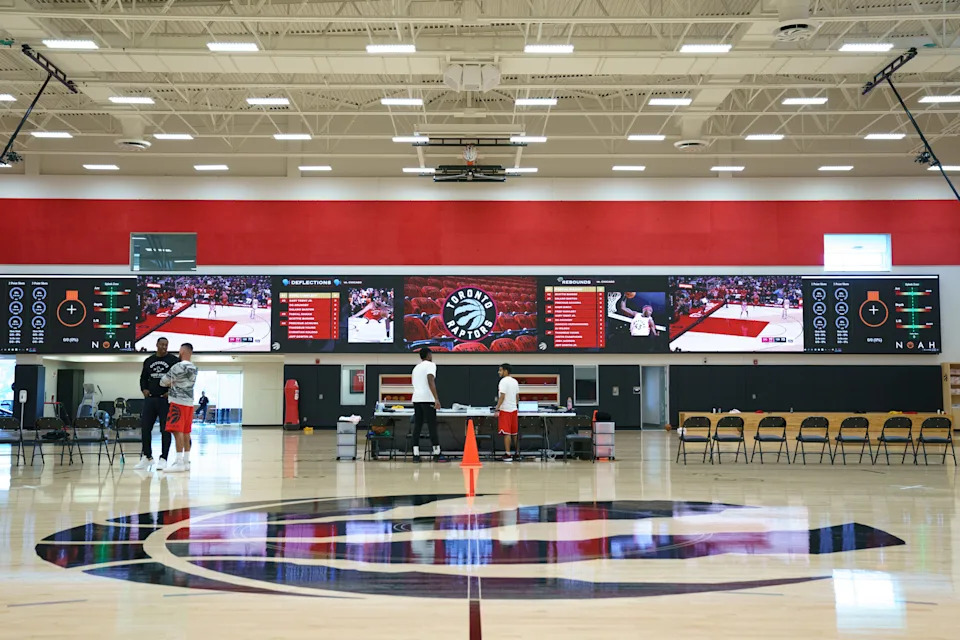
Using analytics and biomechanical data, such as their OVO Athletic Centre practice court, has been part of the Toronto Raptors’ philosophy for year. (Credit: THE CANADIAN PRESS/Alex Lupul
Sports X: Helping MLSE compete
The Sports X initiative was formed shortly after MLSE selected AWS in 2022 as its official provider of cloud systems, artificial intelligence and machine learning. Together, they work toward enhancing team performance across the Raptors, Maple Leafs, TFC and Argos, while using the data to also create better fan experiences.
The Raptors are far from alone in having access to biomechanical data, with AWS even becoming the NBA’s official partner as of October 2025. Julie Souza, AWS’ Global Head of Sports, says that for every second during an NBA game, they’re able to record 29 different points of a player’s body, 60 times per second.
With these “troves of data,” AWS looks to artfully deploy statistics and insights to both fans through their broadcasts, and to the players as they focus on different aspects of their game.
“Players are curious. They want to know how do I extend my playing career, how do I take my game up,” said Souza, emphasizing the importance of using the data to help keep players healthy.
Teherany says there’s been “data parity across teams.” Among the 30 NBA franchises, he says the Raptors are in the top quartile of using this technology, after having also won the 2025 Team Innovation Award for their work with Gen AI Innovation. They also have the benefit of working with other teams under MLSE’s ownership, allowing, for example, the Leafs and Raptors to share insights.
With the way technology is advancing, Teherany and Souza both continue to look to use data with a focus on answering the questions we already have. Because whether it’s me practicing my shot, or a pro fine-tuning his game, what eventually matters with data comes down to one thing, says Teherany:
“The winning advantage is what you do with it.”
In my case, it helped me hit that bucket-list free throw.