
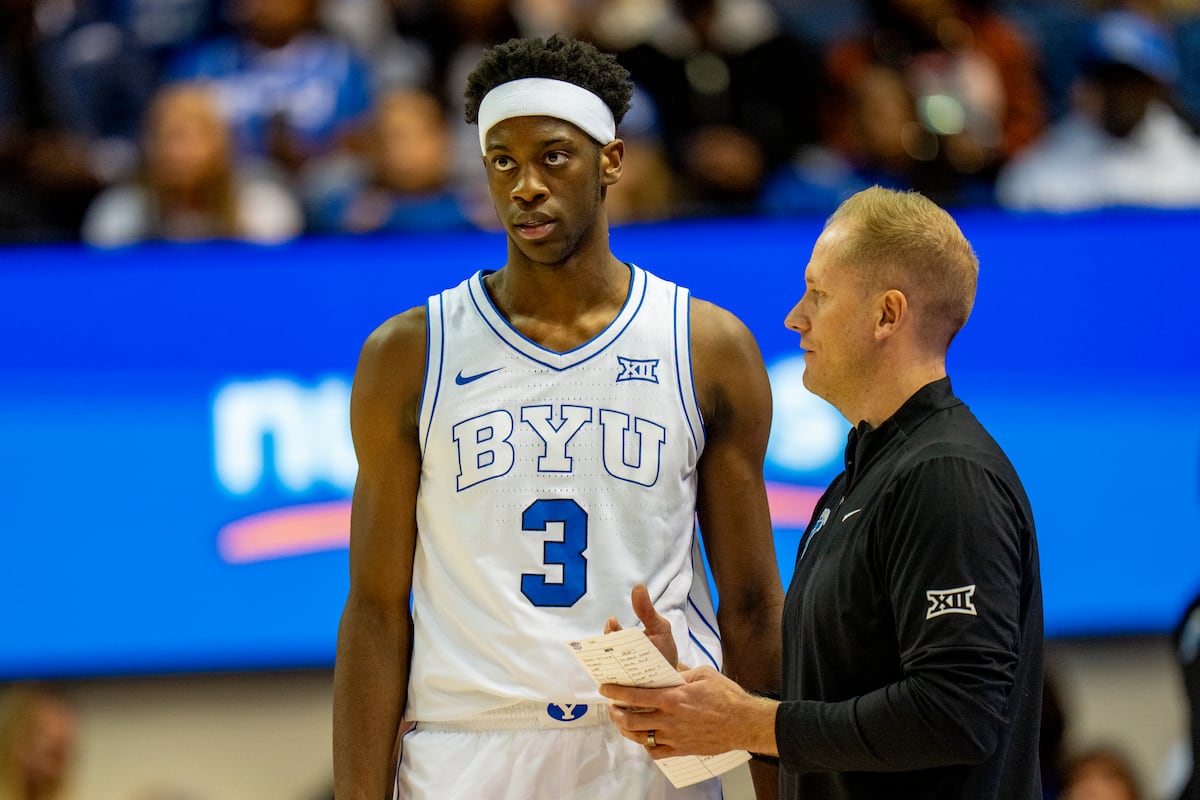
Not long after Kevin Young took over the basketball program at BYU and started into his first season there, he was asked a question that stood out even more this week for controversial reasons.
He was asked the difference between coaching college basketball and coaching in the NBA, where he had spent recent years with the Philadelphia 76ers and the Phoenix Suns, making his name there.
His answer: “It’s not that different.”
On Tuesday, it seemed — but only seemed — nearly identical, as BYU successfully recruited Abdullah Ahmed, a big man who spent the last two seasons playing for Westchester, a G League affiliate of the New York Knicks.
And some other college coaches didn’t and don’t like it. Prominent guys like Bill Self and Tom Izzo don’t like it. Traditionalists don’t like it. They can complain all the day long, bemoaning what is now happening to college basketball, while an outfit like BYU — and a smattering of other programs — takes advantage of new NCAA rules, permitting such recruitment.
The naysayers might wonder what in the world the NCAA is doing, so certain in their minds that there are only cons and no pros in allowing the pros into the college game. They figure NIL payouts and the liberalized transfer portal are bad enough, all the while utilizing them or watching them being utilized to help teams, including their own, win.
But allowing professionals into college basketball is a step too far for those who have yet to rearrange their thinking, even as some college players are paid more than the pros they’d prefer to keep out.
The way Young figures it, signing a 22-year-old center out of a minor league in the United States is no different than signing a player out of Europe. He already did that, was permitted to do that, when the Cougars signed for last season Egor Demin, a kid who previously played in Real Madrid’s organization, and last year and this year Mihailo Boskovic, who played professionally in Serbia.
If those guys can play college ball, why can’t Ahmed, a 6-foot-10 Egyptian?
The answer: He can.
BYU needed a center, and Ahmed wanted to play for Young.
OK, then. OK with Young, who made one delineation in his justification for bringing in Ahmed and, in the future, others like him.
“The G League is no different than the Euro League,” he said. “It’s not the NBA. It’s just not. Now if you are on a two-way [contract], an NBA contract, then you are an NBA player. If you are not, what is the difference? A lot of things that make sense don’t happen. But for me, this actually does make sense.”
If pro players in Europe can play for a college team, why wouldn’t a player in the G League be allowed?
“If you want to strip away both, great,” Young said. “But that is kind of how I see it.”
He’s right, on both counts.
Those on the other side of the argument are not just traditionalists, not just purists who are against the idea of playing opportunities being taken away from high school kids in favor of more seasoned athletes. They are coaches who prefer the status quo, who want more control, who don’t want to recruit inside the pro leagues.
Too late. It’s already happening.
And since it is happening, since it violates no rules, Young is happy to help young players who can help him. An argument can be made against the idea of drawing a line between NBA players — those who have an NBA contract — and players from other pro leagues. They’re all getting paid.
It’s reminiscent of the old, now done away with Olympic rule that once allowed professional players in other countries to play for their country’s national teams in the Olympics, but that disallowed NBA players from playing for the U.S. national team. It was as though the whole of that was competitively unfair, as though NBA players were a different species, from a different planet.
Young’s distinction is similar. But there has to be some line drawn on eligibility, a clock ticking, a league differentiation, a prohibition of some kind. If not, Kentucky might be able to re-sign Shai Gilgeous-Alexander or Oklahoma re-sign Trae Young.
Ridiculous, I know.
Point is, if a player’s on an NBA contract, even a two-way, he is and should be ineligible. But if he’s playing somewhere south of that, let colleges have him, as long as he qualifies by way of other college eligibility rules. Let colleges have as many of them as they want. Don’t let the guys from Europe in and not those from the G League — or any other league. Or, as Young said, eliminate all of them.
Some traditionalists say they’ve had enough of this nonsense, college players now getting paid and such. In truth, they — many of them — have always been paid, one way or the other, whether the traditionalists knew about it or not. Many college players have always been pros.
As it’s happening now, it’ll be OK. The college game will survive. It’s always been OK. And it’s always survived.
Young said it correctly about the college game and the NBA, right from the jump, they aren’t the same, but, yeah … “It’s not that different.”