
Last July, the National Basketball Association announced a new eleven-year media-rights agreement with Amazon, NBC, and ESPN, set to take effect at the start of next season. Notably left out of the seventy-six-billion-dollar deal was Warner Bros. Discovery, the owner of TNT, which has held league-broadcasting rights since the late nineteen-eighties. The news alarmed many N.B.A. viewers: what would happen to the greatest studio sports show ever? It’s likely that “Inside the NBA,” on TNT, has surpassed the nineteen-nineties heyday of ESPN’s “SportsCenter,” John Madden’s mid-two-thousands years on “Monday Night Football,” and Michael Wilbon and Tony Kornheiser’s ongoing debate, “Pardon the Interruption.” It has done so by the steady accretion of talent and team chemistry. An affable former TV-news reporter named Ernie Johnson began hosting “Inside” in 1990, a year into the show’s existence, and the Hall of Famers Charles Barkley and Shaquille O’Neal came along in the new millennium. But it was the arrival of Kenny (The Jet) Smith, a two-time N.B.A. champ and former Basketball Times College Player of the Year, in 1998, that enabled the show to begin living up to its insider-y name.
During the regular season, Smith flies from his Los Angeles home to Atlanta, where the show is filmed, every Thursday and returns on Fridays. In the interim, he stays at his apartment in the Four Seasons—white-and-gold color scheme, books on European travel, a recently acquired virtual-reality headset on a shelf—and takes a car to the TNT studios on Thursdays for the weekly taping of “Inside.” Once, as Smith was running late to work, an escaped zebra appeared on an Atlanta highway, causing gridlock. There was no reason for Smith to be on this highway to get to the studio—as Barkley later pointed out, during the show—but Smith nonetheless blamed the wayward ungulate for his tardiness: a rare on-air fib, it seemed. “Inside” is beloved for many reasons, but perhaps especially for the candid and endearingly incautious opining of its Emmy Award-winning hosts. Smith, a former point guard, is always looking to “throw lobs,” as he says, to Barkley and O’Neal, from whom he often elicits memorable responses. Dunks and bricks, rhetorically speaking, are equally fun to watch.
Last November, fans of “Inside” got good news: TNT would continue to produce the show, licensing it to ESPN after the broadcasting rights change hands, and all four hosts would stay on. (Their contracts are reportedly worth millions annually.) Smith, for his part, plans to maintain his pre-show traditions, which include dancing with a makeup artist to “Before I Let Go,” by Frankie Beverly & Maze, before sitting down between Barkley and Johnson. Seven-foot-one O’Neal, the junior-most host, sits on the other side of Johnson, in a lowered chair, so that their heads are all on the same level. The foursome appears before, during, and after Thursday-night regular-season games, as well as post-season contests, leaving the studio around 2 A.M., often after doing something—Shaq face-planting, say, while racing to the show’s interactive digital screen—that goes viral.
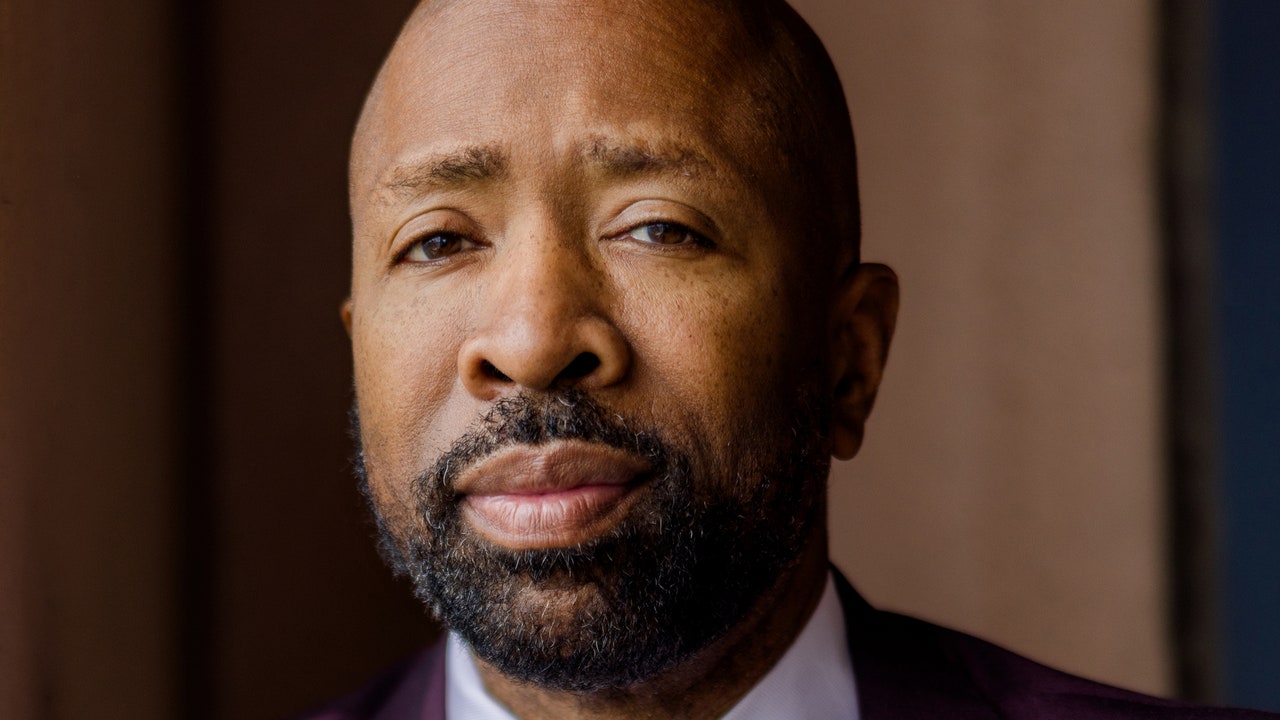
A few hours before a recent taping of “Inside,” Smith, who is sixty years old, bearded, and a few inches over six feet tall, met me at his Four Seasons pied-à-terre. We sat at a table outside the hotel’s restaurant, where Smith spotted and briefly chatted with a former mayor of Atlanta. Smith wore pistachio-green Nike Moon Boots and a matching Air Jordan sweatsuit, which, he noted, he’d paid for (it was not given to him by Michael Jordan, his old friend and former teammate at the University of North Carolina). It was the hundred and first day of the second Trump Administration, which we discussed along with his basketball GOAT, the possibility of a four-point shot, why he calls Barkley “the A.T.M.,” and the similarities between “Inside” and “Seinfeld.” This conversation has been edited and condensed.
The show you’ve co-hosted for the past twenty-eight years is rather unusual. It’s featured a diaper-changing contest; Charles Barkley kissing the ass of an actual donkey; Barkley wrestling with your other co-host, Shaquille O’Neal; a hundred-yard dash, which you arguably won, against Barkley, O’Neal, and a few other large, aging athletes; discussions of police killings of unarmed Black men and athletes protesting during the national anthem; you flying into the studio with a jet pack; water-gun fights, underwater breath-holding, electric-bronco riding . . . and some of the best analysis of basketball games. What kind of show is this?
It’s an informative basketball show at its core, which demonstrates and exercises the ancillary culture of sports. We pay just as much attention to the peripheral as we do the game. There’s fashion, there’s political stances, there’s team chemistry, there’s parenting.
Are there other shows or entertainers that particularly help inform what “Inside” has become? I think of “S.N.L.,” “Punk’d,” “Letterman,” bits and pieces from sketch comedy.
All of that has probably been an influence, but I don’t think any of them kind of did it the way we do it. I think our uniqueness comes from the fact that we’re allowed to have a verbal freedom and a mental freedom, where it’s never rehearsed. We don’t go to production meetings. Charles is figuring out, What am I going to say? I have no idea what he’s going to say tonight. I have no clue.
Does he know?
I’ve learned over time that he knows what he’s going to say. But you really hear an unfiltered, unadulterated version of what each person believes in that moment. It’s never one, two, three. It’s always, Wait, wait, wait: What did you just say? And we’re not going to allow you to misinform us. We are listening. And I think that’s the biggest difference between our show and any other show. We’re the best listeners on television.
I’ve been brought to tears, laughing, as I’ve watched your show. What moments get you misty?
It’s the life moments. Charles has a grandchild, but he’s never changed a diaper. I was, like, “What?” So I’m, like, “Yo, Ernie, Charles has never changed a diaper.” He’s, like, “I can change that.” So, next week, we got diapers—it has to be all organic—and we put a melted Nutty Buddy candy bar in it. Charles freaked out. Then there was the time we were in the back. On the third screen, we’re watching David Blaine as the Lakers are playing. Blaine stayed underwater for seven minutes or ten minutes—something crazy. He broke the world record. So Charles was, like, “Oh, I could do at least four minutes.” I’m, like, “You can’t.” “All right, get a fish tank.” Boom. He lasts twenty-three seconds. It’s got nothing to do with basketball. It’s always something that we’re really talking about. It’s never contrived.
I feel like you’re the pot-stirrer in the group. How do you see your role?
I use a boxing analogy. Shaq is like George Foreman, a big hitter. But he might take some punches. Like, he’s going to trip on the floor running. He’s going to get pushed into the Christmas tree. Charles is more like Mike Tyson: knockout punch coming at you right from the door. He might never get touched. I’m like Floyd Mayweather or Sugar Ray Leonard: I’m going to jab you with information all night and then you might get knocked out by the end. Pop, pop, pop, pop. Ernie is Angelo Dundee—he’s the cut man. He’s making sure no one bleeds to death.
Who’s most likely to bleed?
Shaq. He’s slapstick—he’s O.K. with falling. Or being pushed. He’s O.K. with being made to look a certain way. He’s Benny Hill. I was a big Benny Hill fan.
Does he get that reference?
When I played the theme music for him, he thought it was a Globetrotters song.
What was it like bringing Shaq onto the show in 2011, a decade into your run with Charles and Ernie?
Shaq wasn’t accustomed to not being the most dominant player. On this team, he doesn’t have to be. That was an adjustment. When he first came, I always thought that he was leaving his best material in the greenroom. I was, like, “Shaq, man, the stories that you say here, why don’t you talk about this?” He would tell me about Kobe Bryant and Phil Jackson. They’d just lost a game. Phil and Shaq are talking and Shaq looks over and sees Kobe. He doesn’t have a basketball, but he’s miming every move. Phil is telling Shaq, “So down the stretch, if we get close, we’re going to throw you the ball.” Shaq is, like, “No, no, no. Throw it to the guy who’s back there dribbling without a basketball. The guy who’s imagining the game.” I told Shaq that’s what everyone wants to hear. I call it the Bull Durham Effect: when the managers go to the mound and talk to the pitchers, only those four people know what’s being said. Give us that. And when he started to do that more, things just became natural.