
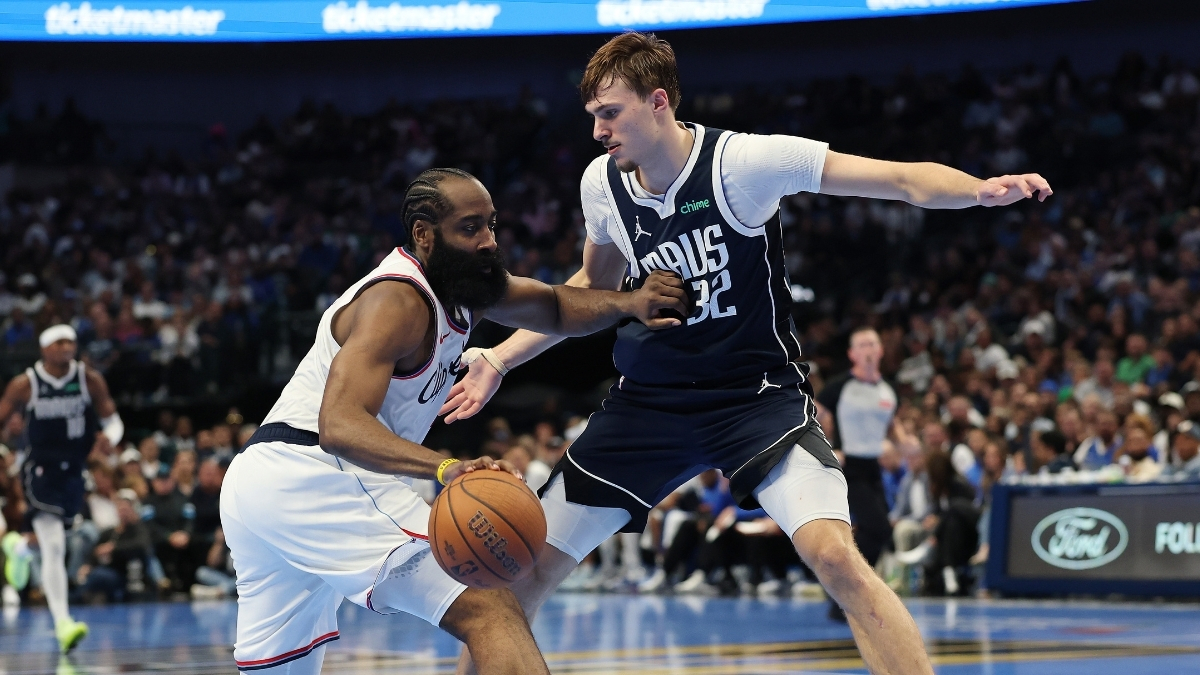
The night began with the Clippers setting the early tone. Harden scored nine quick points as Los Angeles built a 15-point first-quarter lead behind early-clock threes, his pacing, and Zubac’s work inside. Dallas struggled to organize its spacing, turned the ball over on three straight possessions, and allowed the Clippers to dictate tempo.
“Before that, we have to be better defensively too, understanding tendencies,” Mavericks head coach Jason Kidd said. “With Harden, he’s one of the best, and the three is something he wants to get to.”
Dallas finally steadied itself in the second quarter, when improved ball pressure sparked a 25–7 run fueled by Marshall’s attacks, Christie’s perimeter shooting, and several deflections that pushed the team into transition.
“Whatever was working, we tried to redo it,” Russell said.
Still, the Clippers regained momentum before halftime behind Bogdanovic’s threes and Harden’s 23-point first half, sending Dallas into the break down again.
The third quarter brought more back-and-forth swings. Flagg opened the period with strong drives, Christie extended his streak of games with a made three, and Dallas briefly matched Los Angeles possession-for-possession. But the Mavericks missed chances to take control, committing four turnovers during stretches when their defense had finally tightened. Harden and Zubac capitalized, and the Clippers rebuilt a modest lead heading into the fourth.
“A lot of flow-of-the-game stuff,” Flagg said. “Knowing time and score, knowing matchups, who’s on the court. Thinking the game.”
Dallas’ comeback push arrived behind Russell, who took over the fourth with a flurry of step-backs, pull-ups and floaters. His scoring run erased a seven-point deficit and gave the Mavericks a late four-point lead, putting them in position to close out one of their most resilient efforts of the season.
But Harden answered with foul pressure, a drifting three, and a late assist to Zubac to force overtime. Dallas had two chances to win in regulation — a Marshall floater and a Russell pull-up — but both fell short, setting up the first of two extra periods.
The Mavericks forced 16 turnovers, generated 11 steals for the second straight game, battled back from a 15-point deficit, and leaned heavily on their emerging core. But they also committed 25 turnovers, surrendered 23 points directly off those mistakes, and faltered again in clutch moments — an area that has now become a defining issue.
They dropped to 3–10 overall, 0–7 against the West, and 0–2 in NBA Cup group play, while their record in games within five points in the final five minutes fell to 2–8, the most clutch losses in the league.
By the end of the night, the pattern was unmistakable: a team that competes fiercely, improves in areas, and yet continues to lose because of the same structural problems.
James Harden’s Control Becomes the Difference
The Clippers arrived in Dallas desperate to halt a six-game slide, and James Harden delivered exactly the type of command they needed. The former MVP finished with 41 points, 14 rebounds and 11 assists — the first 40-point triple-double in franchise history — while adding six made threes and 10 points across the two overtime periods.
From the opening minutes, Harden’s pace manipulation and foul-drawing shaped the flow of the game. He scored 23 points in the first half and repeatedly forced Dallas into difficult coverages down the stretch.
After the game, Jason Kidd described the difficulty of defending Harden in late-clock situations.
“You have to show your hands, but he’s the best at drawing fouls,” Kidd said. “He understands what he has to do — time and score. It’s not always scoring the ball; it’s getting to the free-throw line, and that leads to scoring. He gets to the shot he wants. That’s the difference between great players and average players.”
Russell, who guarded Harden in key stretches, echoed that assessment from a player’s viewpoint.
“You have to stay disciplined,” Russell said. “There’s an element of surprise in how he attacks you and manipulates defenders. You study it and try to be better.”
Harden’s ability to dictate the pace ultimately became the defining force of the night.
Turnovers Continue to Overwhelm Dallas’ Late-Game Execution
The Mavericks once again found themselves battling through a deficit of their own creation. Their 25 turnovers were not just high in number — they were costly in timing. Dallas committed multiple giveaways in both overtime periods, including two from Russell in the second OT, during possessions where the Mavericks simply needed to enter sets and generate clean looks.
Kidd did not minimize the issue when asked afterward what broke down late.
“It’s something we’ve talked about,” Kidd said. “We have to address it. We have to do better if we want to win — being able to get a shot, and then you want to get a quality shot. The turnovers hurt us. In overtime we had turnovers where we didn’t get a shot.”
Flagg, who played heavy minutes in the loss, acknowledged the same concerns with equal directness.
“Turnovers,” he said. “Some late stupid turnovers. And not getting great shots. We had a couple possessions in double overtime where we didn’t get a good look. When we have empty possessions and don’t get shots up, it’s tough to win.”
Russell pointed the responsibility inward.
“I have to be better,” Russell said. “Limit my turnovers and give us a better chance to make something happen.”
Dallas now leads the league with 12 clutch turnovers, and its 91.7 clutch offensive rating ranks 25th — numbers that speak to a deepening trend.
Cooper Flagg Carries Heavy Load and Shows Growth in Longest Night of His Career
Even amid the disappointment, the Mavericks saw another strong step forward from 18-year-old rookie Cooper Flagg, who played 47 minutes and finished with 16 points on 8-of-13 shooting. His driving floater with 18 seconds left in regulation forced the second overtime and represented another moment where Dallas leaned on him in high-pressure situations.
Flagg said afterward that the extended minutes were a new test — one he embraced.
“It’s a lot of game time,” Flagg said. “It’s a long game, a lot of plays, a lot of minutes. But I thought we battled well tonight. We’re showing more fight, and we’ll clean up some of the execution things.”
He described his mindset in late-game isolations, whether against Giannis Antetokounmpo earlier in the week or Harden in this one.
“Just figuring out spacing, attacking those guys, trying to make a play,” he said.
Kidd praised Flagg for his readiness and composure despite the workload.
“He played his heart out,” Kidd said. “He was aggressive. We struggled in a couple possessions, but once we got the ball in his hands late, he capitalized and scored. He played poised.”
Flagg also discussed the shift back toward his natural position after opening the season at point guard, noting the differences in responsibility.
“Being a point guard comes with a lot of responsibility,” he said. “I don’t know if I was ready for that right away. It doesn’t mean I can’t go back to it or improve… but lately it’s been better having someone else help with pressure.”
Even as the losses accumulate, Flagg continues to show the traits of a long-term foundational piece.
Naji Marshall Continues His Surge and Draws Praise for Two-Way Impact
With Anthony Davis out for the eighth consecutive game and PJ Washington sidelined, Dallas needed a player capable of absorbing both scoring and defensive responsibility. Marshall delivered a veteran-level response, finishing with 28 points, eight rebounds and three made threes, while defending Harden for long stretches.
Kidd highlighted the completeness of his performance, citing both physicality and competitiveness.
“He did a great job on Harden,” Kidd said. “He competed. Offensively he got to the paint, got to his floater, and knocked down three threes for us. He played a complete game on both ends.”
Asked whether Marshall’s matchup assignment was about size or mentality, Kidd emphasized the latter.
“It’s mindset,” he said. “He loves the competition. He loves the best player.”
Russell went even further, pointing to Marshall’s value as a winning player.
“He was scoring for us, and he’s picking up the best player full court,” Russell said. “When you talk about impacting winning, teams want guys like that. He’s going to make a lot of money when the time comes.”
Marshall has now averaged 19.0 points, 6.4 rebounds and 2.8 assists over his last five games, providing steady production amid inconsistent availability elsewhere.
Dereck Lively II’s Return Helps, But Dallas Remains Short-Handed Up Front
Dallas received a much-needed boost inside with Dereck Lively II returning from a nine-game absence due to a right knee sprain. Lively played 17 minutes, delivering four points, five rebounds and three blocks, and providing the rim protection and vertical threat the Mavericks had been missing.
He drew a loud ovation upon checking in, but his return alone could not solve the team’s frontcourt challenges. Ivica Zubac overpowered Dallas for 27 points and 11 rebounds, while Harden’s penetration consistently forced interior rotations.
The Mavericks have still not played a single minute this season with Lively, Davis and Daniel Gafford all active — and it showed again.
Kidd noted that the team still struggled to organize late in overtime, a sign of ongoing offensive rhythm issues without its full frontcourt.
“We struggled in a couple possessions,” Kidd said. “We needed to get into our stuff earlier.”
Dallas is 1–7 this season without Davis and 2–3 when he plays.
D’Angelo Russell’s Fourth-Quarter Surge Keeps Dallas Alive Before Overtime Slip
Russell led the Mavericks’ fourth-quarter push with a sequence of timely threes and dribble attacks that erased a seven-point deficit and forced overtime. His 28-point, six-rebound, five-assist line made him only the ninth reserve in franchise history to post a 25-5-5 performance.
When asked how he found his rhythm, Russell said the stretch felt like a blur.
“I don’t even remember, to be honest,” he said. “It was a long game. I think we were hammering what was working.”
But after carrying the Mavericks in the fourth, Russell cooled in overtime and committed two costly turnovers in the second extra frame.
“I have to be better,” he said. “Limit my turnovers and give us a better chance.”
His honesty underscored the larger trend: Dallas’ best moments are being undone by its most repeated mistakes.
A Familiar Conclusion to a Different Kind of Night
The Mavericks showed meaningful progression in several areas — ball pressure, defensive activity, late-game poise from Flagg, and continued scoring from Marshall and Russell. They forced turnovers, matched the Clippers’ physicality, and played with visible competitiveness despite a depleted rotation.
But the areas that continue to dictate results — turnovers, late-game organization, interior vulnerability without Davis — surfaced again in the most critical moments.
Dallas will close its homestand Sunday against Portland. Though the NBA Cup implications have faded, the urgency has not. The Mavericks remain confident they can build something from their improved effort, but until the lapses that define their losses are resolved, the climb out of their early-season hole remains steep.
Latest Dallas Mavericks News & NBA Rumors